
Commercial Quartz: How to Specify Countertops for High-Traffic Projects
Commercial Quartz: How to Specify Countertops for High-Traffic Projects
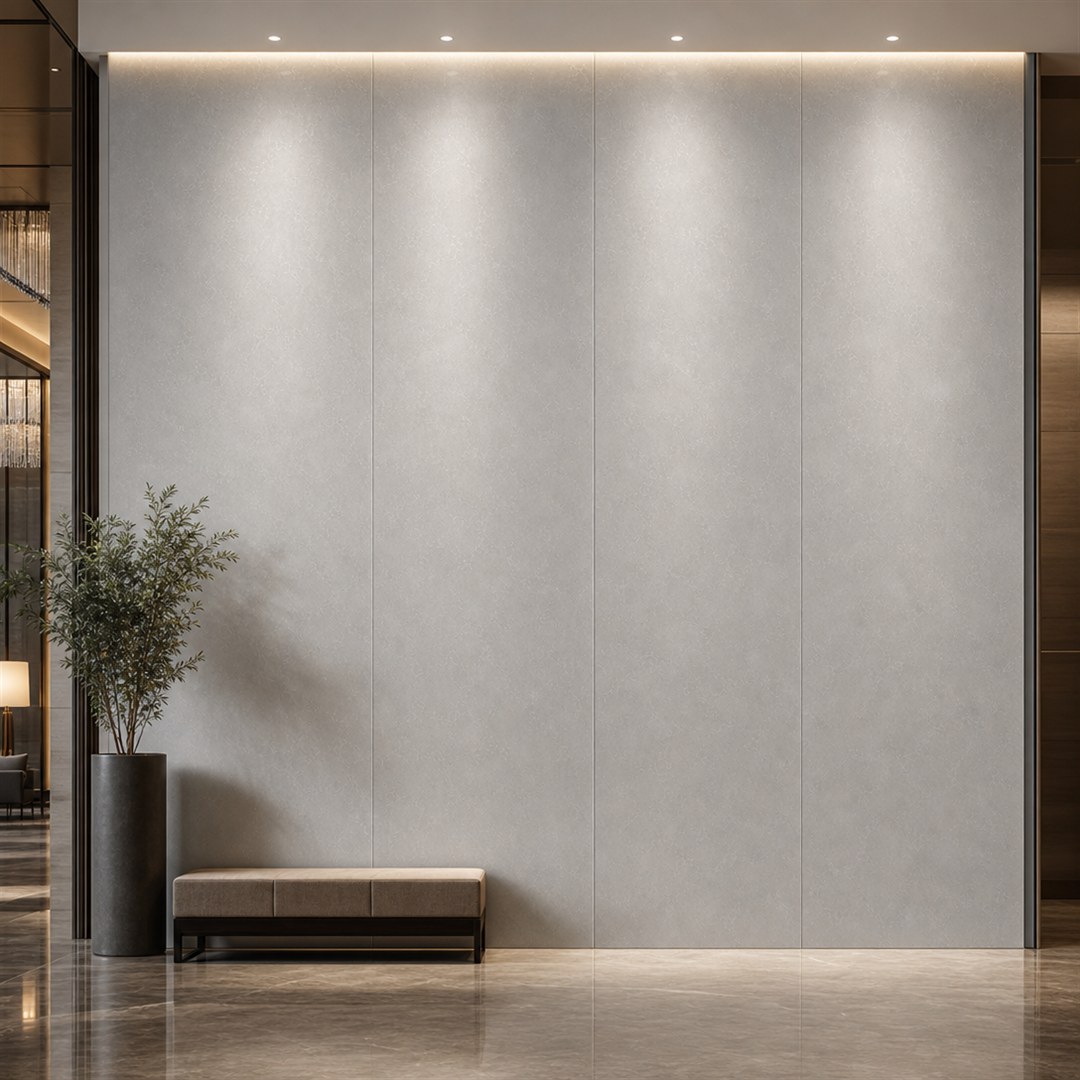
Commercial quartz is specified differently from residential quartz, and most of the specification mistakes we see in export orders come from treating the two as the same product. A commercial counter has a different duty cycle, a different owner, and a different cost of failure. It is cleaned ten times a day by staff who did not choose it, it takes heavier loads, it is measured against a lease rather than a family, and when it fails the cost is a closed counter, not an annoyed homeowner.
This guide covers what actually differs in a commercial quartz specification: the surfaces that get used, the thickness and substrate decisions, the standards buyers should ask for, and the questions to put to your supplier before you order.
What Makes Commercial Quartz Different
Three factors separate a commercial specification from a residential one, and they compound each other.
- Usage intensity. A residential kitchen sees a few hours of use a day. A hotel lobby reception, a mall food counter, or an office tea point sees continuous use, frequent spills, and cleaning by staff who are not invested in the outcome.
- Cleaning regime. Commercial counters are cleaned more aggressively and more often. Alkaline cleaners and high-alcohol sanitiser, both standard in hospitality, will dull a honed finish and attack some sealants over time.
- Cost of failure. If a residential counter fails, one household is inconvenienced. If a commercial counter fails, a venue has a food-safety or operational problem on a Saturday.
Our commercial quartz guide for shopping malls and front desks covers the application-level detail, and our hotel bathroom quartz guide covers the hospitality case specifically.
Choosing the Colour for a Commercial Space
Colour choice in commercial work is driven less by taste and more by maintenance reality and perceived cleanliness. In a venue where staff wipe the counter dozens of times a day, the practical question is what a surface looks like after a year of that treatment, not what it looks like on the day it is installed.
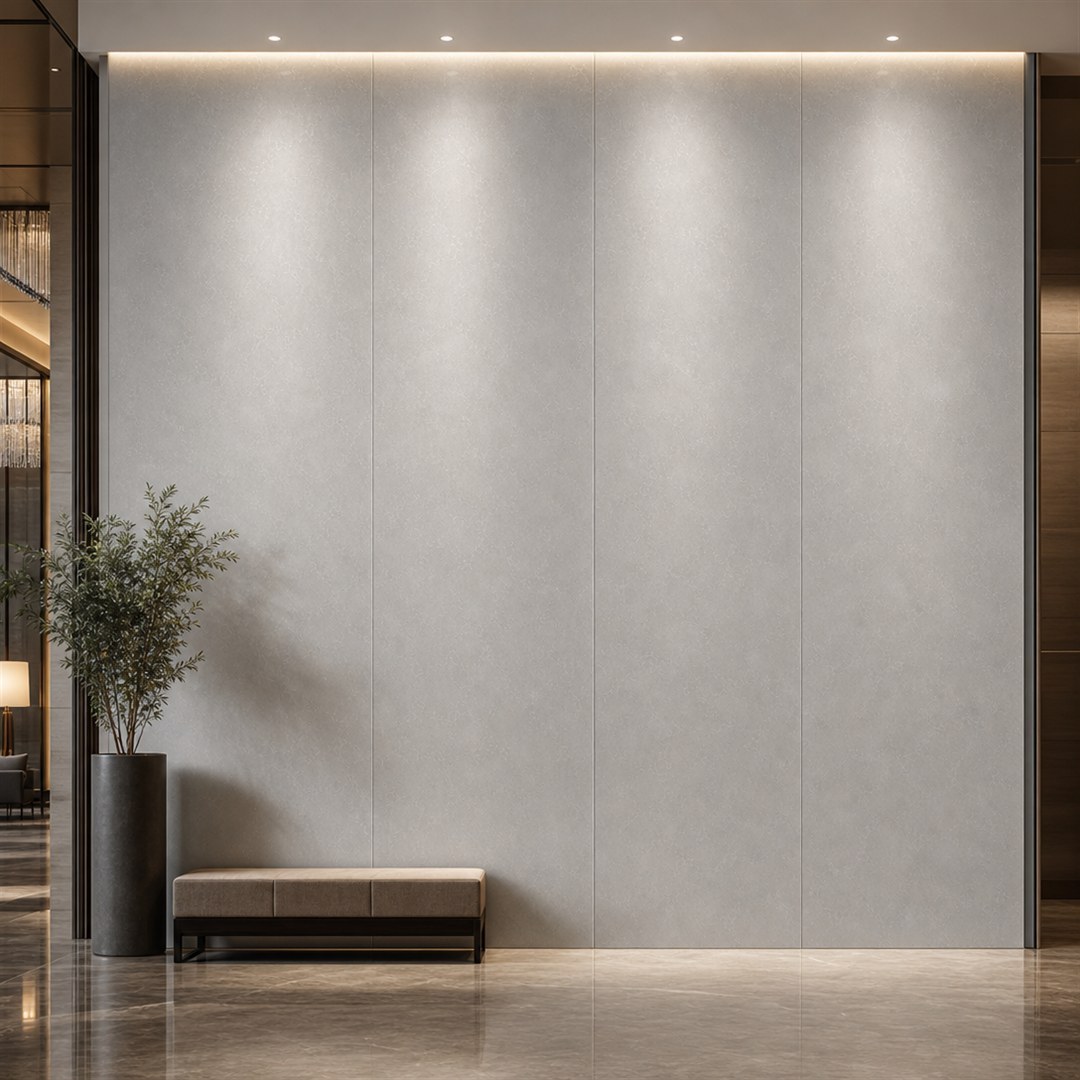
Light, uniform commercial quartz tones hold up best in this environment. A mid-to-light grey with minimal veining hides the day-to-day accumulation that a high-contrast pattern makes obvious, does not visibly yellow, and reads as clean under the flat, often cool-white lighting used in retail and hospitality. Our quartz slab colour guide sets out the behaviour of each colour family, including the maintenance cost of pure white.
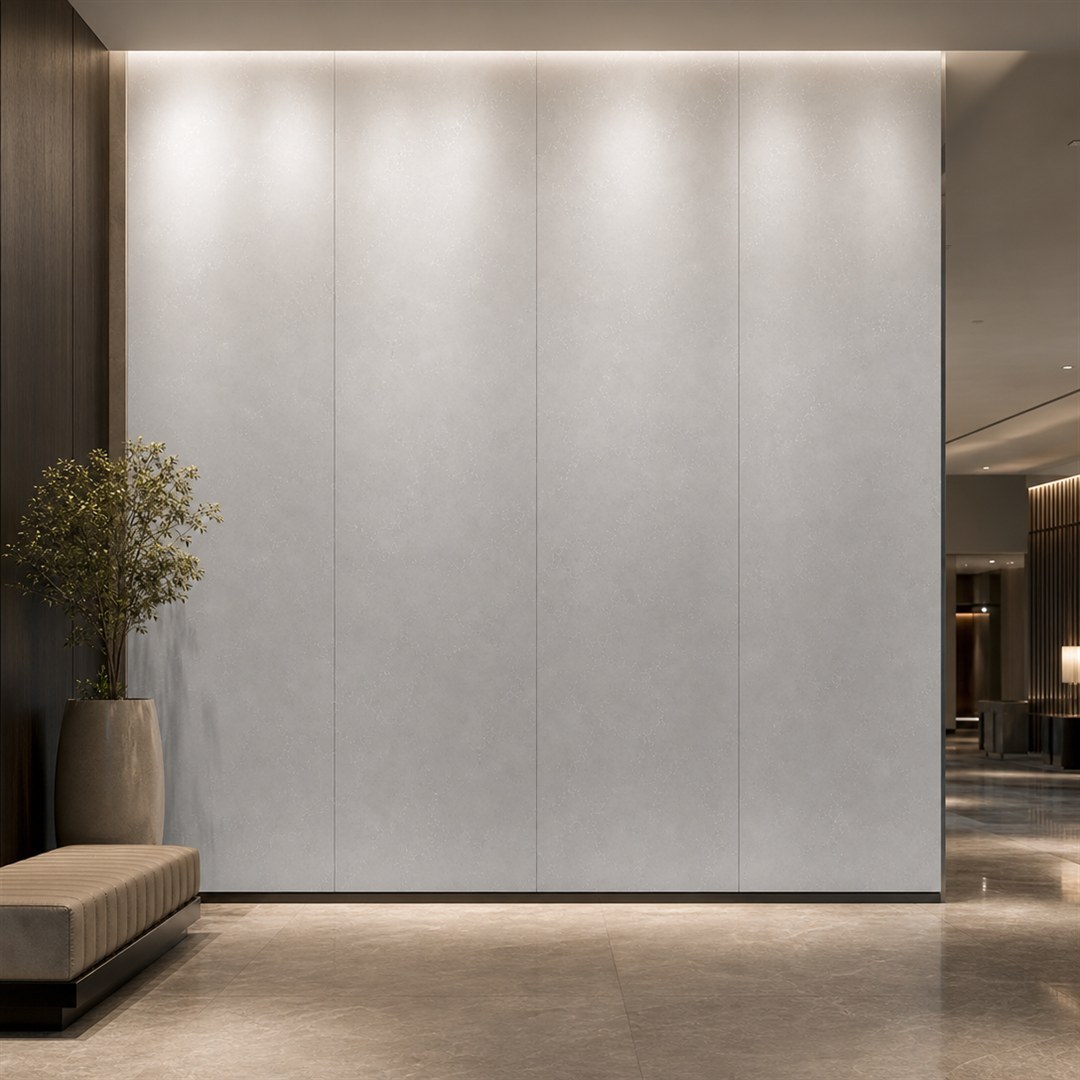
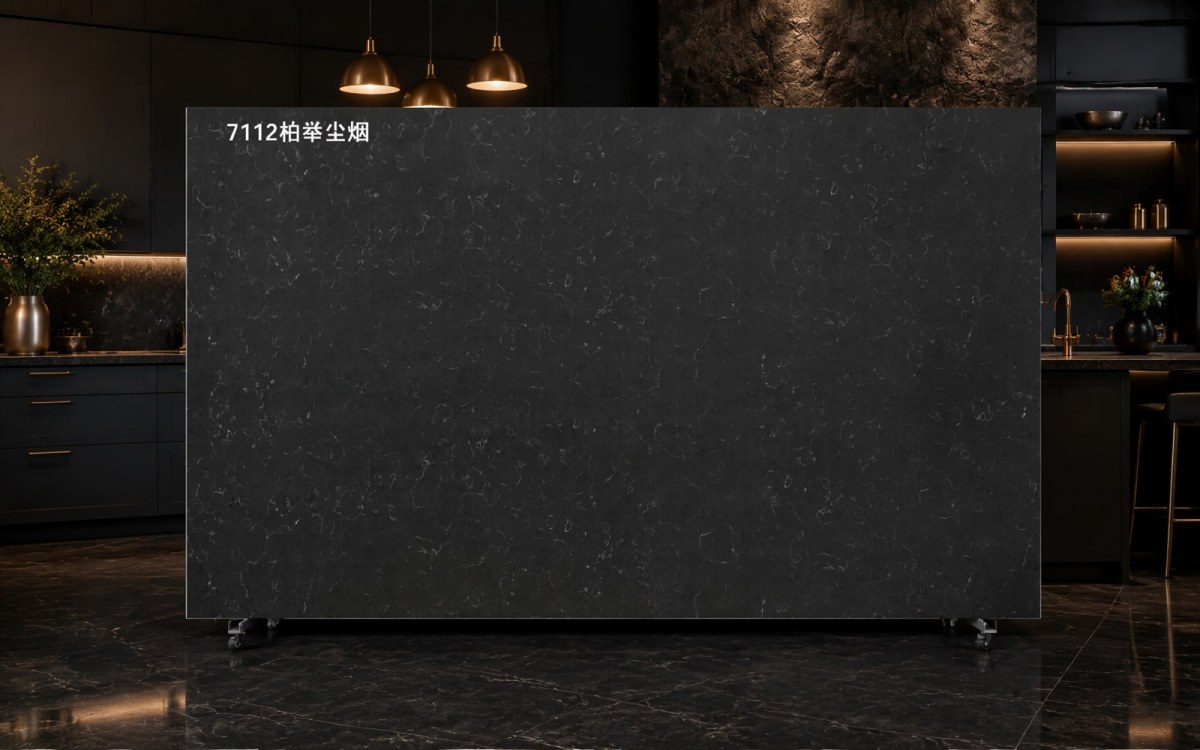
Two colour approaches work well in commercial: a light uniform tone for maximum brightness and perceived hygiene, or a mid-tone with restrained veining for a more designed feel that still reads professionally. Deep, high-contrast dark quartz is specified more often for hotel and retail feature walls than for counters, because gloss on a dark base shows every streak from a cleaning cloth.
Finish: The Decision That Matters Most in Commercial Work
If you specify only one thing differently from a residential order, specify the finish. This is where most commercial quartz problems originate.
Polished is the hardest surface and the easiest to keep visually clean, because the reflection shows contamination immediately and staff are motivated to wipe it. Its downside on a counter is that it shows scratches and fingerprints, and that aggressive cleaning compounds both over time.
Honed is the default for commercial counters. It has no reflection, so it does not show fingerprints or cleaning streaks, and it is far more forgiving in heavy-traffic environments. The trade-off is that a honed surface must be sealed properly, and the sealer needs refreshing on a maintenance schedule that your client should be told about.
Matte / leathered finishes suit hospitality and hospitality-adjacent work where a soft, tactile appearance is wanted and the highest scratch resistance matters. They are the most maintenance-tolerant of the three and the most likely to be specified incorrectly by buyers who expect them to hide everything.
Our glossiness standard guide covers the finish options and how they behave, and our quartz maintenance guide covers the cleaning regimes that preserve each finish.
Thickness, Substrate, and Load
Commercial counters are usually a 20 mm slab on a substrate, not a fabricated 20 mm solid piece. The reason is deflection: a long run in a hotel lobby or a mall counter spans more distance than a kitchen run, and a supported build-up with a substrate deflects under load in a way that a solid slab does not. Where the design calls for a thicker visual edge, that is achieved with mitred returns rather than with a genuinely thicker slab.
Two specification points matter. First, request calibrated thickness rather than nominal, so the substrate build-up is dimensionally predictable. Second, specify the substrate: MDF, plywood, and cement board behave differently under point loads and in wet areas, and the right choice depends on the installation environment rather than on the counter itself.
Our 18mm versus 20mm slab guide covers the thickness trade-off, and our custom cut slabs for project installation guide covers what to send your fabricator so the pieces arrive cut to the final template.
Standards and Documentation to Ask For
Commercial buyers are routinely asked for documentation that residential buyers never request. Before you order commercial quartz, confirm what your client actually requires, because specifying certificates that were never needed is expensive and specifying none of them can disqualify you from a tender.
The following are the ones that come up most often:
- Food-contact safety — where the surface will contact food. Engineered quartz is inert and generally acceptable, but your client or their health inspector may require a specific declaration.
- Slip resistance — for floor and step applications. A polished floor slab is not a compliant wet-area surface; specify the floor application and the required rating at order stage.
- Fire performance — required in many hospitality and public-buildings codes, particularly for wall panels and vertical surfaces.
- Low-silica / crystalline silica declaration — increasingly requested in Europe and Australia. Our material is a zero-silica-additive engineered quartz, and we can document it.
- Batch and shade consistency record — for multi-phase projects, so that a second phase ordered a year later matches the first.
We hold ISO 9001, NSF for food contact, and SGS testing for environmental and fire performance. Our safety and environmental guide covers what our certifications mean and where the boundaries of each one sit.
Commercial Quartz and the Low-Silica Question
A growing share of European and Australian commercial tenders now ask whether the material contains engineered crystalline silica. This matters more in commercial settings than residential because of volume: more cutting, more grinding, more workers exposed over a project lifetime. Natural stone and traditional sintered products answer this question differently from engineered quartz, and a supplier who cannot answer it precisely is telling you something.
Our quartz versus granite comparison covers the material-level differences relevant to project specification, and our safety guide covers our position on engineered material in indoor environments.
Logistics and Supply for Commercial Projects
Commercial projects rarely buy one container. A hotel bathroom programme or a mall counter rollout is phased, and the real supply risk is not the first container — it is the phase two order arriving a year later in a different shade. Ask your supplier how batch continuity is maintained and how much warning they need to reproduce a colour, and get that in writing before you sign.
Our lead time guide for bulk quartz orders covers realistic production and shipping schedules, and our slabs per container guide covers the packing arithmetic that determines how a phase is shipped.
For projects where the design is still moving, ordering cut-to-size pieces rather than full slabs gives you far more flexibility — but it removes your ability to select vein pattern, so it suits flat-colour commercial work rather than feature walls.
How to Specify Commercial Quartz the Right Way
A commercial order that avoids problems has five elements in it, and the absence of any one of them is where claims come from.
- Application per piece. Counter, floor, wall panel, or vanity — these have different substrate, finish, and edge requirements, and they should not share one line item.
- Finish, stated separately from colour. "Light grey, honed" is a complete specification. "Light grey" alone is not.
- Edge profile and whether it is eased or polished. For commercial, eased edges are the usual choice on counter perimeters for safety.
- Certification list, agreed before order. Name each certificate the client requires rather than accepting whatever is supplied.
- Batch continuity commitment. A written undertaking to match shade across phases, with a lead time for reproduction stated.
Our five checks before you accept a shipment guide is worth reading alongside this one, because in commercial work acceptance at the container door saves considerably more than in a residential job.
Frequently Asked Questions
What is the best quartz countertop for commercial use?
A mid-to-light grey or warm off-white engineered quartz in a honed finish, on a supported substrate at 20 mm. That combination handles daily cleaning chemistry, reads clean under commercial lighting, and does not show the fingerprints that make polished dark surfaces impractical in public venues.
Is honed quartz harder to maintain than polished?
It requires sealer maintenance on a schedule, but it is far less likely to show new scratches and cleaning streaks. In a staff-maintained environment, honed is usually the lower total cost of appearance over a year.
Can commercial quartz be used for floors?
Engineered quartz is used as a floor and step surface, but you must specify it as such. Slip resistance, the finish, and the support system all matter, and polished quartz is not appropriate for a wet floor. Our outdoor and external application guide covers where quartz is and is not suitable.
How do I get matching colour across multiple phases?
Order the total project quantity from one production batch where possible. If phasing makes that impossible, get a written shade-matching commitment with a stated reproduction lead time before you sign. Our colour difference control guide covers how we handle this.
What certifications should a commercial supplier provide?
Depends entirely on the application and the client, but commonly: food-contact declaration, fire performance, slip resistance where floors are involved, and a low-silica declaration for European and Australian tenders. Ask for the list in writing before ordering.
Is commercial quartz more expensive than residential?
Not inherently — the material is the same. Cost differences come from the finish, the substrate build-up, the edge profile, the cut pieces versus full slabs, and the documentation. Our quartz slab price guide explains what actually drives the number.
Send Us A Message