
Quartz Glossiness Explained: How Shiny Should Your Slab Be?
Quartz Glossiness Explained: How Shiny Should Your Slab Be?
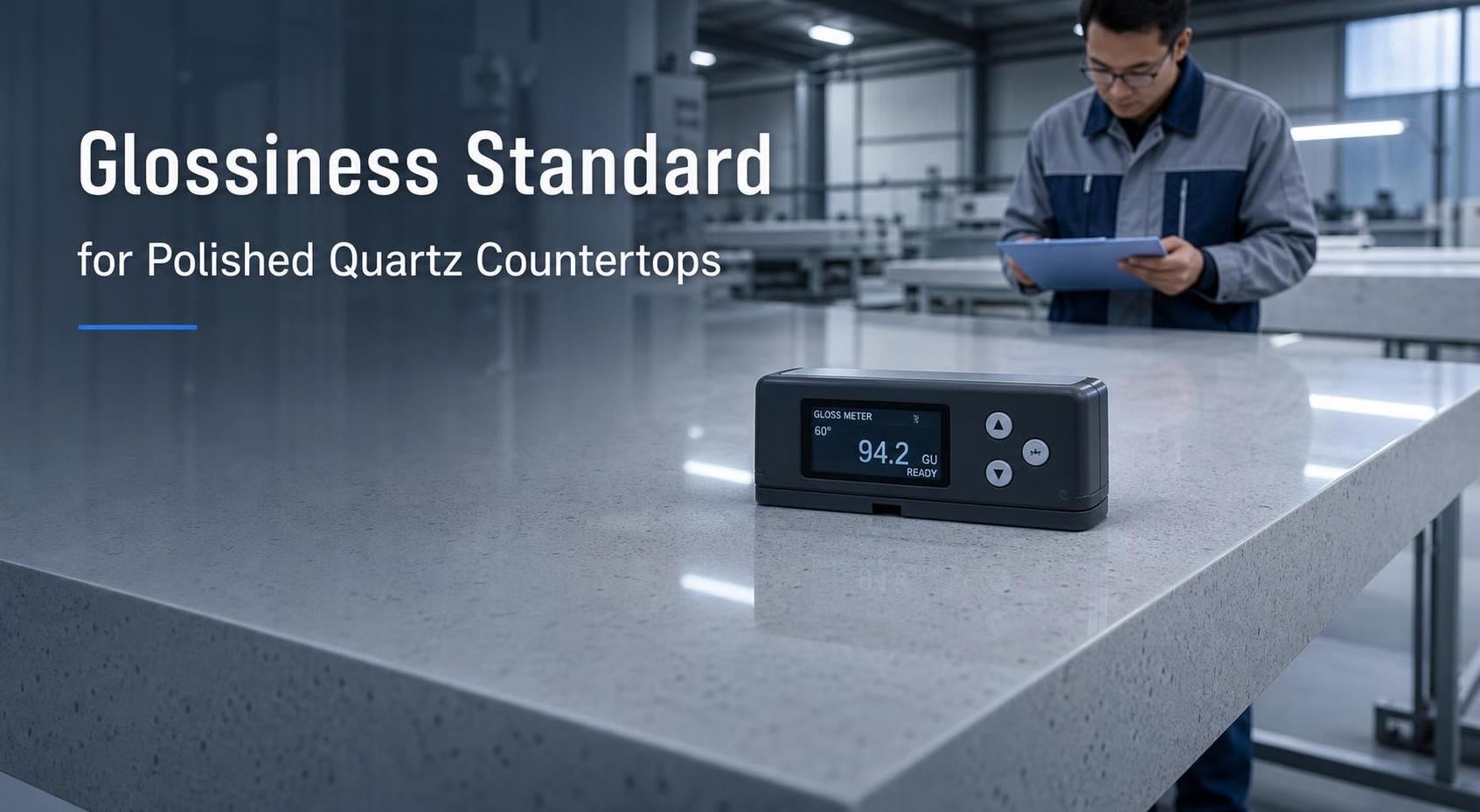
Polished Quartz Countertops Glossiness: What the Standard Really Means
Why Glossiness Is More Than a Visual Detail
The glossiness standard of polished quartz countertops is often treated as a finish issue, but in real projects it affects much more than appearance. A countertop with a clear, even gloss tends to look cleaner, denser, and more premium. A surface with poor gloss consistency, even if the slab color is attractive, can make the whole installation feel cheaper than expected.
In building decoration materials, gloss is one of those details that buyers notice immediately and struggle to describe technically. They may say the slab looks “flat,” “cloudy,” or “not sharp enough.” What they are reacting to is usually the way the polished surface reflects light. That reflection tells you something about the finishing process, the resin distribution, the quality of polishing, and sometimes the stability of production from batch to batch.
For that reason, gloss standards matter not only to manufacturers, but also to fabricators, developers, interior designers, and stone distributors who need a predictable result after installation.
What “Glossiness Standard” Usually Refers To
In practical terms, glossiness is the level of light reflected from the countertop surface under controlled measurement conditions. In the quartz industry, this is commonly checked with a gloss meter. The exact test angle and acceptance value can depend on the internal quality standard of the producer, customer specification, or project requirement.
That point is worth slowing down on: there is no single magic number that explains all polished quartz. A slab can have a high gloss reading and still perform poorly if the reflection is uneven, if there are polishing marks, or if edges and center areas do not match. On the other hand, a slightly lower reading may still be acceptable in a design that uses soft lighting, matte cabinetry, or heavy veining where visual uniformity matters more than mirror-like shine.
So when people ask for a “gloss standard,” they usually mean three things at once: measurable gloss value, consistency across the slab, and whether the installed top looks right in the intended space.
How Gloss Is Measured on Polished Quartz
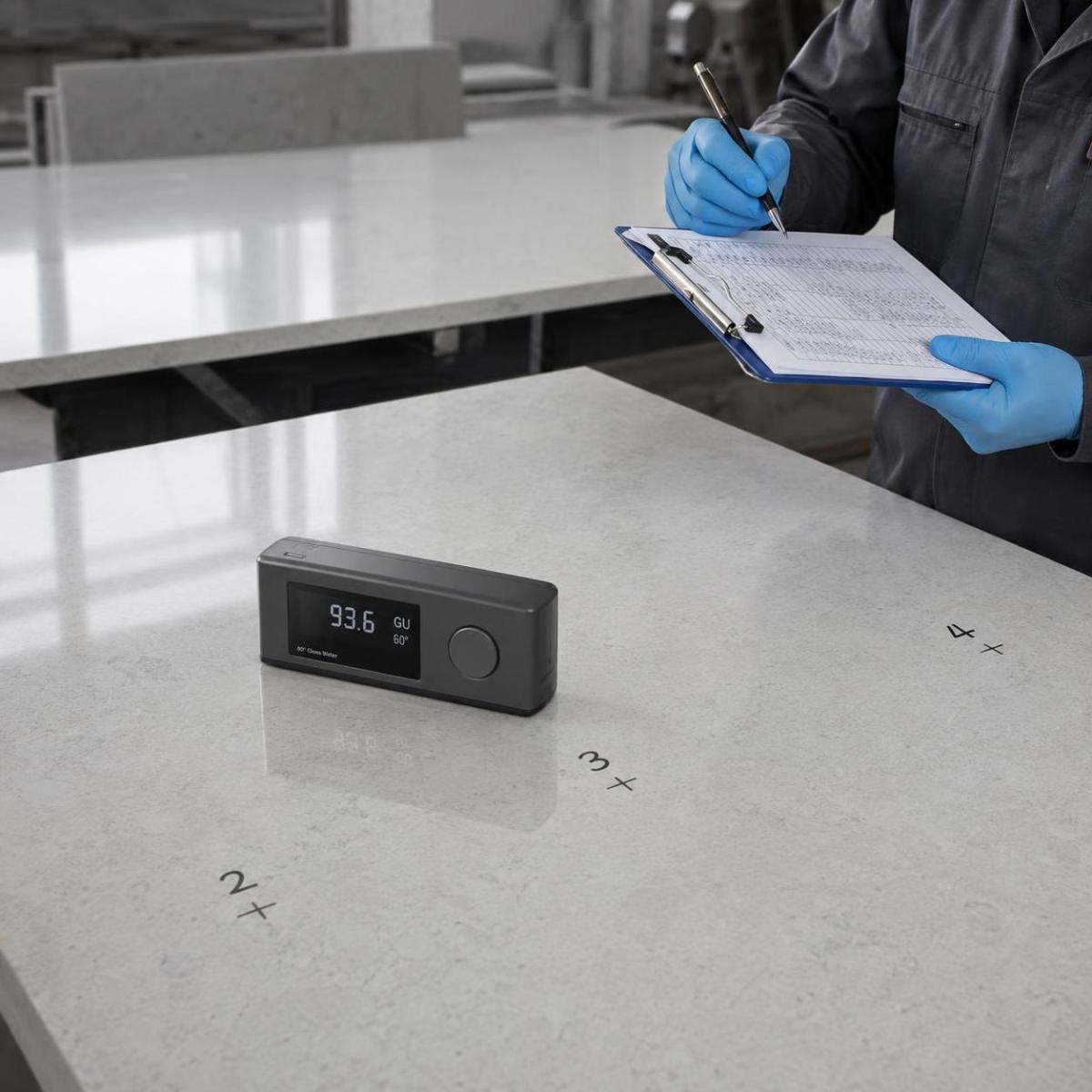
The normal tool is a gloss meter, used on a clean and dry surface. Readings are usually taken at multiple positions rather than one single point. That matters because quartz slabs can show local variation caused by pattern density, resin-rich zones, polishing pressure, or handling during production.
In factory inspection, experienced teams do not rely only on the instrument. They also check the slab under angled light because some defects are easier to see than to measure. Fine swirl marks, edge dullness, and haze after polishing may not always show up clearly in a basic acceptance sheet, but they become obvious after installation under kitchen lighting or near a window.
This is why a decent gloss inspection usually includes both numerical reading and visual examination. If only one is used, the result can be misleading.
What Affects the Final Gloss Level
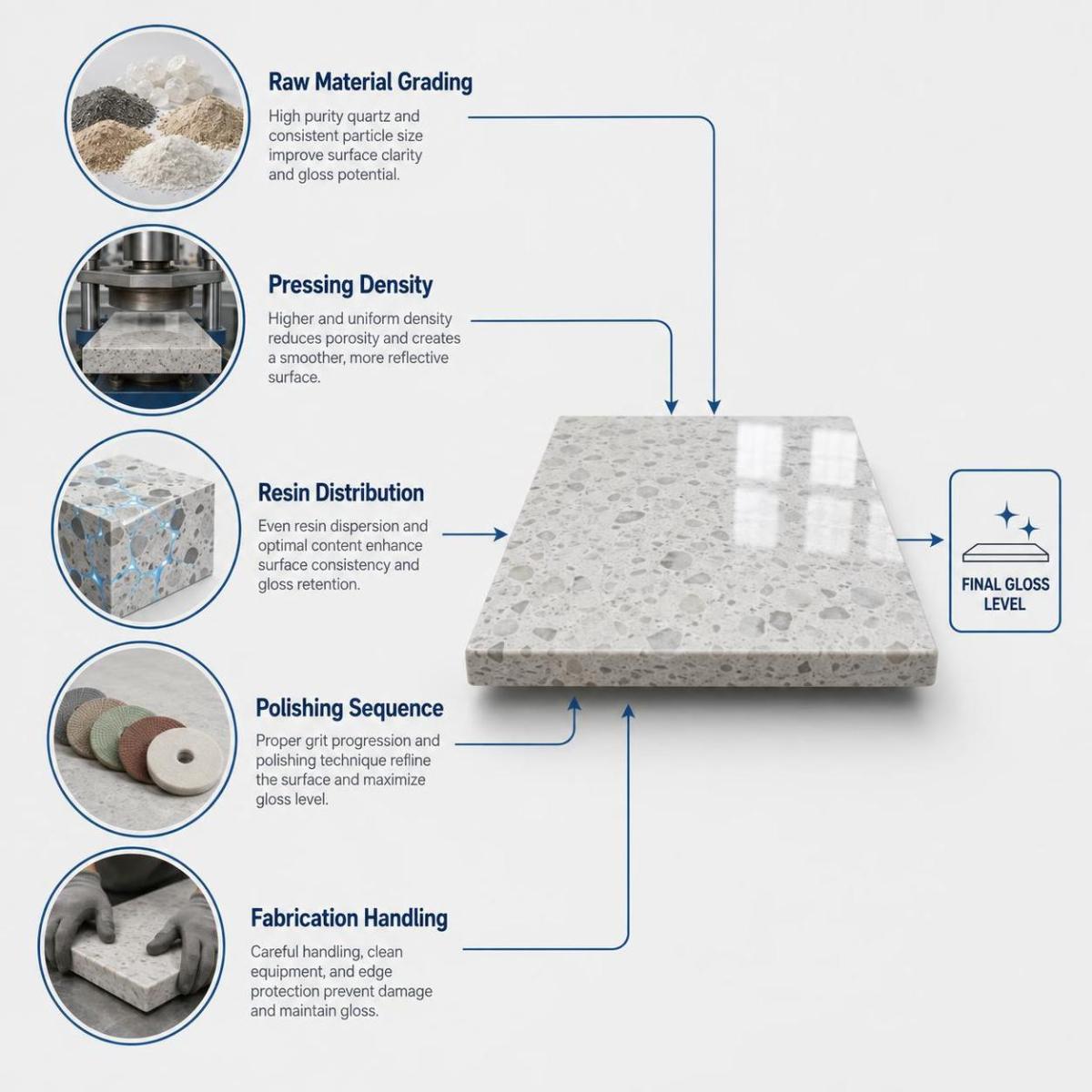
Polished quartz does not gain gloss from one step alone. It is the result of the full production route: raw material grading, pressing density, resin quality, curing control, calibration, and the polishing sequence itself.
A few factors tend to make the biggest difference:
- Surface flatness before polishing. If calibration is unstable, the polish may look bright in some areas and weak in others.
- Polishing head condition and abrasive sequence. Worn tools can leave haze or micro-scratches.
- Color and pattern design. Dark slabs usually reveal gloss variation more easily than light, grainy designs.
- Resin distribution. Uneven resin content can affect how light reflects across the slab face.
- Post-production handling. Protective film, dust, water residue, and transport marks can alter the apparent finish before installation.
Fabrication also has an effect. A slab may leave the factory with a strong polish, but cutting, edge profiling, seam work, and on-site cleaning can reduce the perceived gloss if not handled carefully.
The Difference Between High Gloss and Good Gloss
This is where many purchasing discussions go off track. Chasing the highest gloss number sounds logical, but in practice “good gloss” is often more about balance than maximum reflection.
An overly aggressive polish can make a slab look flashy in a showroom while exposing every fingerprint, water mark, and fine scratch in daily use. In residential kitchens, that may become a complaint point. In hotel vanity tops or commercial counters, maintenance staff may prefer a polished finish that is bright but not extreme, because it stays visually cleaner through repeated use.
Uniformity matters just as much. A countertop with slightly lower but stable gloss from center to edge will generally look better after installation than one with a high average reading and obvious patchiness.
Common Problems Hidden Behind Gloss Complaints
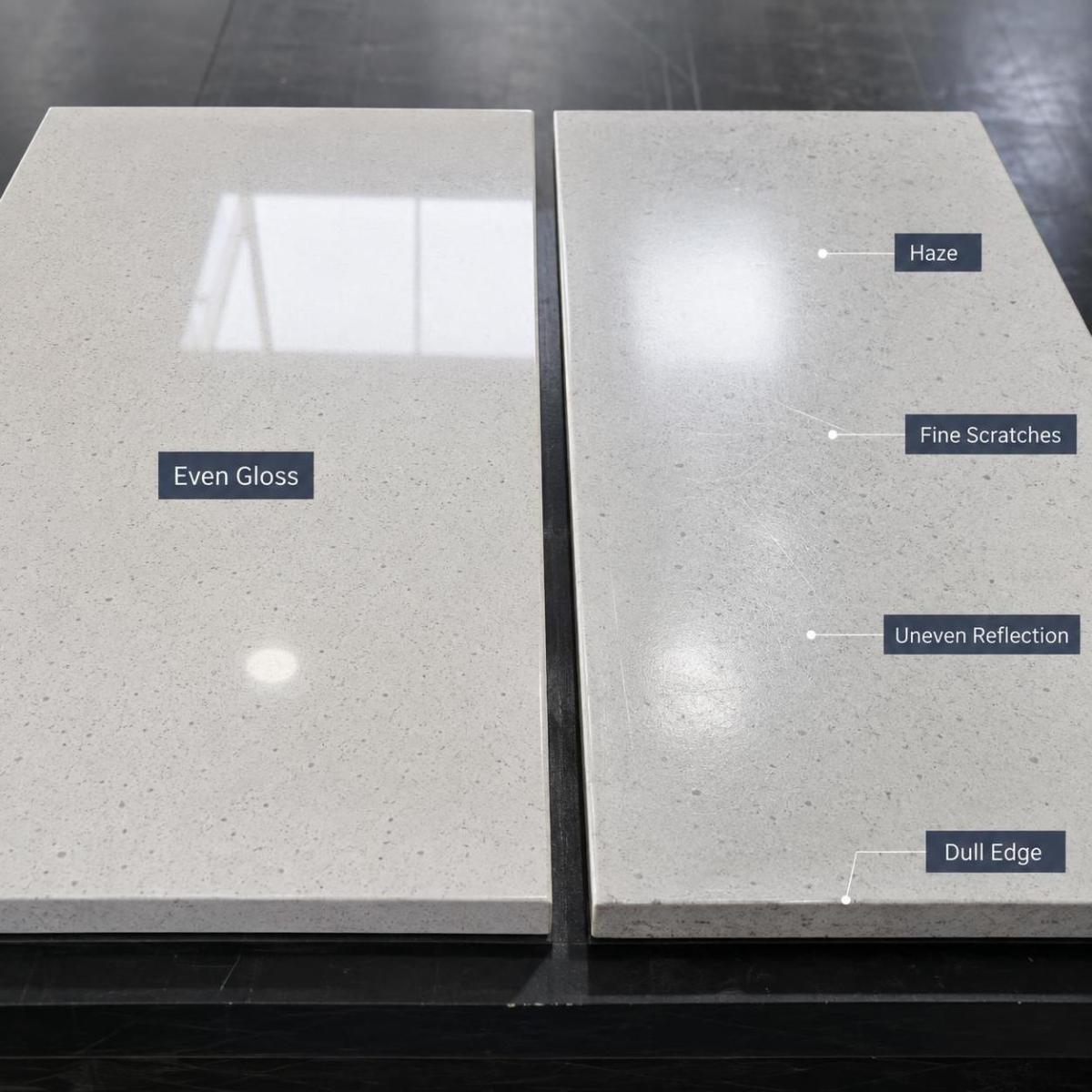
When a buyer says the quartz countertop “has poor gloss,” the issue may not be simple dullness. It can point to different underlying problems:
- Uneven polishing between slabs in the same batch
- Low edge gloss after fabrication
- Surface haze visible under side lighting
- Fine scratches from transport or site handling
- Residue from adhesive, wax, or improper cleaning products
This is why gloss should not be judged only at the warehouse door. A slab that looks acceptable under diffuse lighting can show defects clearly once it is installed below LED strip lights or opposite large windows. For projects with stricter visual requirements, it is smarter to inspect samples and finished slabs under lighting conditions close to the actual application.
How to Evaluate Gloss Before You Commit to a Batch
If the project places weight on surface quality, a few simple checks help more than broad promises. Ask how gloss is inspected, whether readings are taken across multiple points, and whether edge finish is included in quality control after fabrication. If possible, compare several slabs from the same series rather than one showroom sample.
It also helps to define what “acceptable” means before production or shipment. That may include visual consistency, allowable variation, and the inspection condition. For some projects, especially large-volume residential developments, consistency is often more critical than pushing for the brightest finish available.
Another practical point: do not separate gloss from color and pattern approval. A white quartz with subtle texture can hide minor finish variation. A deep black or solid dark gray slab usually cannot. The same gloss standard may be experienced very differently depending on the design.
Why Gloss Standards Matter in the Market
In the building decoration materials trade, surface finish influences perceived value very quickly. Buyers may not know pressing pressure or resin formulation, but they can see whether a countertop reflects light cleanly. That visual reaction affects showroom conversion, project acceptance, and after-sales discussions.
A reliable gloss standard also supports smoother communication between supplier, fabricator, and project team. Without a shared benchmark, complaints become subjective. One side says the slab is polished; the other says it looks dull. Once the finish expectation is clearly defined and checked in a consistent way, many of those arguments become easier to avoid.
A Useful Way to Think About It
The best polished quartz countertops are not simply the shiniest ones. They are the ones whose gloss level fits the design, stays consistent across the slab, survives fabrication well, and still looks right after months of actual use.
If you are comparing materials for a project, treat gloss as a performance detail, not a showroom trick. Check how it is measured, how stable it is across production, and how it behaves in the real lighting of the space. That is usually where the difference between a good slab and a troublesome one starts to show.
Gloss is largely decided on the finishing line, which Quartz Production Line Upgrade for Higher Slab Quality explains in detail, and Anti-Scratch Quartz for High-Frequency Usage Spaces covers how the finished surface behaves afterwards.
Related Articles
- Maintenance Guide for Quartz Countertops
- Complete Engineered Quartz Slab Production Process
- Strict Quality Control System for Export Quartz Slabs
- Stain Resistance Performance of High-Grade Quartz Slabs
Polished Quartz Slabs With Even, Consistent Gloss
We control gloss through stable calibration, a disciplined polishing sequence, multi-point gloss-meter readings, and angled-light visual inspection, delivering an even, clean reflection from center to edge and consistent finish across batches. Contact us for samples, inspection records, and project pricing.
📱 WhatsApp: +86 198 6115 3736
📧 Email: raykelee@hyquartzslabfactory.com
Send Us A Message