
How We Control Color Difference in Bulk Quartz Orders
How We Control Color Difference in Bulk Quartz Orders

Color Difference in Bulk Quartz Orders: How We Keep It Under Control
In bulk quartz orders, color consistency is not a cosmetic detail. It is a project risk factor. A small difference that seems acceptable on a single sample can become highly visible once dozens or hundreds of slabs are installed across a hotel lobby, apartment kitchen program, retail chain, or commercial vanity package. For importers, fabricators, contractors, and distributors, this is where many disputes begin: the approved sample looked right, but the delivered batch does not read as one unified surface.
That is why color difference control in engineered quartz has to be managed as a production system rather than a final inspection exercise. If the process starts only after slabs are polished and packed, it is already too late. Reliable control depends on how raw materials are selected, how recipes are stabilized, how production batches are organized, and how slabs are sorted before shipment.

Why color variation happens in quartz production
Quartz slabs are manufactured materials, but “manufactured” does not mean perfectly identical by default. Color variation can come from several sources, and some are more difficult to manage than buyers assume.
The first source is raw material fluctuation. Quartz stone powder, resin, pigments, and decorative particles are sourced in lots, and even when suppliers meet specification, slight differences in whiteness, particle tone, moisture, or transparency can influence the final appearance. White, light grey, beige, and marble-look designs are especially sensitive because small shifts in base tone are easier for the eye to detect.
The second source is formula and mixing stability. Pigment dispersion, resin ratio, curing conditions, and mixing time all affect how the slab surface reads after pressing, curing, polishing, and finishing. In patterned quartz, the placement density of veining chips or mirror particles can also create visual differences between slabs if not controlled carefully.
The third source is production sequence. Even with the same formula, slabs produced across different days, under different ambient conditions, or with different raw material lots may not be visually identical enough for one project. This is why large project orders should never be treated as a collection of independent production runs.

Raw material control is where consistency begins
For bulk orders, the most practical way to reduce color difference is to lock the raw material system before mass production starts. That means confirming the exact quartz sand or powder grade, resin source, pigment code, and additive combination to be used for the order. If substitute materials are introduced during production because of inventory pressure or supplier change, color consistency becomes much harder to maintain.
In practice, stable manufacturers often do three things here. They qualify suppliers in advance, they retain reference samples for incoming material comparison, and they avoid mixing too many material sources for one project batch. This matters especially for engineered quartz colors with a clean and uniform base. A slight raw material whiteness deviation that is barely measurable in isolation may become obvious when two kitchen islands from different lots are installed side by side.
Buyers sometimes focus heavily on finished slab photos but spend too little time asking how raw material lots are managed. From a procurement risk perspective, that is the wrong emphasis. A supplier that cannot explain batch discipline at the material stage is unlikely to deliver strong consistency at scale.
Color control is not only visual; it must be tied to batch discipline
One of the most common misunderstandings in quartz sourcing is to assume that all slabs in the same color code are interchangeable. For small retail replacement jobs, that may be acceptable. For volume orders, it usually is not.
A disciplined batch management approach means that slabs for the same project, phase, or container are grouped under a defined production lot. The point is not just traceability after a complaint; it is preventive control before delivery. When production is organized by batch, the factory can compare slabs against the same reference standard, isolate outliers early, and reduce the risk of mixed-tone loading.
This is also why experienced buyers often request shipment from the same production batch for large-area installations. That request is reasonable, but it only works when the supplier has internal systems to identify, store, and release slabs accordingly.

Sample approval should reflect real production, not an idealized reference
Another avoidable source of conflict is the gap between sample approval and mass production reality. Small samples are useful, but they do not always represent the visual effect of a full slab, especially in designs with movement, grain variation, or decorative aggregates. Lighting conditions also distort perception. A sample reviewed under showroom lighting may look different in natural daylight or on a large horizontal installation.
For that reason, stronger quality practice usually involves confirming not only a hand sample but also a production reference standard tied to the actual slab design. In some cases, a control slab or photographed benchmark from a previous approved batch is used for comparison. The main goal is to reduce subjectivity. “Close enough” is not a workable standard in bulk quartz supply.
From a buyer’s side, it is worth clarifying in advance whether approval is based on a sample chip, a full slab image, a physical slab, or a signed batch reference. The more expensive and visually continuous the application, the more important that distinction becomes.
Slab matching before packing is a critical checkpoint
Final inspection in quartz should not be limited to checking dimensions, thickness, gloss, and visible defects. For bulk decorative projects, slab matching matters just as much. This means comparing slabs within the same order and separating those that deviate in tone, brightness, particle distribution, or pattern expression.
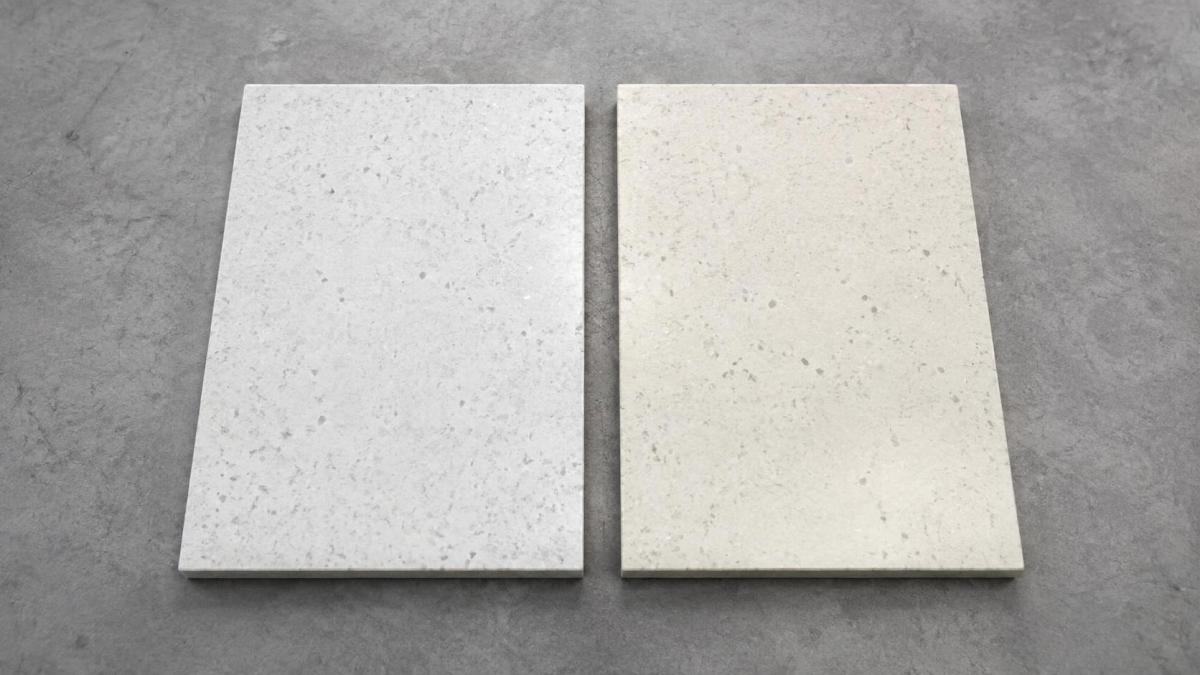
In practical terms, this step helps solve a frequent project issue: slabs may pass individual quality standards, yet still look inconsistent when installed together. That is why some manufacturers conduct side-by-side slab review before packing, especially for light colors, hotel projects, multi-unit developments, and orders that require sequential installation appearance.
This sorting stage also helps determine whether a batch should be split by area of use. For example, one tone group may be allocated to kitchen tops and another to vanity tops, instead of allowing mixed installation in one open space where differences would be obvious.
Why light colors and large projects require tighter control
Not all quartz colors carry the same risk. Plain white, super white, ivory, cement grey, and soft marble-look surfaces usually demand stricter control than darker or highly textured colors. The reason is simple: the eye catches tonal drift more easily on clean and uniform backgrounds.
Project scale matters too. In a single residential countertop, a slight variation may never trigger a complaint. In a multi-building residential development or chain-store fit-out, that same variation can create installation inconsistency across units, causing rework, claim exposure, and brand image issues for the contractor or developer.
This is where quality control becomes a commercial issue, not just a technical one. A factory may consider a deviation “within tolerance,” but the project owner may judge it based on installed visual impact. Those are not always the same standard.
What serious buyers should ask before placing a bulk order
When color consistency is important, buyers should ask more than whether the supplier “controls color difference.” That phrase is too general to be useful. Better questions include:
How are raw material lots managed for one project order? Can the supplier keep production within one controlled batch window? How is the approved reference defined? Are slabs sorted before packing by tone or pattern similarity? Can the supplier provide batch identification for traceability? If replenishment is needed later, what is the process for reducing mismatch risk?
These questions are not administrative details. They reveal whether the factory operates with project-level quality thinking or simply with standard commodity production logic.
Reorders are where many color problems appear
Initial shipments may be controlled well, but repeat orders months later are often where inconsistency becomes most visible. Raw material lots change, formulas are adjusted, equipment conditions shift, and the original batch is no longer available. For quartz distributors and project contractors, this is one of the biggest operational realities to plan for.
The practical lesson is straightforward: if a project is large and future replenishment is likely, order planning should address this early. Some buyers choose to reserve extra slabs from the same batch. Others require retained reference slabs or documented batch standards for future comparison. Neither option guarantees a perfect match later, but both are better than relying on memory or sample chips alone.
Consistency is a process capability, not a claim
In the quartz business, almost every supplier can promise stable color. The difference is whether that promise is backed by process control. Reliable color consistency in bulk orders depends on discipline across the full chain: stable raw materials, fixed formulas, controlled production lots, realistic approval standards, slab matching, and careful shipment management.
For buyers, the key judgment is not whether slight color difference can be eliminated completely. In industrial production, that is rarely a realistic standard. The real question is whether the supplier can keep variation within a controlled range that remains visually acceptable for the intended project.
That is the level on which good bulk quartz supply should be evaluated. Not by a single attractive sample, but by whether the production system is built to deliver repeatable decorative results at scale.
Keeping a large order visually consistent is also a scheduling question, so Stable Lead Time for Global Bulk Quartz Orders and Large Batch Quartz Slabs Ready for Shipment are worth reading together.
Related Articles
- Strict Quality Control System for Export Quartz Slabs
- Complete Engineered Quartz Slab Production Process
- Glossiness Standard of Polished Quartz Countertops
- Thickness Tolerance Standard for Export Quartz Slabs
Bulk Quartz Orders With Controlled, Same-Batch Color Consistency
We lock raw material systems and formulas before production, organize project orders under defined production lots, and conduct side-by-side slab matching and tone sorting before packing, delivering unified color across hotels, multi-unit projects, retail chains, and repeat orders. Contact us for batch references, samples, and project pricing.
📱 WhatsApp: +86 198 6115 3736
📧 Email: raykelee@hyquartzslabfactory.com
Send Us A Message