
Thickness Tolerance Standard for Export Quartz Slabs
Thickness Tolerance Standard for Export Quartz Slabs
Export Quartz Slabs Thickness Tolerance: The Standard We Work To
For buyers, fabricators, and project managers sourcing stone for global markets, understanding the thickness tolerance standard for export quartz slabs is essential to ensure quality, installation accuracy, and compliance. This guide explains how thickness deviations are measured, what acceptable ranges typically apply, and why consistent slab thickness matters for transportation, fabrication, and end-use performance in building and decorative projects.
The core search intent behind this topic is practical and commercial. Readers are usually trying to confirm what thickness tolerance is acceptable for export quartz slabs, how to inspect it, and how much deviation may create production or installation risk.
What matters most to this audience is not a broad explanation of quartz itself. They want a usable standard, a clear inspection method, and a way to reduce disputes between supplier, buyer, fabricator, and project team.
The most valuable content, therefore, is guidance on tolerance ranges, measurement points, export quality expectations, fabrication consequences, and contract language. General marketing claims, decorative trends, and unrelated stone care topics should stay minimal.
Why Thickness Tolerance Matters in Export Quartz Slabs
Thickness tolerance affects much more than a technical data sheet. In export business, it directly influences packing stability, machining precision, edge profiling, seam quality, adhesive performance, and final visual consistency after installation.
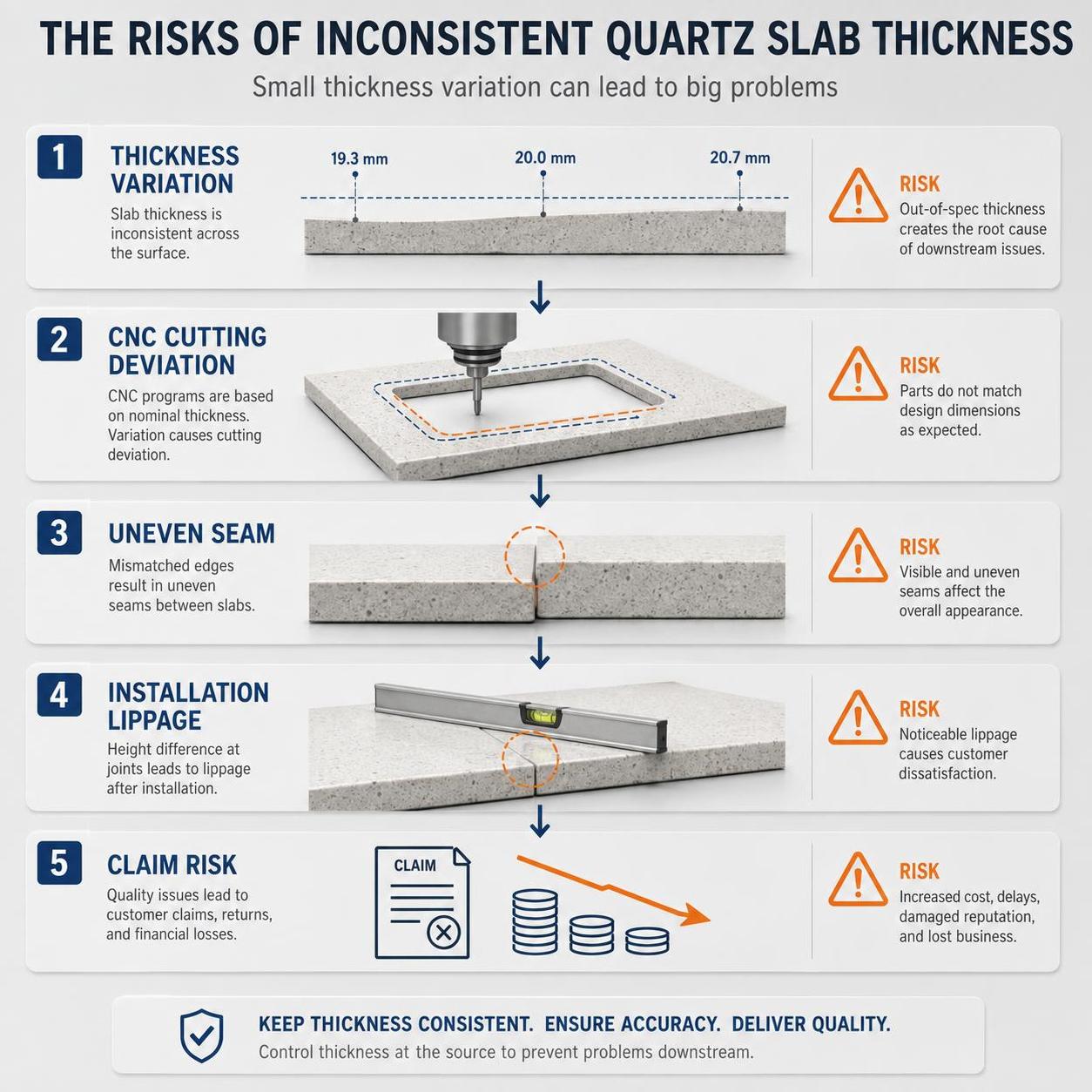
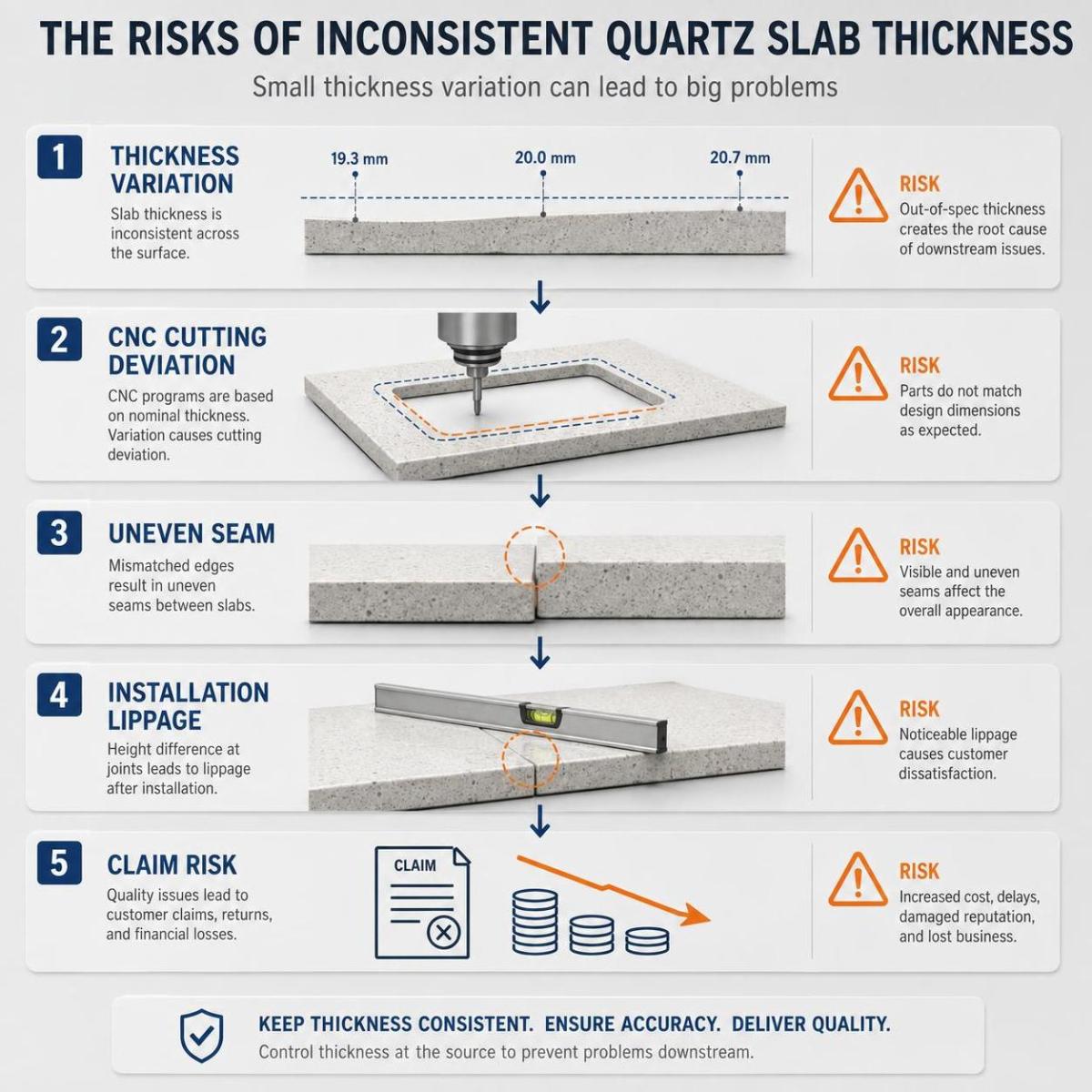
When slab thickness varies too much, fabricators must spend more time recalibrating tools and adjusting programs. That raises labor costs, increases material waste, and creates delays that are especially costly in large commercial or multi-unit residential projects.
For importers and project managers, tolerance problems also create claims risk. A slab may pass a visual check at loading, yet still cause lippage, uneven cutouts, or alignment issues once it reaches the workshop.
That is why the thickness tolerance standard for export quartz slabs is usually treated as a quality control issue, not just a manufacturing detail. Consistency protects both downstream efficiency and the supplier’s reputation in international markets.
What Buyers Usually Mean by “Thickness Tolerance Standard”
In practice, thickness tolerance refers to the allowable deviation between the nominal slab thickness and the actual measured thickness. A slab sold as 20 mm or 30 mm is rarely exactly that number at every point.
What matters is whether the variation stays within an agreed acceptable range. The standard may be based on factory control rules, buyer specifications, regional market expectations, or project documents prepared for a specific contract.
For export quartz slabs, buyers often expect a tighter and more consistent tolerance than for low-end domestic material. This is because overseas fabrication often relies on automated cutting, CNC processing, and predictable edge finishing.
In other words, the question is not whether there is any deviation. The real question is whether the deviation is controlled, measurable, and small enough to avoid operational or installation problems.
Typical Thickness Tolerance Ranges for Export Quartz Slabs
There is no single global rule that covers every market, but many export transactions use practical working tolerances. For standard quartz slabs, a common reference range is within plus or minus 0.5 mm of nominal thickness.
Higher-end orders, engineered production lines, or projects with strict fabrication demands may require tighter control, such as plus or minus 0.3 mm. Lower-spec orders may accept wider variation, but that usually increases downstream risk.
For 15 mm, 20 mm, and 30 mm slabs, the acceptable range should always be written into the purchase agreement or technical sheet. Relying on verbal expectations is one of the main reasons thickness disputes happen in export trade.
Buyers should also confirm whether the tolerance applies to average slab thickness, local spot thickness, or thickness variation across the entire slab. These are related but not identical quality standards.
How Thickness Should Be Measured Correctly
Measurement method matters almost as much as the tolerance itself. A supplier and buyer may report different numbers simply because they use different tools, different sample points, or different pressure when measuring the slab.
The most common tools are a digital caliper, micrometer, or other precision thickness gauge suitable for stone products. The tool should be calibrated and used on clean, flat points away from chipped corners or damaged edges.
Most professional inspections check multiple points across the slab, including both ends, the center, and several side positions. Measuring only one spot can hide thickness variation caused by polishing, pressing, or uneven production control.
It is also important to distinguish between edge thickness and body consistency. Some slabs may show acceptable thickness at the edge while still having meaningful variation in the usable field area.
What Problems Can Happen When Thickness Is Inconsistent
Even small deviations can create expensive consequences in fabrication. CNC programs may cut slightly differently than intended, sink or cooktop cutouts may need adjustment, and laminated edges may fail to align cleanly.
Installers may then face uneven countertop transitions, backsplash mismatch, or visible lippage where adjacent pieces meet. On wall panels or vanity tops, inconsistent thickness can also affect support, leveling, and joint appearance.
Transportation and packing are affected as well. If slabs in one bundle vary too much, separators and support frames may not distribute pressure evenly, increasing the chance of edge stress during long-distance shipping.
In large projects, these issues become cumulative. A minor tolerance problem on one slab may be manageable, but variation across a full container can damage scheduling, labor efficiency, and the buyer’s confidence in future orders.
How Buyers and Fabricators Should Evaluate Supplier Capability
When sourcing export quartz slabs, buyers should ask more than “What is your thickness?” A stronger question is “What is your guaranteed thickness tolerance, how do you measure it, and how do you record inspection results?”
Reliable suppliers can usually provide a technical specification sheet, in-process control procedure, and final inspection records. They should also be able to explain whether thickness variation is monitored slab by slab or batch by batch.
It is useful to ask for measured data from recent production, not just a generic brochure. Photos or videos of gauge checks at several slab positions can help buyers verify that the stated standard is applied in routine production.
Fabricators should also evaluate whether the supplier’s tolerance is compatible with the workshop’s machinery, edge profiles, and installation standards. A tolerance that looks acceptable on paper may still be inefficient in real processing conditions.

What to Put in Contracts and Purchase Specifications
One of the best ways to prevent claims is to define the thickness tolerance standard for export quartz slabs in writing before production begins. This should appear in the quotation, proforma invoice, or product specification attachment.
The document should list nominal thickness, allowable deviation, measurement method, number of measurement points, and the basis for acceptance. If a third-party inspection is required, that condition should also be stated clearly.
Buyers may also define what happens if slabs fall outside tolerance. This can include rejection, price adjustment, replacement, or sorting by grade. Clear remedies reduce conflict and make quality expectations commercially enforceable.
For recurring orders, it is worth building a stable approval standard instead of renegotiating every shipment. Consistent documentation improves forecasting, reduces inspection time, and supports a more predictable supply relationship.
How to Make a Practical Judgment Before Ordering
Not every project needs the same level of thickness precision. For basic applications, a standard commercial tolerance may be sufficient. For high-visibility kitchens, prefabricated systems, or strict modular installations, tighter control is usually justified.
Buyers should balance tolerance requirements with price, lead time, and supplier capability. Extremely tight tolerance may increase production cost, but uncontrolled variation often costs far more once fabrication and installation begin.
A practical approach is to approve sample slabs, confirm measurement standards, and match tolerance expectations to the actual application. This turns the discussion from abstract quality language into a clear operating requirement.
That is the real value of understanding thickness tolerance: it helps the buyer make a better sourcing decision before material enters the container, not after problems show up in the workshop or on site.
Conclusion
The thickness tolerance standard for export quartz slabs is a critical quality benchmark for international buyers, fabricators, and project teams. It affects processing accuracy, installation finish, shipping reliability, and the overall cost of using the material.
In most cases, readers searching this topic need a practical answer: define the nominal thickness, confirm an acceptable deviation range, verify how it is measured, and put those requirements into written purchase documents.
When slab thickness is consistent, the entire supply chain works better. Fabrication becomes more efficient, installation quality improves, and the risk of claims falls sharply. For export quartz sourcing, that consistency is not optional; it is part of professional quality control.
Tolerance matters most at the fabrication stage: Strict Batch Inspection Standard for Export Quartz Orders shows how thickness is verified, and the Custom Cut Quartz Slabs Sizing and Project Installation Guide covers what it means on site.
Related Articles
- Strict Quality Control System for Export Quartz Slabs
- Why Does Quartz Stone Warp and How We Control It
- Complete Engineered Quartz Slab Production Process
- How to Avoid Bubbles and Porosity in Quartz Stone
Export Quartz Slabs With Tight, Documented Thickness Tolerance
We control slab thickness through calibrated production, multi-point gauge inspection across every slab, and recorded final inspection data, delivering the consistent tolerance that CNC fabrication, clean seams, and stable export packing depend on. Contact us for spec sheets, measured inspection records, samples, and project pricing.
📱 WhatsApp: +86 198 6115 3736
📧 Email: raykelee@hyquartzslabfactory.com
Send Us A Message