
Custom Cut Quartz Slabs Sizing and Project Installation Guide
Custom Cut Quartz Slabs Sizing and Project Installation Guide
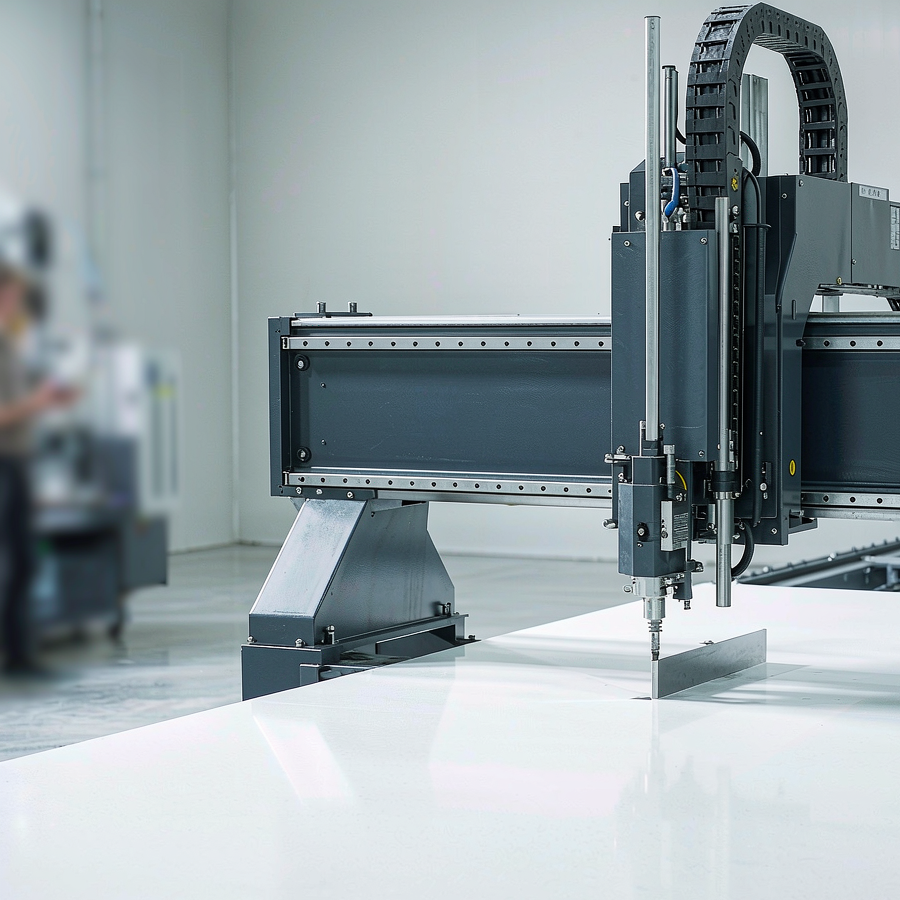
Custom Cut Quartz Slabs: Sizing, Tolerances and Installation Guide for Projects
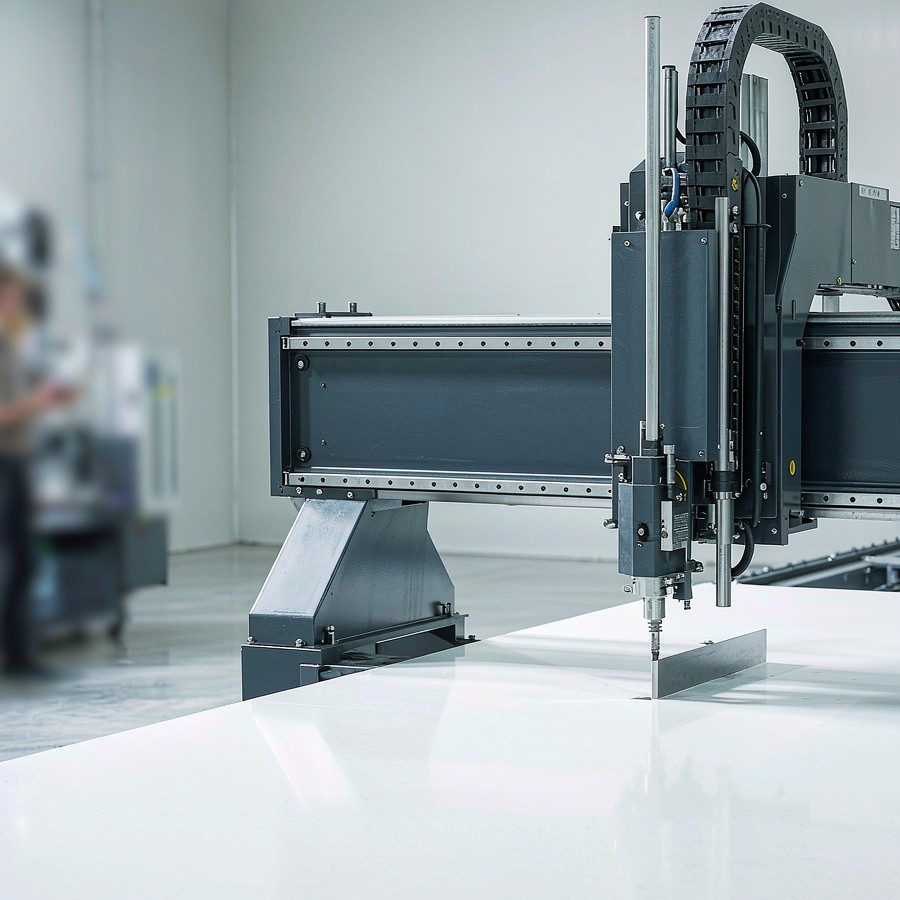
Most project buyers do not order quartz the way a homeowner picks a countertop from a showroom rack. A hotel reception desk, a shopping mall food court, or a residential tower with three hundred identical kitchens all share the same requirement: the material must arrive at the job site already cut to the dimensions on the drawing. That is exactly what Custom Cut Quartz Slabs are for. Instead of shipping full slabs and leaving every cut, every cutout and every edge to a local fabricator, the factory performs the cutting, drilling and edge work before the material is packed.
This guide is written for importers, contractors, designers and procurement teams who are considering cut-to-size quartz for the first time, or who want to tighten up the way they currently specify it. It covers how the cutting process works in the factory, which tolerances you should put in writing, how cutouts and edges are handled, and what information a supplier needs in order to quote and produce without surprises.
Why Custom Cut Quartz Slabs Matter for Project Buyers
On paper, buying full slabs and fabricating locally looks flexible. In practice, project work punishes that flexibility. Local fabrication varies from shop to shop; two fabricators working from the same drawing can produce noticeably different edge profiles, polished surfaces and cutout radii. When a project has dozens or hundreds of repeating units, those small differences multiply into visible inconsistency and installation delays.
Factory cutting solves this differently. The same CNC program cuts every piece in a batch, so piece 300 matches piece 1. Polishing is done on calibrated lines, so gloss and flatness stay consistent. And because the work happens where the slabs are made, any internal characteristic of the material is known before cutting starts, not discovered afterwards. For project buyers, the value of custom cut quartz slabs is not only convenience — it is repeatability, and repeatability is what keeps a multi-unit installation on schedule.
From Drawing to Slab: How the Cutting Process Works
The process starts with your shop drawings, not with the slab. Drawings are converted into cutting programs, usually in CAD/CAM software connected directly to the machinery. A typical flow looks like this:
First, nesting software arranges every required piece onto full slabs to maximize yield and keep the grain direction of the pattern consistent across visible surfaces. Second, a bridge saw or waterjet performs the primary cutting of large pieces. Third, CNC machining centers handle the precision work: sink and cooktop cutouts, faucet holes, drainboard grooves, and edge profiles. Finally, each piece is polished, inspected against the drawing, and labelled before packing.
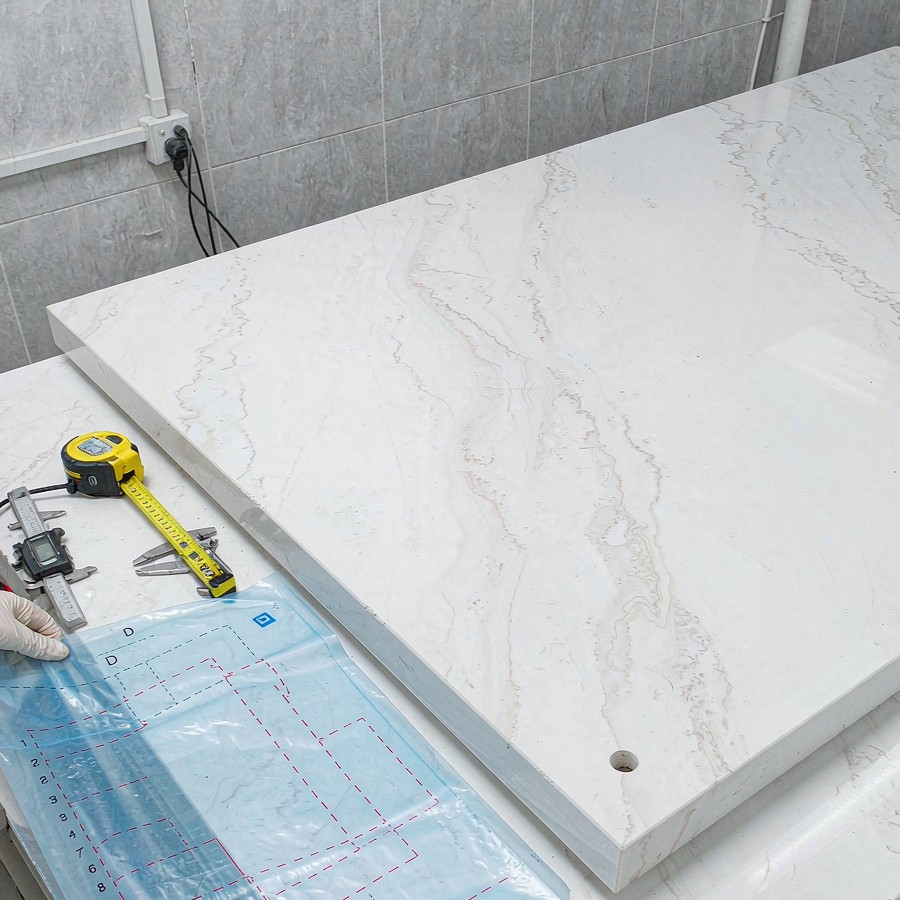 One practical detail matters more than most buyers expect: labelling. Every piece of a cut-to-size order should carry an identifier that maps back to the drawing — unit number, position, and room. When three hundred pieces arrive on site, the difference between a labelled and an unlabelled shipment is measured in days of installation time.
Dimensional Tolerances You Should Put in Writing
"Cut to size" means nothing without numbers attached. Reputable factories work to stated tolerances, but the buyer's job is to confirm them before production, not after delivery. For most project work the following ranges are realistic and worth writing into the purchase order:
Length and width: ±1 mm is a standard expectation for cut-to-size pieces. Thickness: polished quartz slab typically runs at nominal 15 mm, 18 mm or 20 mm; ask for the actual tolerance rather than the nominal figure, because thickness variation shows up as height steps between adjacent pieces. Diagonal squareness: for rectangular pieces, equal diagonals confirm the corners are true 90 degrees — critical for seamless joints. Cutout positions: ±1.5 mm is a reasonable ask for sink and cooktop openings, because the appliance manufacturer's own tolerances also consume part of the gap.
When tolerances are agreed in advance, inspection on arrival becomes a five-minute checklist instead of a dispute. This is the single cheapest risk-reduction step in the whole custom cut quartz slabs workflow.
Edge Profiles and Surface Finishes for Cut-to-Size Work
The edge is where custom cutting becomes visible design rather than invisible engineering. Common profiles include the flat polished edge, the eased edge with a small chamfer, half-bullnose and full-bullnose for softer hand feel, and bevel or ogee profiles for more traditional interiors. Each profile is produced by the CNC line, so the profile you approve on a sample is the profile every piece in the batch will carry.
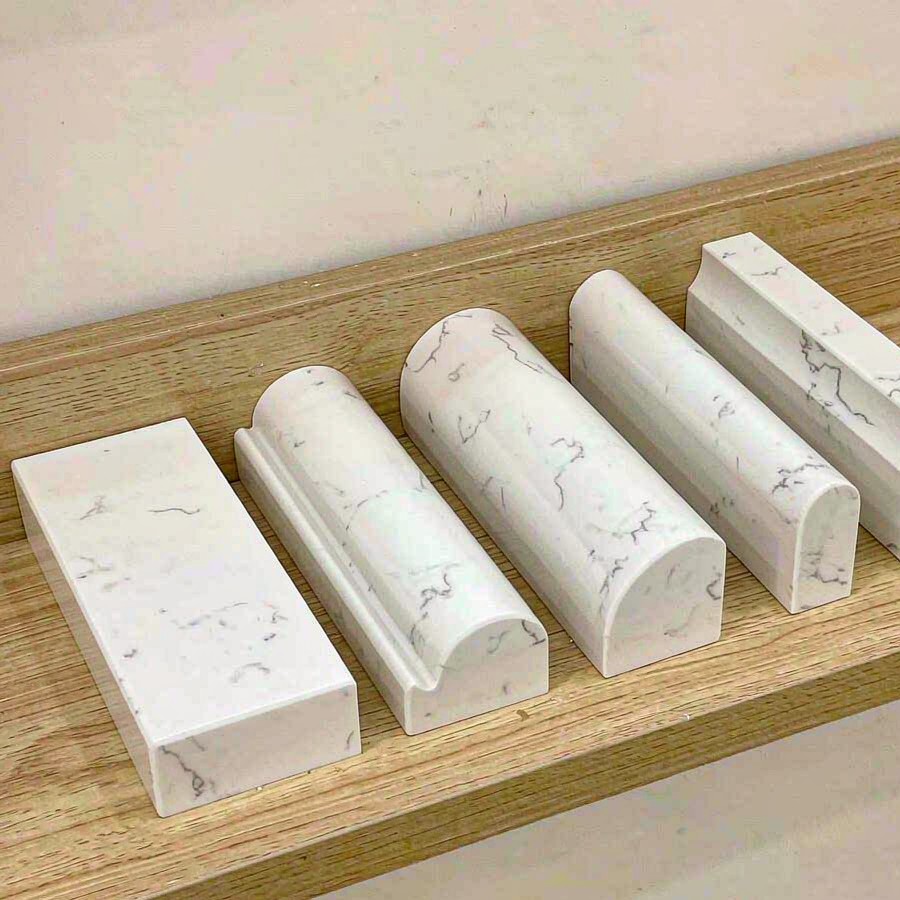 Surface finish deserves equal attention. Polished is the default for quartz and the easiest to keep consistent across a large order. Honed finishes are increasingly popular but show fingerprints and water marks more readily, which matters in high-traffic hospitality work. Whatever you choose, request a finished sample cut from the same batch material, not a generic showroom chip — color and pattern vary slightly between production runs, and the sample is your reference if anything is disputed later.
Cutouts: Sinks, Cooktops, Faucets and Outlets
Cutouts are the highest-risk features in any cut-to-size order, for a simple reason: they must match equipment you have not shipped yet. The factory cuts the opening; the sink or cooktop arrives months later from a different supplier. The bridge between them is the template. Always provide the manufacturer's installation template or an exact CAD file, and state which dimension is critical — most undermount sinks need the opening sized to the sink's underside lip, not its top rim.
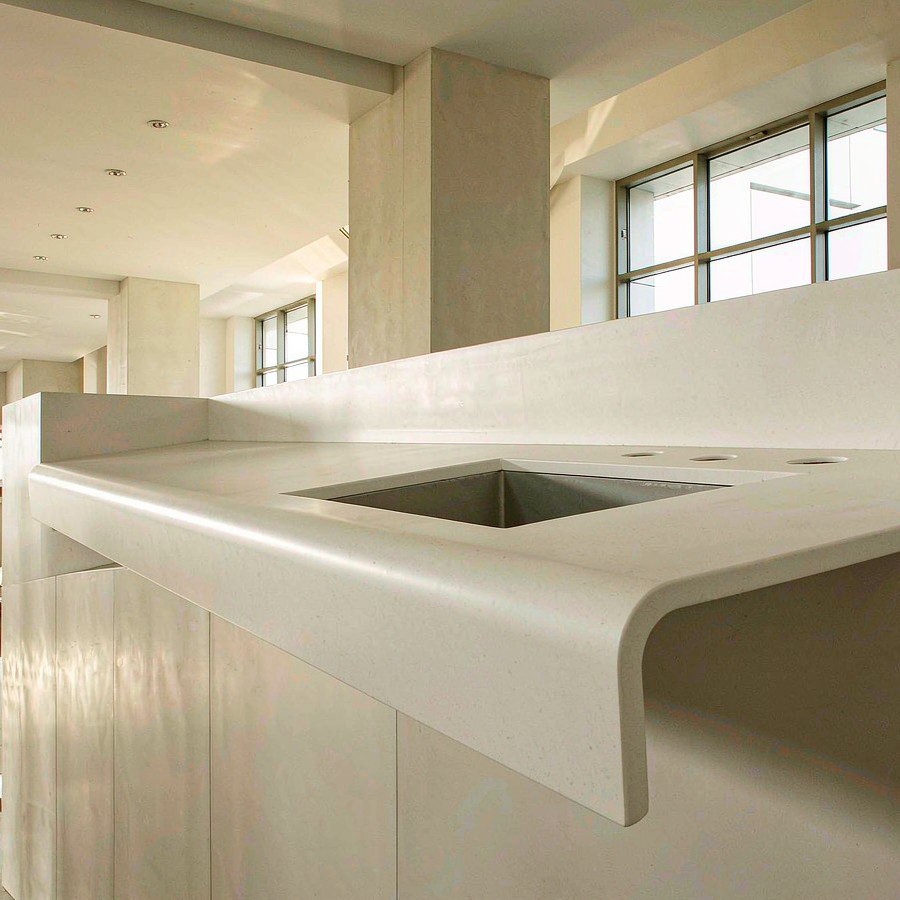 Internal corners of cutouts should have a small radius rather than a sharp corner, because sharp internal corners concentrate stress in an engineered stone that is strong but not flexible. A 6 mm or larger radius is standard practice. For faucets, soap dispensers and electrical outlets in backsplashes, give the factory center-to-center positions rather than edge distances; center positions survive small drawing revisions better and are faster to verify at inspection.
Packaging and Shipping Cut-to-Size Pieces
Full slabs travel in A-frames; cut-to-size pieces usually do not. Smaller pieces are packed in wooden crates with foam interlayers, and larger pieces are crated vertically or horizontally depending on size and weight. What matters to the buyer is not the packing material but the packing logic: pieces should be separated by unit and by room, and the packing list should mirror the labelling on the pieces themselves.
Ask how breakage is handled before the order is confirmed. A practical arrangement is a small spare percentage produced alongside the main batch — typically a few pieces per run — so that one cracked riser does not hold up an entire installation while a replacement crosses the ocean. Factories that regularly export cut-to-size work will have a standard answer to this question; hesitation is a signal worth noticing.
How to Get an Accurate Quote for Custom Cut Quartz Slabs
A quote for cut-to-size work is only as good as the information behind it. The fastest way to a firm number is a complete drawing package: piece dimensions with tolerances, edge profile per edge, cutout templates, the chosen color and finish, and the total square meters. With that package, a factory can calculate slab yield, machine time and packing in one pass.
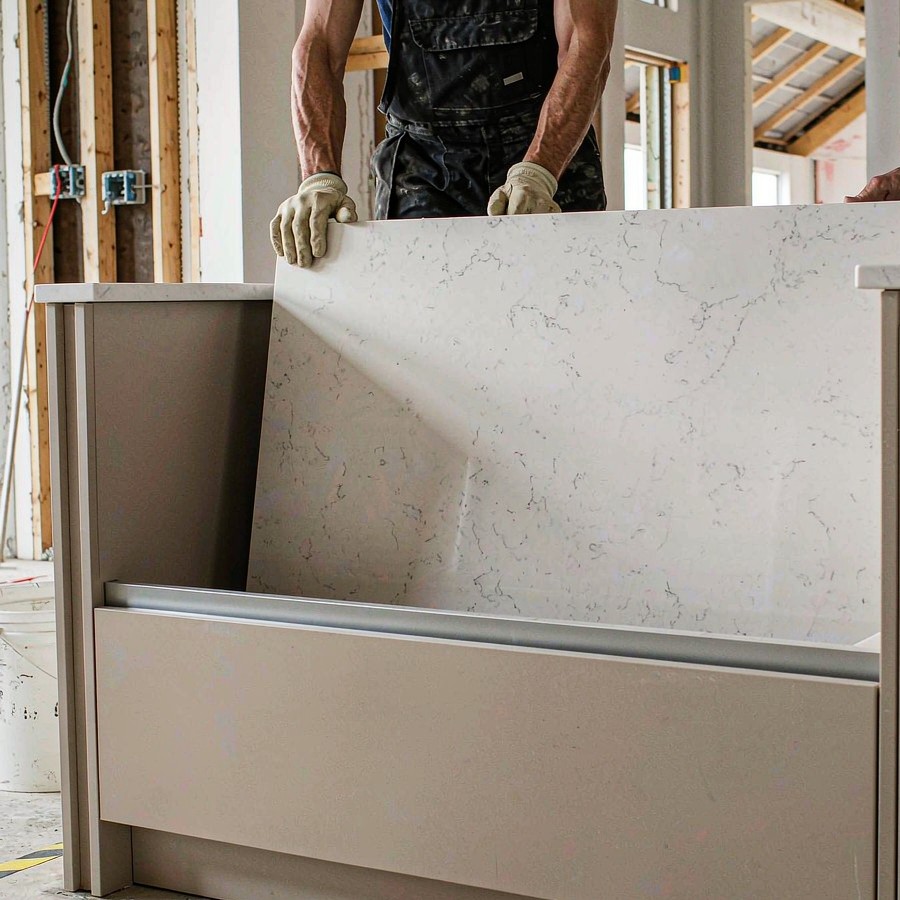 Without it, suppliers must quote conservatively, and conservative quotes are higher quotes. If your drawings are not final, say so and ask for a budget price based on square meters plus a cutting surcharge — then convert to a firm price when the drawing package freezes. Buyers who send complete information consistently receive better pricing, not because of favoritism, but because the factory's own risk has been removed from the calculation.
Frequently Asked Questions
What is the minimum order quantity for custom cut quartz slabs?
Most factories set a minimum based on square meters rather than piece count, commonly around 30 to 50 square meters for a custom production run, because program setup and calibration cost the same whether you cut ten pieces or a hundred. Small prototype orders are sometimes possible at a higher per-piece price. It is always worth asking with your actual drawing attached rather than assuming.
How accurate is factory cutting compared with local fabrication?
CNC cutting routinely holds ±1 mm on linear dimensions, and because every piece in a batch runs the same program, consistency across hundreds of pieces is the real advantage. Local fabrication quality varies widely by shop and workload. For a single kitchen, a good local shop is often fine; for multi-unit projects, factory cutting removes a whole category of variation.
Can cut pieces be modified on site if measurements change?
Minor trimming is possible with proper diamond tooling, but cut-to-size pieces should be treated as finished goods. Edge profiles cannot be re-created on site, and cutting a piece shorter does not restore a polished end edge. If site conditions are uncertain, confirm final field dimensions before releasing the drawing package for production.
How long does production of a cut-to-size order take?
After drawings are approved and the material is in stock, typical production runs two to four weeks depending on complexity and quantity, plus shipping time. Cutout-heavy orders and special finishes sit at the longer end. The clock starts at drawing approval, not at inquiry — which is one more reason to finalize dimensions early.
Conclusion: Send Drawings Early, Agree Tolerances in Writing
Cut-to-size quartz rewards preparation. Buyers who send complete drawings, agree tolerances before production, and label every piece receive material that installs quickly and looks uniform across the whole project. Buyers who treat cutting as an afterthought inherit every variance in the chain. If you are planning a project and want factory-direct pricing on custom cut quartz slabs, send your drawings or even a rough piece list — a serious supplier will tell you within one working day what is feasible, what it costs, and what information is still missing. If you are ordering from a supplier in China, our guide to buying quartz slabs from China covers the MOQ, sample, tolerance and packing points to settle before drawings are released.
Related Articles:
- Thickness Tolerance Standard for Export Quartz Slabs
- How We Control Color Difference in Bulk Quartz Orders
- Wall Panel and Floor Application of Engineered Quartz
- Quartz vs Granite: Pros and Cons for Project Use
Contact us for a quote: WhatsApp: +86 198 6115 3736 | Email: raykelee@hyquartzslabfactory.com
Send Us A Message