
Quartz vs Porcelain vs Sintered Stone: Which Countertop Wins?
Quartz vs Porcelain vs Sintered Stone: Which Countertop Wins?
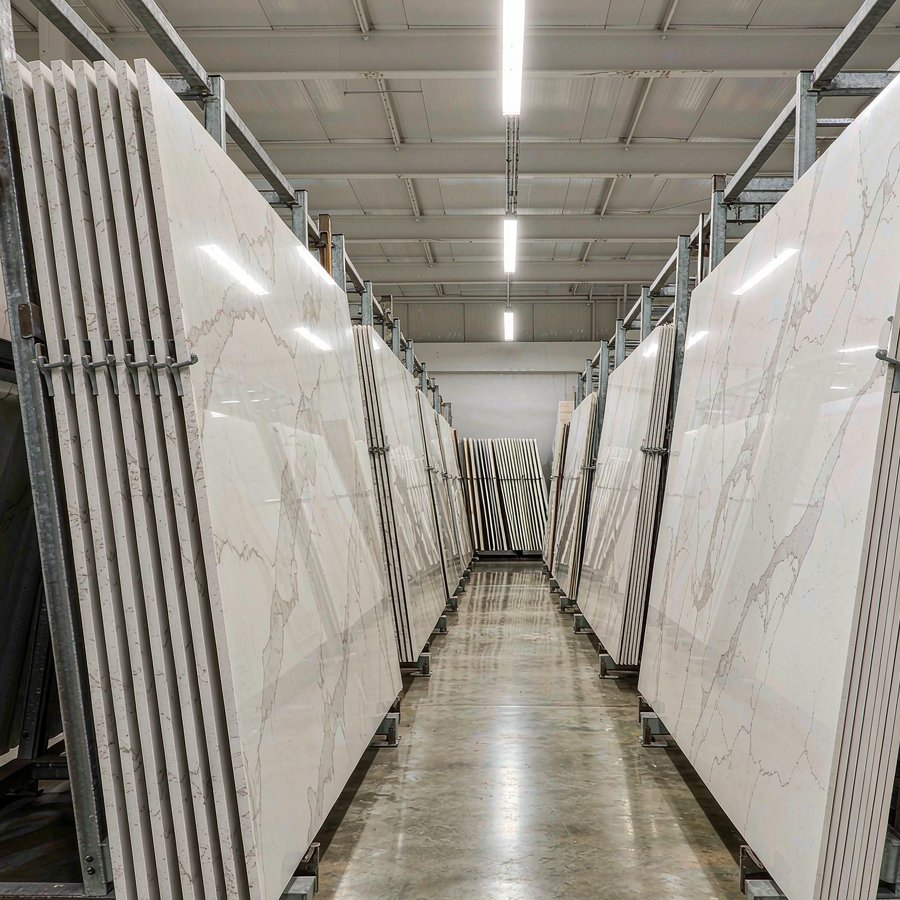
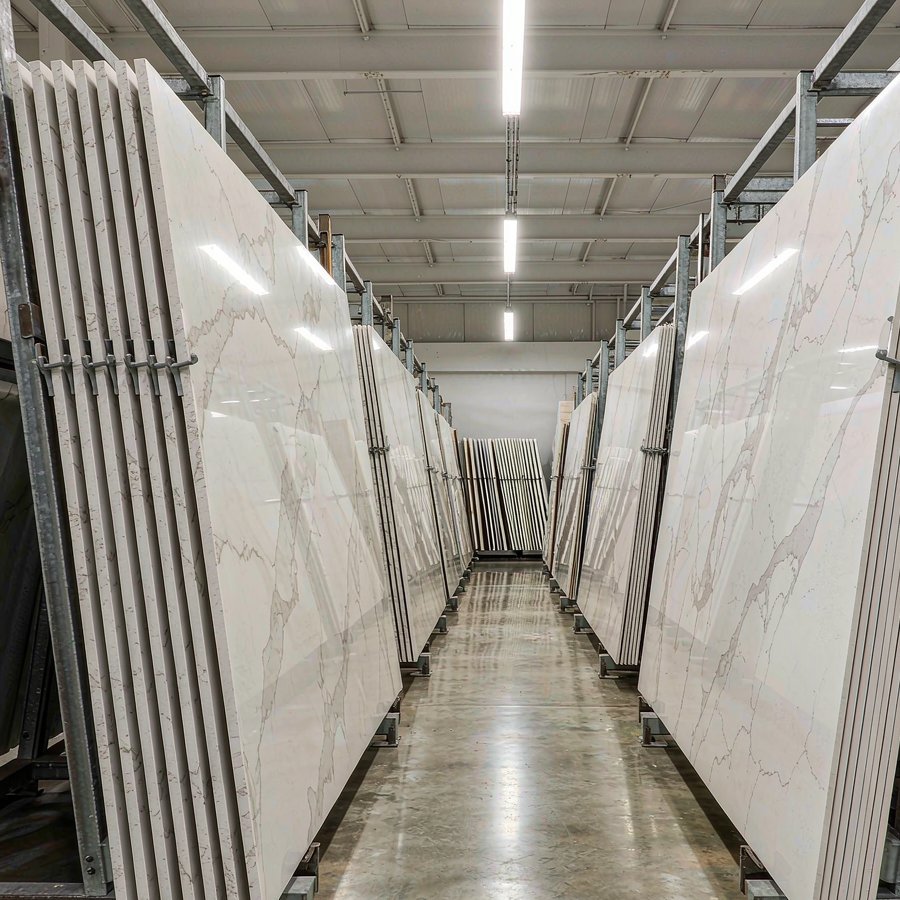
Specifiers now put engineered quartz, porcelain slab and sintered stone on the same sheet, and the quartz vs porcelain decision comes down to four things: what the surface is made of, how it behaves under heat and impact, how visible the seams are, and what the installed square metre costs. This guide compares all three from the production side — we press and finish engineered quartz slabs — and states plainly where porcelain wins and where engineered quartz is still the better specification.
Quartz vs Porcelain: The Short Answer
Engineered quartz is manufactured: roughly 90% crushed quartz aggregate bonded with resin and pigment, vacuum-vibrated, compressed and polished. Porcelain slab and sintered stone are fired mineral bodies — clay, feldspar and silica sintered near 1,200 °C into a dense, thin, vitrified sheet. That one difference explains almost everything else in a quartz vs porcelain comparison: the resin bond gives engineered quartz a thicker, impact-tolerant body that standard stone tooling can cut, while the fired body gives porcelain near-total heat and UV resistance at a third of the thickness.
So the useful question is never "which material is better?" but "which failure mode can this project tolerate?" A hotel bar top is damaged by impact and staining. A shower wall is damaged by almost nothing.
What Each Material Actually Is
- Engineered quartz — quartz aggregate with a resin binder and pigment, formed under vacuum vibration and pressure, then polished. Non-porous, 6 on the Mohs scale, moisture content around 0.02%, supplied at 18 mm and 20 mm.
- Porcelain slab — clay, feldspar and silica fired near 1,200 °C. The body is vitrified, with water absorption typically under 0.5%, usually supplied at 6–12 mm.
- Sintered stone — a commercial name, not a separate chemistry. It describes a very dense, pressed-and-fired mineral slab, and in most catalogues the products behind the label are porcelain-based. Ask for the body composition, not the label.
Treating sintered stone as a third material is how buyers end up comparing the same substrate twice. In a quartz vs porcelain comparison, body composition is the only fact that decides how the surface will age.
The Comparison at a Glance
Every quartz vs porcelain comparison reduces to four rows of this table: heat, impact, water absorption and slab size. Read it as trade-offs, not a scorecard — the material that is better on heat is worse on cut-outs, and the material that is better on cut-outs must be protected from pans.
Durability: Hardness, Chipping and Impact
Hardness is the least useful number in a quartz vs porcelain comparison, because it measures abrasion resistance, not impact resistance. A porcelain face resists a knife scratch better than a polished quartz surface — and then chips at the edge of a sink cut-out that a quartz slab would have survived.
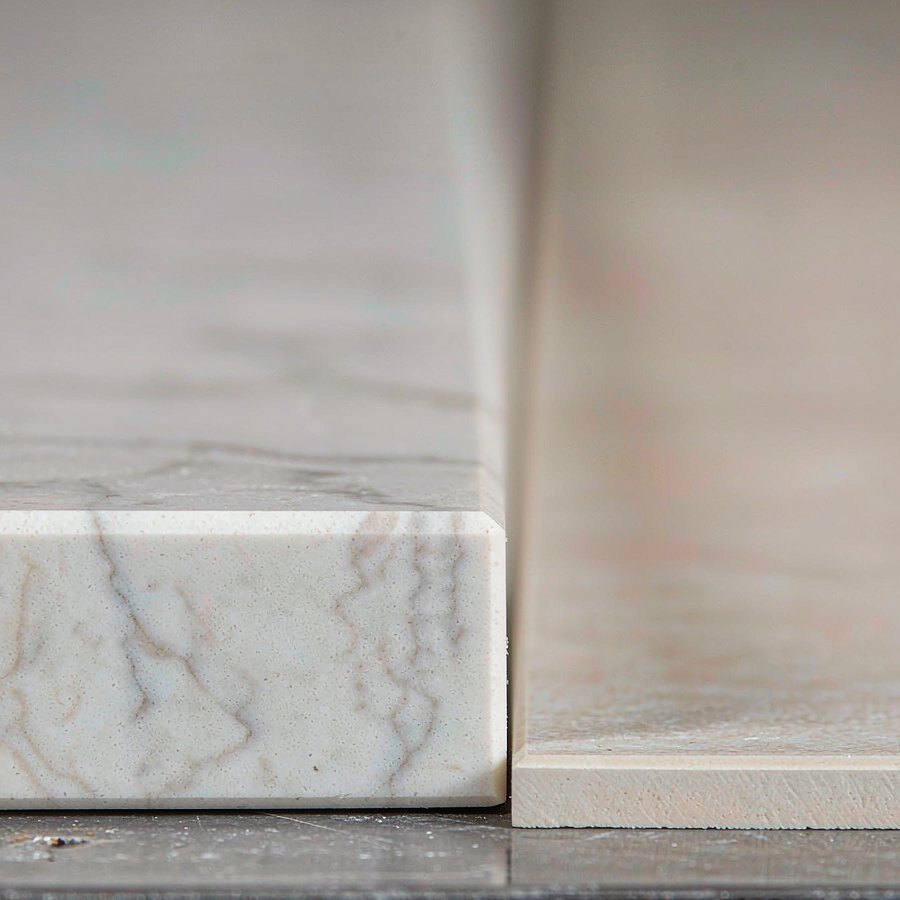
At 6 on the Mohs scale with moisture content around 0.02%, engineered quartz absorbs nothing and stains rarely. With an 18 mm or 20 mm body, that thickness is what makes it forgiving on a working counter: it tolerates the cut-outs, overhangs and daily knocks that a 6 mm porcelain edge does not. Light scratches on a polished quartz face can be polished out on site; a chipped porcelain edge cannot.
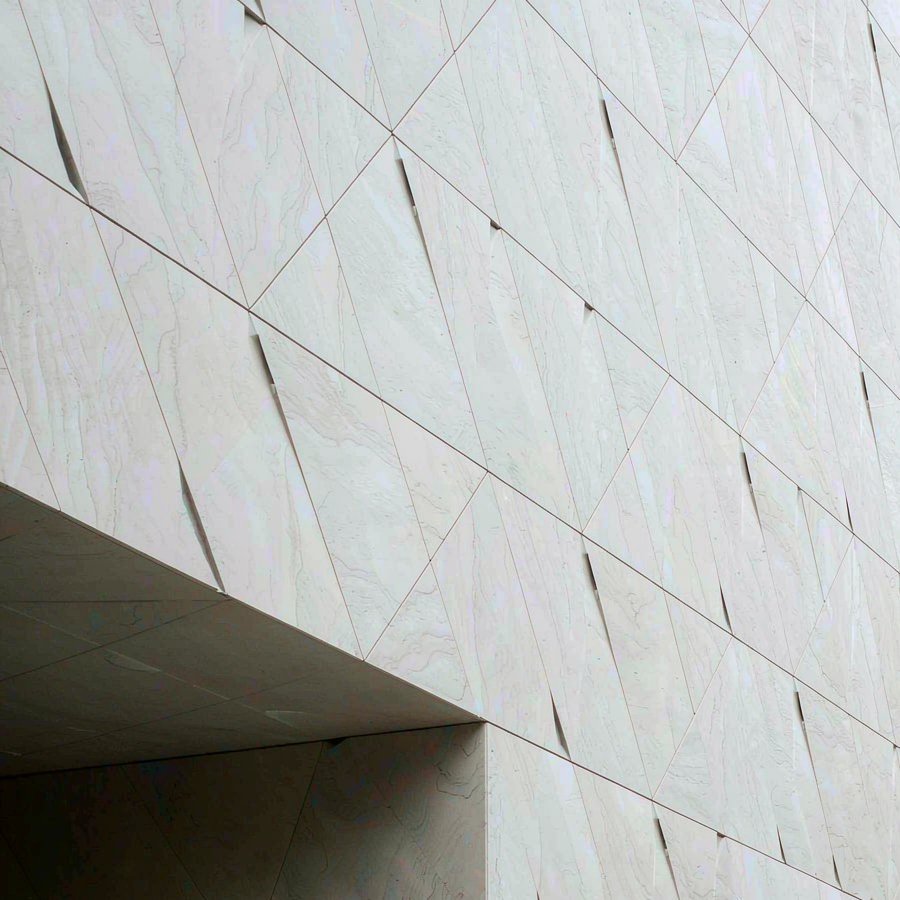
Porcelain wins on abrasion across vertical and low-traffic surfaces, and anywhere the material is bonded to a solid substrate so an edge can never be struck. That is why large-format porcelain dominates wall panels and facades, and engineered quartz still dominates working kitchen counters.
Heat and Stain Resistance
This is where buyers most often discover the difference too late. Engineered quartz is heat-resistant, not heat-proof. The quartz aggregate survives far more than the resin binder does: sustained heat above roughly 150 °C — a pan straight from the hob, a slow cooker left running — can dull the surface and leave a mark that polishing will not remove.
On heat, porcelain and sintered stone are the clear winner of any quartz vs porcelain comparison: fired near 1,200 °C, a hot pan is a non-event. On staining the gap narrows — at 0.02% water absorption engineered quartz is effectively non-porous, so wine, oil and turmeric wipe off — though any tiled porcelain installation adds grout lines, and grout is where stains actually live.
So the honest reading of a quartz vs porcelain comparison on heat is simple: porcelain wins on heat, engineered quartz wins on impact, cut-outs and edge behaviour. They are built for different kinds of abuse.
Cost and Total Installed Price
Comparing slab price per square metre is the most expensive mistake in a quartz vs porcelain decision. What matters is the installed cost, and it has six parts: material, fabrication, the off-cut and waste rate, transport and breakage, installation labour, and the expected repair cost over the life of the surface.
Porcelain is often cheaper per square metre as raw material and dearer to fabricate: thin bodies need diamond tooling and waterjet work, break more in handling, and need a flat, stable substrate — a cost that lands on the installer, not the supplier. Installed over an existing sound surface, large-format porcelain can still work out cheaper overall, because removal and rebuild are eliminated.
Engineered quartz costs more per slab, but fabrication is standard stone work, the 18 mm and 20 mm bodies survive transport better, and the waste rate on a 3200 mm slab is predictable. We do not publish prices: a quotation is built from format, thickness, finish, volume and Incoterm, and it is only comparable if it states all four.
Fabrication, Seams and Slab Formats
Seam count is decided at the drawing stage, and slab size decides it. Our engineered quartz is produced in 3200 × 1800 mm, 3200 × 1600 mm and 3200 × 750 mm formats, plus an oversized 1800 × 3500 mm slab for islands and full-height panel work, where fewer joints change the finished look. Thickness is 18 mm or 20 mm. Weight is published, not estimated: a 3200 × 1800 × 18 mm slab is approximately 248.8 kg, and the same format in 20 mm approximately 276.4 kg.
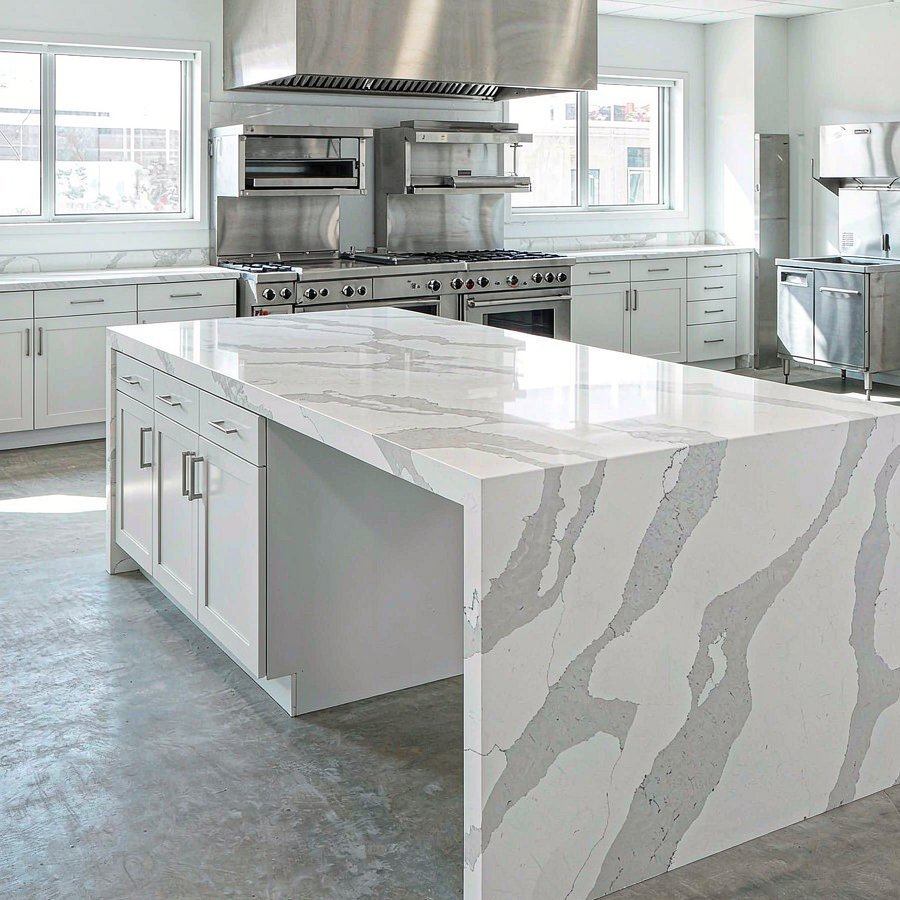
Porcelain slabs are thinner and lighter — easier to handle, cheaper to ship — but on a long run they produce more joints, and a joint in a 6 mm body is harder to disguise than one in a 20 mm body. That detail decides many quartz vs porcelain specifications on kitchen islands before cost is even discussed.
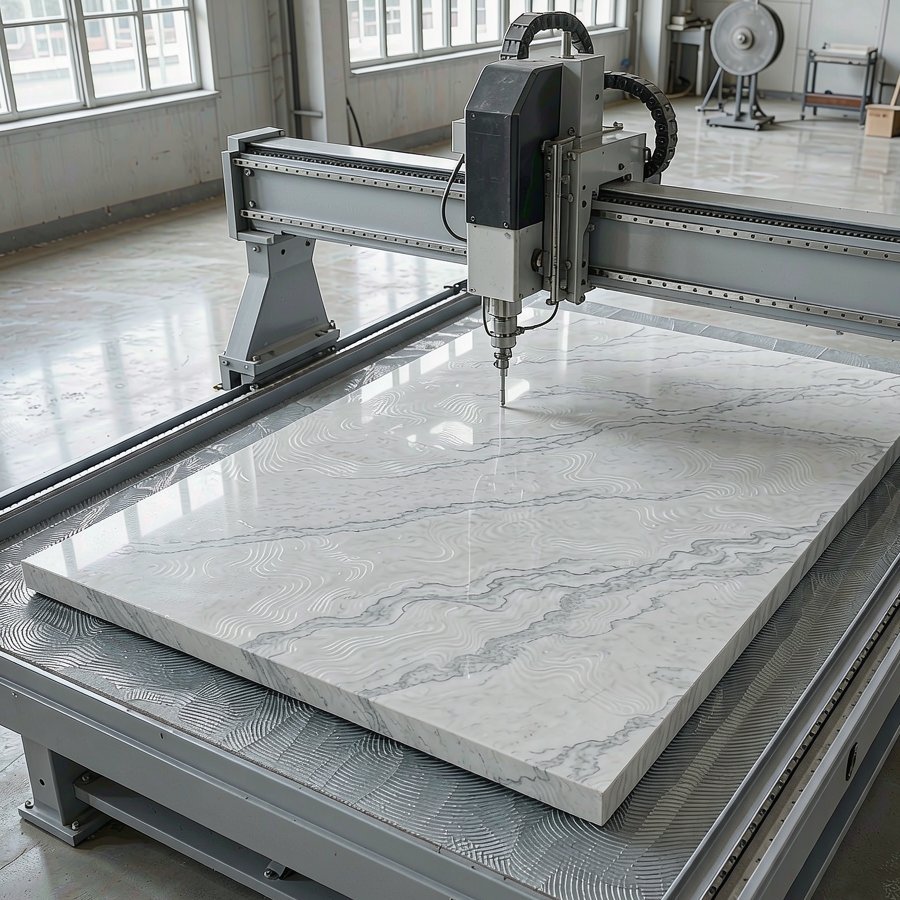
Cut-outs are the other quartz vs porcelain question to settle early. Sink and hob cut-outs concentrate stress, and a thin porcelain slab around a cut-out is the classic failure point in the category. Ask the fabricator who will handle the material, not the supplier.
Where Each Material Wins
The quartz vs porcelain decision is really a question about where the surface sits and what hits it:
- Kitchen counters, domestic and commercial — engineered quartz: impact tolerance, non-porous surface, cut-outs, standard fabrication.
- Bathroom walls, shower panels, feature walls — porcelain and sintered stone: no impact, no cut-outs, thin body saves weight.
- Outdoor kitchens, sun-exposed terraces, facades — porcelain and sintered stone win on UV stability, unless the quartz is specified as UV-stable. See our guide to using quartz countertops outdoors.
- High-traffic commercial counters — engineered quartz, which is why food-contact certification matters: our slabs hold NSF (food contact), SGS and ISO9001.
- Vanities, table tops, retail fixtures — engineered quartz, for edge detail and batch colour consistency.
Specifying for Trade Buyers: The Six-Line Brief
A quartz vs porcelain argument is almost always a brief that was never written down. Six lines prevent it:
- Material and body composition — engineered quartz, porcelain or sintered; ask for the declared crystalline silica content too, especially for Australia, the UK and parts of the United States.
- Format and thickness in millimetres — the exact slab size and the finished thickness, not "standard".
- Finish — polished or honed; the same design in two finishes reads as two different products.
- Edge profile and cut-outs — drawn, not described.
- Tolerance and batch colour control — a working range of ±0.5 mm on nominal thickness, measured across the slab rather than at one point.
- Packing standard and Incoterm — EXW, FOB or CIF, plus the crate spec, because packing quality decides whether the material arrives as ordered.
Our guide to buying engineered quartz slabs from China works through MOQ, samples, inspection and payment on the same six-line structure, and it is worth reading before the first container rather than after.
Common Mistakes and Myths
- "Sintered stone is a different material from porcelain." Usually it is not — it is a denser, pressed-and-fired slab from the same family.
- "Harder is better for a worktop." Hardness resists scratching; it does nothing for impact, cut-outs or fabricability.
- "Porcelain is always cheaper." Cheaper per slab, often dearer installed — compare the installed square metre, the only quartz vs porcelain number that means anything.
- "Quartz is heat-proof." It is heat-resistant. A hot pan will mark it, and the mark does not polish out.
- Choosing thin porcelain for a worktop with cut-outs without confirming the fabricator's tooling and substrate. That is where the category gets its reputation for cracking.
Frequently Asked Questions
Is porcelain more durable than quartz?
It depends on the damage. Porcelain is harder and far more heat-tolerant, so it resists scratching and hot pans better. Engineered quartz is more durable against impact, edge chipping and sink or hob cut-outs, and its non-porous body resists staining without a glaze. On a working kitchen counter, a quartz vs porcelain comparison is settled by impact and cut-outs — the failure modes that actually occur.
Is porcelain more expensive than quartz?
As raw material, porcelain is often cheaper per square metre; installed, it can be more expensive, because thin bodies need diamond tooling and waterjet cutting, demand a flat substrate, and break more in handling. Compare the installed square metre, not the slab price.
What is the difference between porcelain and quartz?
Engineered quartz is a manufactured slab: quartz aggregate bonded with resin, compressed and polished, typically 18–20 mm thick. Porcelain is a fired mineral body — clay, feldspar and silica sintered near 1,200 °C, usually 6–12 mm thick. One is bonded, the other fired, which is why one tolerates cut-outs and the other tolerates heat.
Is sintered stone the same as porcelain?
In commercial use the two terms overlap heavily. Sintered stone describes a very dense pressed-and-fired mineral slab, and most products sold under that name are porcelain-based. Ask for the body composition, the firing data and the slab thickness rather than relying on the label.
Which is better for a kitchen worktop: quartz or porcelain?
Engineered quartz, in most kitchens. A worktop collects impact, stains and sink and hob cut-outs, which is exactly where a thick non-porous body is the advantage — provided the surface is protected from hot pans. Porcelain is stronger on a wall panel, a facade, or any surface never struck at the edge.
Conclusion
There is no single winner in the quartz vs porcelain question, and any supplier who claims one is selling a material rather than solving a problem. Porcelain and sintered stone win wherever heat and abrasion dominate and edges are protected — walls, facades, sun-exposed surfaces. Engineered quartz wins wherever the surface is worked on: kitchen counters, commercial counters, vanities and retail fixtures, where impact, cut-outs and staining decide the outcome and a 3200 mm slab in an 18 mm or 20 mm body keeps the seams down.
Porcelain and sintered stone are not the only materials quartz is quoted against. Our guide to quartz vs solid surface covers the cast acrylic family, including Corian, on the same grounds — hardness, heat, seams and whether the surface can be refinished.
Material thickness interacts with the surface you choose — our quartz slab thickness guide compares 18mm and 20mm for countertops and walls.
Related Articles
- Quartz vs Marble: Which Is Better for Kitchen Countertops?
- Quartz vs Granite: Pros and Cons for Project Use
- Quartz That Looks Like Taj Mahal: Quartzite Alternatives
- Is Engineered Quartz Stone Safe and Eco-Friendly?
Comparing Materials for a Project? Send Us the Brief
We press and finish engineered quartz slabs in-house for importers, fabricators, distributors and project buyers — from marble-look designs such as Marble Golden Thread to dark statement slabs at 3200 × 1800 mm and oversized 1800 × 3500 mm, in 18 mm and 20 mm. Send the format, thickness, finish, colour direction and volume — plus whatever quartz vs porcelain question your application raises — and we will come back with a loading plan, the technical data sheet, current ISO9001, NSF and SGS certificates, and an indicative quotation.
📱 WhatsApp: +86 198 6115 3736
📧 Email: raykelee@hyquartzslabfactory.com
Send Us A Message