
Quartz Countertop Sink Cutout: Undermount vs Topmount Sizes and Tolerances
Quartz Countertop Sink Cutout: Undermount vs Topmount Sizes and Tolerances
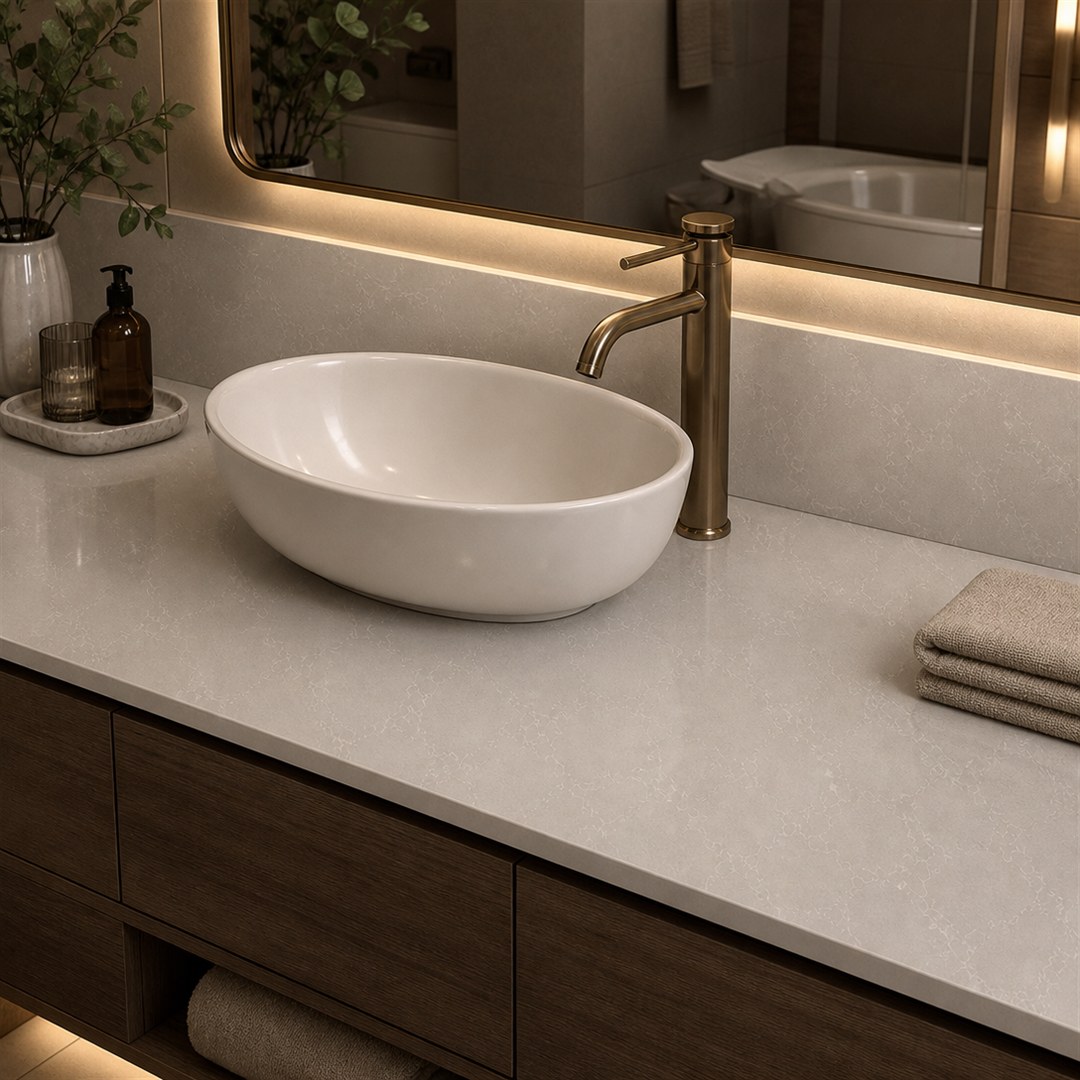
The quartz countertop sink cutout is the single most mis-specified detail in an imported quartz order, and it is the one that gets discovered far too late — when the slab arrives and the hole does not match the basin sitting in your warehouse. A cutout is not just a hole in stone. It is a decision about how the basin meets the surface, how much material is removed, which edges get finished, and how the whole assembly behaves once it is bonded and filled. Get it specified correctly at quotation stage and the fabrication runs cleanly. Get it wrong and you pay for a second slab, a second cutout, and a delivery delay of weeks.
This guide covers the two cutout families you will be offered, the dimensions that matter, and the specification language to put on your purchase order so the factory cuts exactly what your fabricator expects.
Undermount vs Topmount (Vessel): The Two Cutout Families
Every sink cutout belongs to one of two families, and the choice cascades through edge finishing, sealant work, and cleaning requirements.
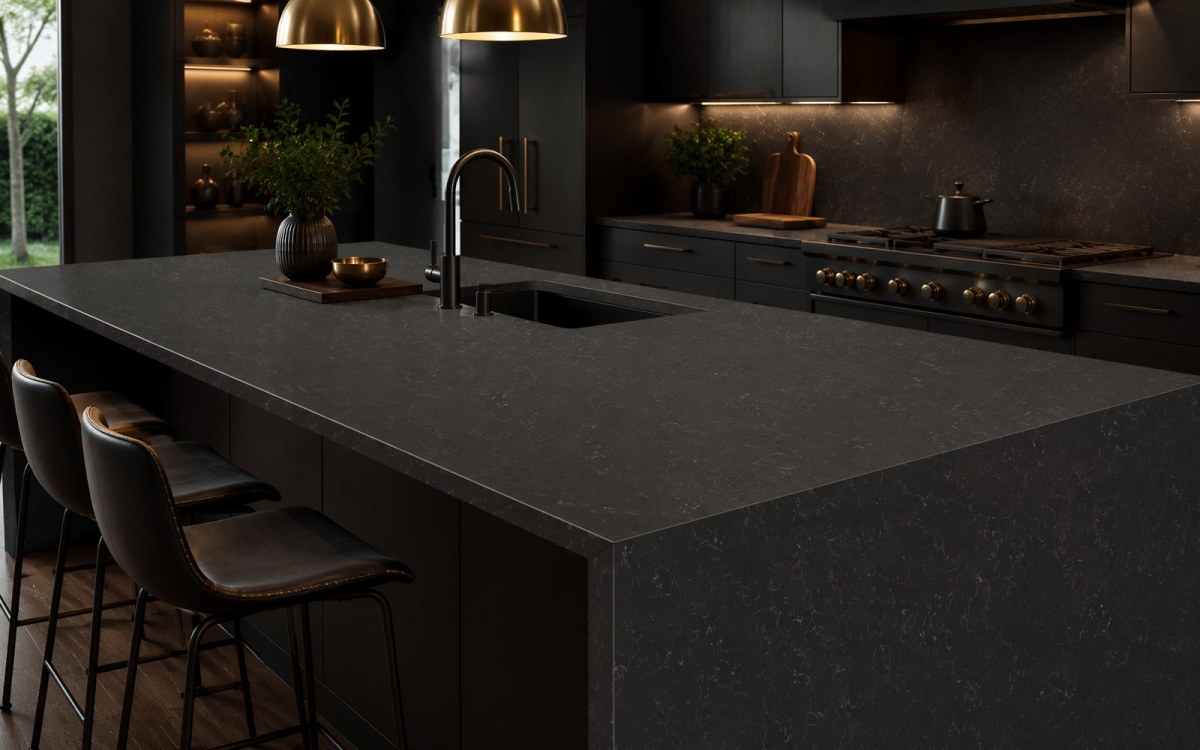
- Undermount (under-counter) — the basin is mounted underneath the stone, so the slab shows an open rectangular hole with the basin lip concealed. This is the standard for quartz countertop sink cutout work in kitchens because it keeps water off the surface and makes wiping the counter a single flat motion. It also puts the seam entirely out of sight.
- Topmount (drop-in / vessel) — the basin sits on top of the stone, with its rim resting above the surface. Simpler to install and cheaper to produce, but the rim catches water and creates a visible joint line you clean around daily.
Our quartz vanity tops sizes and sinks guide covers the basin size ranges that pair well with each cutout family in a bathroom context, which is where undermount dominance is strongest.
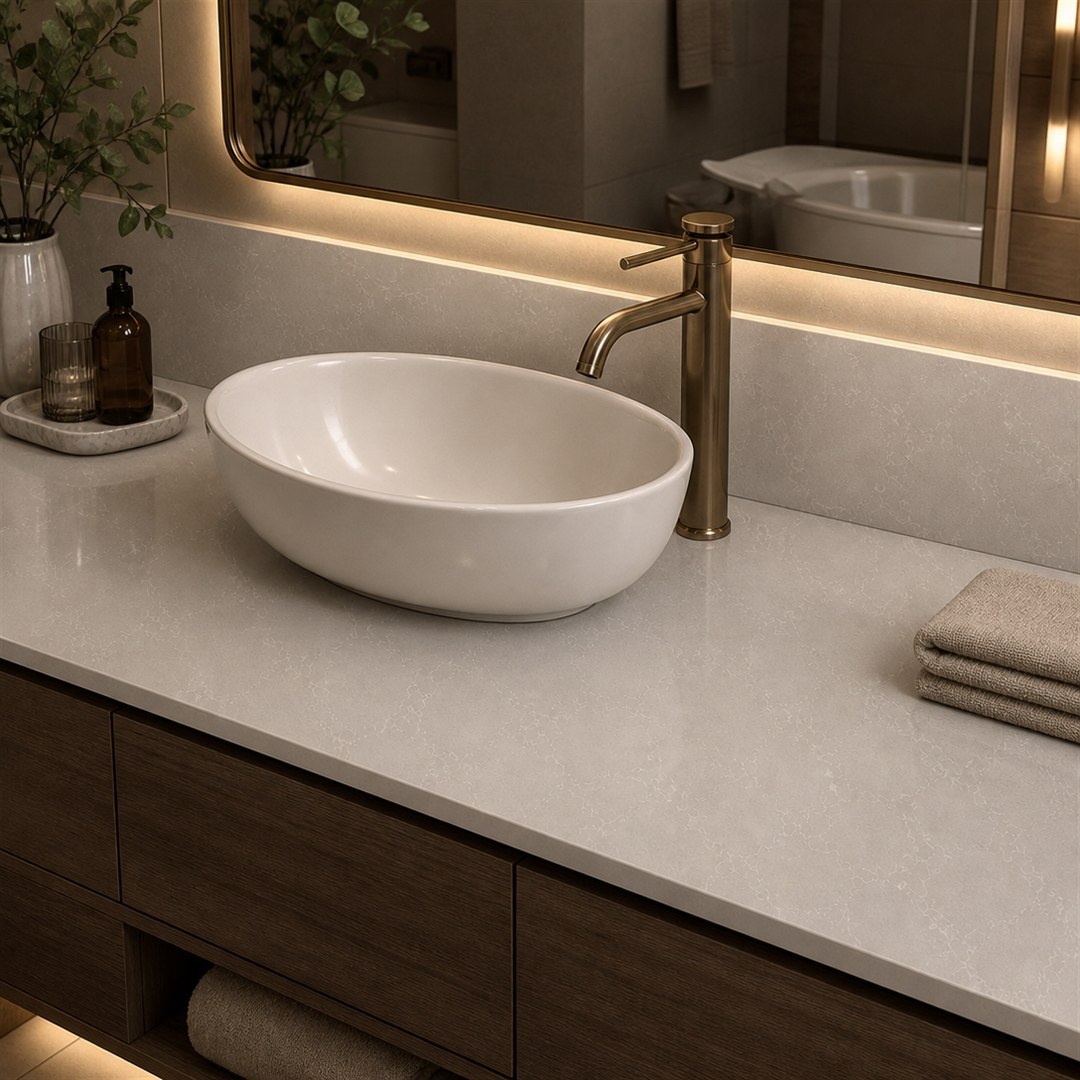
The Three Measurements That Decide the Cutout
Quotations go wrong because buyers give a basin brand name and expect the factory to know the dimensions. Here are the three numbers that must appear on your order.
1. Cutout Size (W x D)
The cutout is always smaller than the basin outer rim, so the rim overhangs and rests on the slab. A typical kitchen single bowl undermount takes a cutout of roughly 540 x 400 mm for a 550/560 mm bowl. Oversizing the cutout is the dangerous mistake: if the cut approaches the basin width minus the minimum support ledge, the slab loses its support under the load of a filled sink.
2. The Support Ledge / Rim Width
Always confirm how much stone remains between the cut edge and the outer slab edge or the wall splashback. For a standard 600 mm deep countertop, a minimum 60 mm support ledge is the practical floor on the front and back sides. Front ledges narrower than this crack under load in normal use — the same quartz that handles a full pot on a counter will not survive a cantilevered basin lip with no support beneath it.
3. Corner Radius and Polished Edge
Standard cutouts use a 10 mm internal radius or a square corner with a radiused transition. Internal corners in quartz must be drilled or diamond-routed to a minimum 10 mm radius — square internal corners create a stress riser and will chip during installation or later under thermal shock. Whether the cut edge itself is polished, eased, or left raw is a separate instruction, and for undermount the raw cut is often preferred because the basin covers it.
What to Put on the Purchase Order
Most quartz cutting disputes trace back to one sentence of ambiguity. Specify in this order:
- Cutout family — undermount or topmount.
- Exact cutout dimensions in mm, width first then depth, measured centre to edge.
- Basin model — the manufacturer and part number, not just a description.
- Internal corner radius — R10 minimum.
- Edge treatment on the cutout — raw, honed, or polished.
- Tap hole and waste position — single hole, rear hole, or tap hole with the drain 60 mm behind centre.
Our quartz edge profiles spec guide maps eased, bevel, bullnose and ogee to real applications, including which profiles pair acceptably with an undermount reveal.
Cutouts on Full Slabs vs Cut-to-Size Pieces
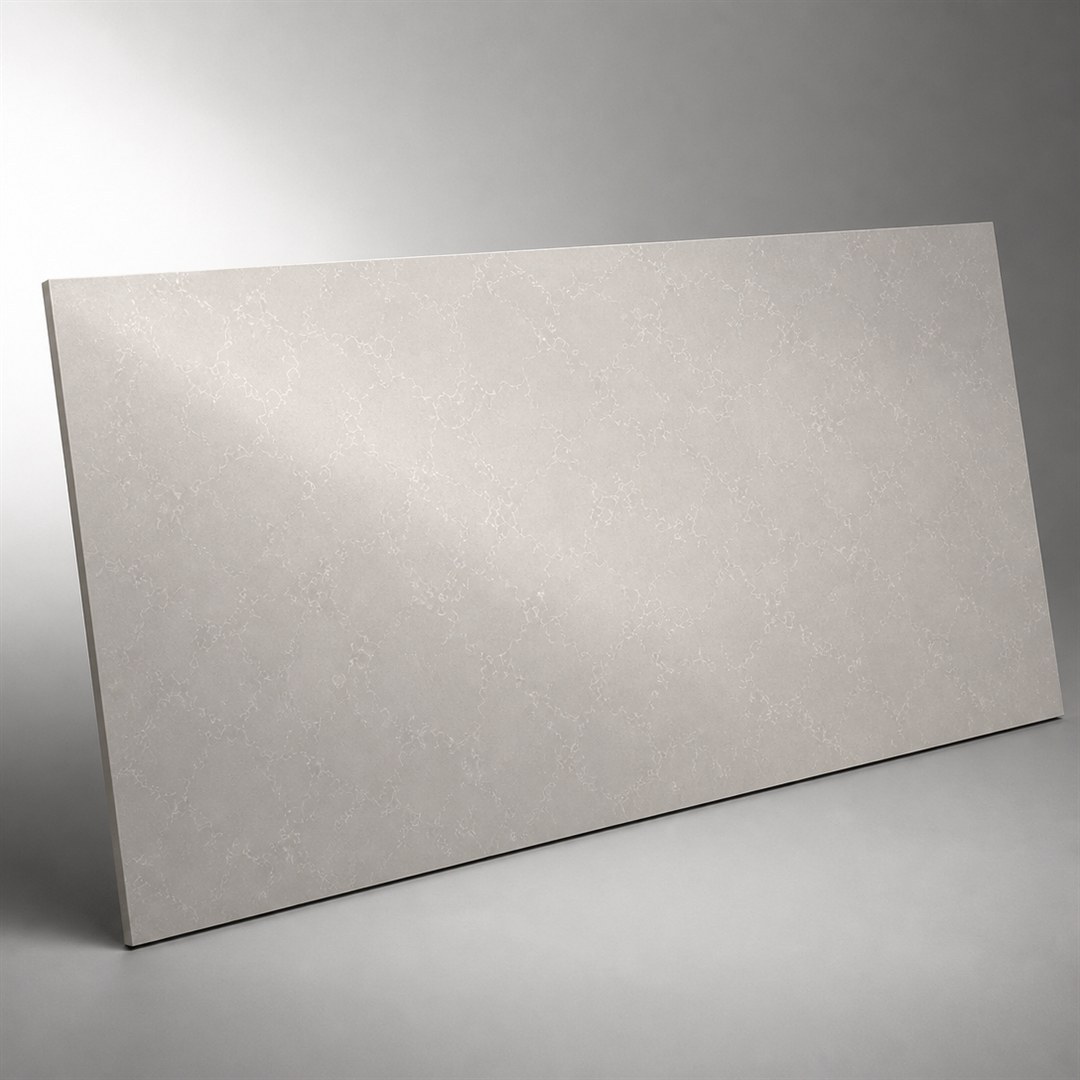
If you are buying full jumbo slabs for a project, cutouts are almost always machined at your fabricator rather than at the factory, because the cutout position depends on the actual vein layout of the slab you received. If you are buying cut-to-size pieces, the factory can machine the cutouts before shipment — which is worth asking for on projects where the countertop template is already fixed.
Our quartz slab sizes and jumbo formats guide covers the standard slab dimensions these decisions are made against, including which sizes carry cutouts most efficiently in a full-container order.
The practical reason to cut at the factory is verification: you receive the pieces with the openings already finished, can inspect them in person, and reject before installation. The reason to cut locally is vein matching on a full slab. For sink cutout work specifically, most projects do local cutting because the basin position relative to the vein is an aesthetic decision made after seeing the slab.
Common Mistakes We See on Import Orders
Oversized cutouts. The buyer reads the basin inner dimension instead of the cutout dimension. The cut weakens the slab and the install fails.
Square internal corners. Specified as a 90 degree corner in the drawing, routed to a sharp corner in production, then chipped on site. Require R10 minimum in writing.
Tap hole direction mismatched to the faucet. A rear tap hole with a centre-mount faucet wastes the tap deck, or forces the faucet too close to the bowl. Confirm the hole pattern against the actual faucet drawing.
Cutout requested on the slab, template later changed. Once cut, it cannot be undone. Freeze the template before cutting, and confirm the finished wall dimensions not just the nominal ones.
No specification of the reveal. Undermount basins need a small clearance for silicone movement — typically 3 to 5 mm per side. Specifying zero clearance produces a jammed basin that cannot be removed for repair.
Why Slab Thickness Changes the Cutout Decision
A quartz countertop sink cutout is also a thickness decision. On 18 mm slab the cut edge is thinner and the support ledge requirement grows proportionally; on 20 mm the same basin allows a slightly larger cutout for the same ledge width. Many fabricators will not cut an undermount narrower than a certain internal radius precisely to protect the thin edge. Our 18mm vs 20mm slab thickness guide breaks down how thickness interacts with cutouts, splashbacks and unsupported overhangs.
For waterfall designs, thickness affects the visible mitre and the strength of the cut return — both worth settling at the same time as the cutout itself. Our waterfall countertop book-match guide covers that coordination.
How to Get the Cutout Right on Your First Order
Send your fabricator template, not a basin catalogue page. A template carries the finished wall dimensions, the basin part number, the tap hole position, and the edge profile — the four inputs the factory needs. Where the basin is not yet purchased, approve the countertop after the basin, never before.
Our custom cut quartz slabs for project installation guide covers how template files are prepared and confirmed before cutting.
When you request a quote, state the cutout requirement as a line item in the order. A price quoted per slab with no cutout definition is a price that excludes the machining risk — and a cheaper quote that excludes it will not be cheaper by the end.

Frequently Asked Questions
What is the minimum internal radius for a quartz sink cutout?
R10 minimum, drilled or diamond-routed. Some fabricators specify R15 or R20 for undermounts to further reduce stress risers and improve the fit against the basin rim.
Can I move a cutout after the slab has been cut?
No. Once machined, the slab is scrap for countertop use. This is the reason every dimension should be frozen against a verified template before production rather than adjusted on site.
Does the cutout affect the slab price?
It should, and the machining cost should be visible as a separate line in the quotation. Some suppliers absorb it, some price it per cutout, some exclude it entirely — and only the third option will come back as a change order later.
Should the cutout edge be polished for an undermount?
Rarely necessary. The basin covers the cut edge, so a raw or honed edge is typical and slightly cheaper. Polished edges make sense for topmount and for exposed waterfall cuts where the edge is visible.
How much clearance around an undermount basin?
3 to 5 mm per side is standard, which allows for silicone movement and thermal expansion. A larger cutout with a wider support ledge is a better solution than minimal clearance.
Send Us A Message