
Quartz Waterfall Countertops & Book-Matched Islands: A Slab Layout Guide
Quartz Waterfall Countertops & Book-Matched Islands: A Slab Layout Guide
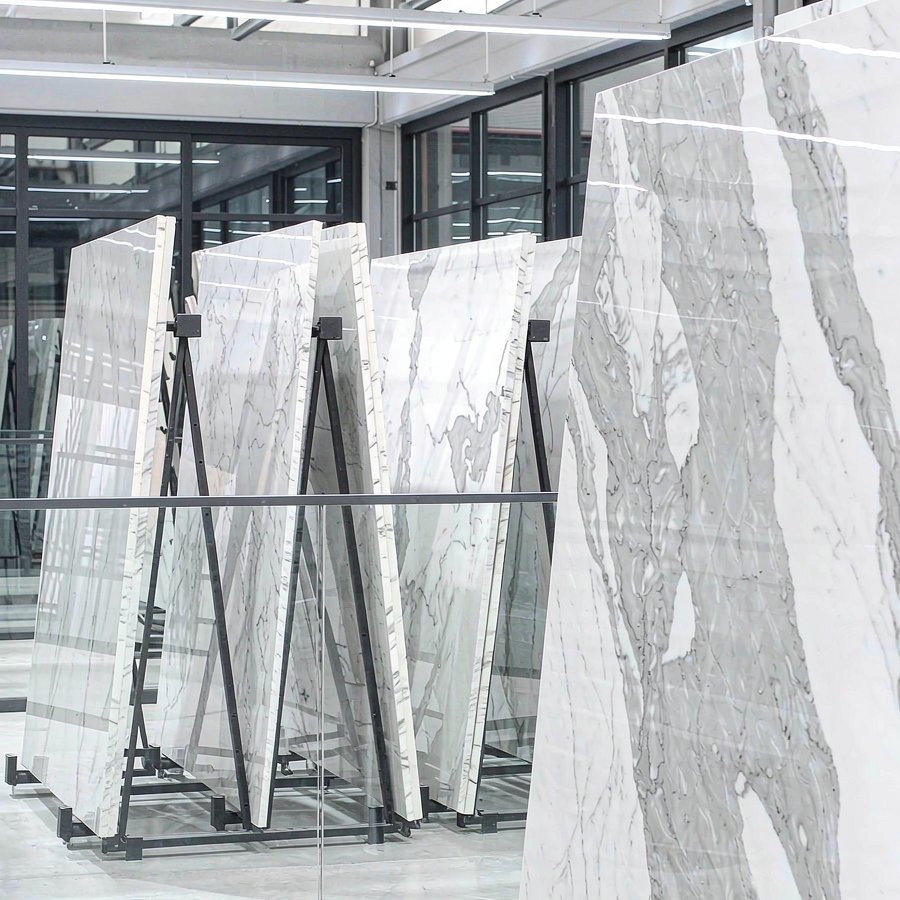
A quartz waterfall countertop is a slab that runs across the top of a kitchen island and then folds straight down the side to the floor, turning the cabinet edge into a vertical face of the same stone. It is the single most requested premium detail in new kitchen design, and it is also one of the most misunderstood, because a true waterfall is decided long before fabrication — it is a slab-layout problem, not just an edge problem. This guide explains how a quartz waterfall countertop is planned and produced in a factory: how the island is measured, how many slabs the layout needs, how book-matching turns two slabs into one mirrored pattern, and what actually drives the cost. The numbers below come from our own cutting and polishing lines, where waterfall islands ship alongside full slabs every week.

What Exactly Is a Quartz Waterfall Countertop?
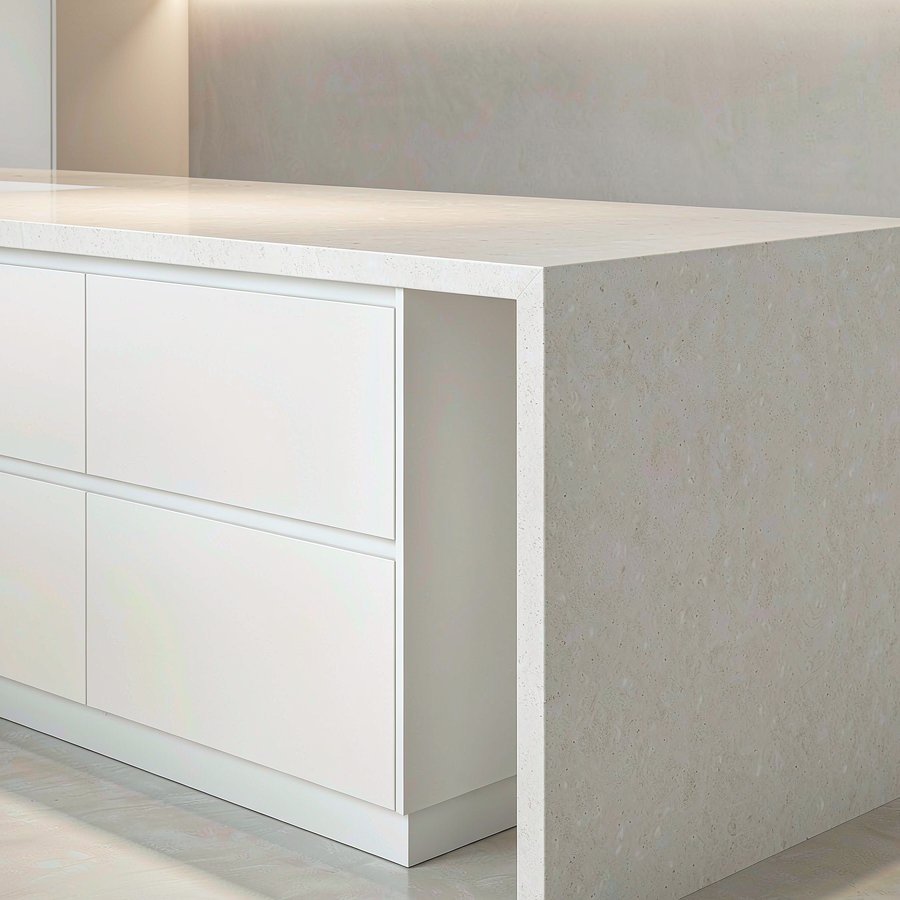
The defining feature of a quartz waterfall countertop is the vertical drop. On a standard island the worktop simply overhangs the cabinet and stops at a thin finished edge. On a waterfall island the slab continues past the edge and runs down the side panel until it meets the floor (or a recessed plinth), so the eye reads one continuous piece of stone wrapping the island. The effect can be one-sided — only one end of the island drops — or two-sided, where both ends fall to the floor and fully enclose a free-standing island. A quartz kitchen island waterfall with two falling ends is the more dramatic version and the one most often photographed in design magazines.
Mechanically, the waterfall face is not a separate glued-on panel that happens to look similar. It is the same slab, cut and mitered so the vein travels without interruption from the horizontal top onto the vertical face. That continuity is the whole point, and it is why the planning has to start at the slab-selection stage rather than at the installer’s truck. Because of that, a high-quality quartz waterfall countertop is usually ordered as a complete island kit, not as a loose slab.
Why Specifiers Choose a Waterfall Edge
There are several reasons a quartz waterfall countertop keeps winning specifications in both residential and hospitality projects:
Design continuity. The stone becomes the furniture, not just the surface. A quartz kitchen island waterfall reads as a single sculpted object in the middle of the room, which is exactly the look high-end kitchens are after.
Protection for the cabinet end. The exposed end of an island takes the most knocks from trolleys, hoovers and feet. A stone face there is far more durable than a painted or veneered panel.
Hiding storage and appliances. Many waterfall islands wrap a bank of drawers, a wine fridge or a bin cupboard. The continuous stone front hides the seams and hardware that would otherwise break up the design.
Resale signal. In the resale market a waterfall edge reads instantly as “upgraded”, which is why developers specify it even on mid-range units. That combination of practicality and status is why the quartz waterfall countertop has moved from luxury showrooms into mainstream specification.
Planning the Slab Layout for a Quartz Kitchen Island Waterfall
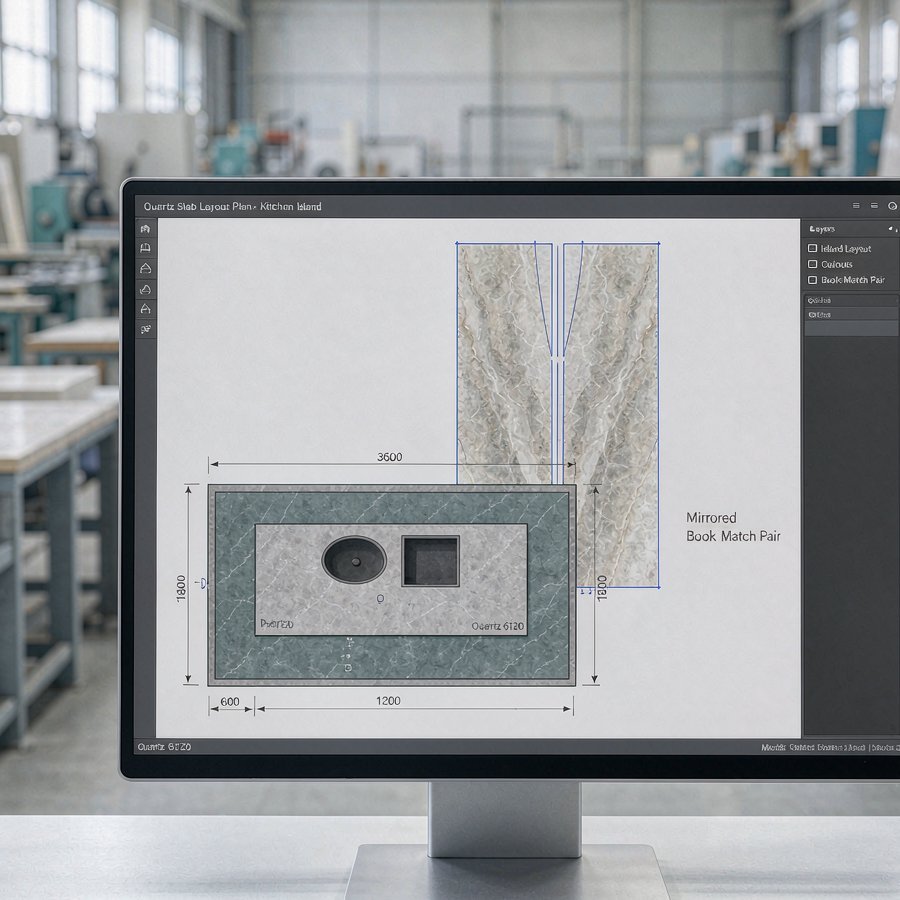
The mistake most people make is treating the waterfall as an edging afterthought. In reality the layout is a two-dimensional nesting puzzle on the slab. Take a common island: 2400 mm long × 1000 mm deep, with a 900 mm waterfall dropping on each end. You need one horizontal top (2400 × 1000 mm) and two vertical faces (1000 × 900 mm each). Lay those shapes out on a standard slab of 3200 × 1600 mm or 3200 × 1800 mm and you can usually nest the top plus one end on a single slab; the second end often needs a second slab or very careful placement. Our full slab sizes and jumbo formats guide covers the exact footprints and how jumbo slabs change the maths.
Two practical rules follow. First, the waterfall faces consume slab area you would never need on a standard overhang, so a quartz waterfall countertop almost always uses more material than the same island with a plain edge. Second, if you want the vein to flow across the top and down the face without a visible jump, the cut orientation of the top and the waterfall panel has to be planned together — which is the bridge into book-matching. Getting this layout wrong is the fastest way to turn a profitable quartz waterfall countertop into a material-loss job.
Book-Matched Quartz — One Pattern, Mirrored Across Two Slabs
Book-matching is the technique that makes a waterfall island look intentional rather than assembled. When slabs are cut from a block, adjacent slices are opened like the pages of a book; the veins on the two faces mirror each other at the join. A book matched quartz installation places those two mirrored slabs so the seam disappears into the symmetry. On a quartz waterfall countertop the book-match is most often done at the top-to-waterfall seam (the vein appears to flow continuously down the face) and, on two-ended islands, between the two falling ends.
The mirror is only possible when the factory controls the cut sequence and the orientation of each slab. Random slab stock cannot be book-matched after the fact. That is why book matched quartz slabs are produced and labelled as pairs, and why a custom pattern developed for a project — the kind we describe in our custom quartz colour guide — gives the cleanest result, because the vein is designed to mirror from the first cut. For a premium quartz waterfall countertop, the factory therefore treats the pair as a single matched set from selection through packing.

Which Vein Styles Book-Match and Waterfall Best
Not every design book-matches equally. Bold, directional veins mirror dramatically; very subtle cloud patterns can look almost the same whether matched or not, which wastes the effort. The designs in our range that perform best on a quartz waterfall countertop:
Gold Vein and Cloud Jade Gold Vein. Pure white with a deep brown-gold diagonal vein — the Calacatta Gold look. The strong diagonal mirrors cleanly and reads as luxury the moment the island is photographed. See the Gold Vein slab and the Cloud Jade Gold Vein slab.
White Realm Black Mark. White with black flowing veins — a Calacatta Viola character. The high contrast makes the mirror obvious and is a favourite for dramatic two-ended islands. View White Realm Black Mark.
Obsidian Gold Mesh. Deep black with gold veining for clients who want the waterfall to be the dark anchor of the room rather than the bright one. View Obsidian Gold Mesh.
Marble Golden Thread. Soft white with a quiet grey-gold movement — the closest we make to the Taj Mahal feel — for a calmer, more restrained waterfall. View Marble Golden Thread. The right vein turns a standard island into a statement, which is the reason many designers choose the quartz waterfall countertop over a conventional edge.
Cost Drivers of a Quartz Waterfall Countertop
The question we are asked most is simply “how much does a quartz waterfall countertop cost?” The honest answer is that it is quoted per project, because the waterfall premium is not a single line item — it is the sum of several factors:
Extra slab area. The vertical faces are real stone you would not need on a plain edge, so material goes up with every waterfall end.
Book-match pairs. A book-matched island usually consumes two sequenced slabs instead of one, and the off-cuts from the mirror cannot always be reused.
Mitred joinery and edge return. Cutting the 45° miter, polishing the returned edge and achieving an invisible seam takes more fabrication time than a standard pencil edge.
Thickness build-up. A thick-looking waterfall face is typically laminated, which doubles the edge material on the falling panel.
Edge profile. A complex ogee or miter on the waterfall adds polishing time per metre.
Our quartz slab price guide breaks down what moves the base price of a slab; the waterfall simply multiplies the relevant factors by adding faces, pairs and joinery. We quote each island from its drawing rather than from a rate card, because two islands that look identical in a showroom can use very different slab layouts. All of this means a quartz waterfall countertop quote is only as good as the drawing it is based on.
Thickness, Support and the Seamless Mitred Joint
Most quartz ships at 18 mm or 20 mm. On a quartz waterfall countertop the visible thickness is usually built by lamination — two pieces are glued so the edge reads as 36 mm or 40 mm — because a single 20 mm slab would look thin against a large island. The waterfall face is laminated the same way, so the vertical thickness matches the top.

The seam that matters most is the mitre where the top meets the falling face. Both pieces are cut at 45° and joined so the stone appears to fold as one block. Precision here is everything: a misaligned vein or a visible adhesive line ruins the illusion, so the joint is cut on CNC, dry-fitted, and only bonded once the vein aligns. Behind the overhang, the cabinet must carry the load — a quartz waterfall island is heavier than it looks, and the supporting frame is part of the drawing we review before production. The weight and precision required explain why a quartz waterfall countertop should be fabricated by a shop with CNC mitring experience rather than templated on site.
How We Run a Waterfall & Book-Match Order
A quartz waterfall countertop order in our factory follows a fixed sequence so nothing is left to chance:
1. Receive the island drawing. We need the overall length and depth, the overhang, which ends fall, the sink and tap positions, and the edge profile.
2. Nest and select. The top and waterfall faces are nested on the slab; for book-match we pull the correct adjacent pair and label it.
3. Cut and mitre. CNC cuts the top, the 45° mitre and any sink cut-outs; the edge is polished to the specified profile.
4. Number and pack. Panels are labelled in assembly order so the installer cannot mix up the mirrored pair, then packed for export. Standard orders run on a 2–4 week lead time; bespoke vein-matching or custom colours add time, as set out in our custom quartz guide. This controlled workflow is what lets us promise a consistent quartz waterfall countertop finish even on container-volume orders.
Quartz Waterfall vs Other Stones
A quartz waterfall countertop is often compared with granite, marble and porcelain. Granite can waterfall and book-match too, but it is heavier and every slab varies, so matching pairs is harder. Marble etches and stains in a working kitchen, which removes it from most busy-island specifications despite the look. Porcelain can be printed with a matching vein but ships thin, so the waterfall edge has to be built up differently and the corner radius is limited. Quartz sits in the practical middle: consistent, non-porous, predictable for book-match, and strong enough for a full-height island without special framing. For importers and fabricators, that predictability makes the quartz waterfall countertop the safest premium detail to stock and sell.
Frequently Asked Questions
How much does a quartz waterfall countertop cost?
It is quoted per project. The premium over a standard edge comes from the extra slab area of the falling faces, any book-match pairs, the mitred joinery and the edge build-up. Send us the island drawing and we will price the exact layout rather than guess from a rate card.
Can you book-match quartz slabs?
Yes. Book matched quartz is standard for premium islands when the factory controls the cut sequence. We produce and label the mirrored pair so the seam disappears into the symmetry, and we can design a custom vein specifically to mirror from the first cut.
Do I need a jumbo slab for a kitchen island waterfall?
Not always. A 3200 × 1600 mm or 3200 × 1800 mm standard slab covers many single-end islands; a two-ended waterfall or a book-match pair often needs two slabs nested together. The layout drawing decides it.
Is 18 mm or 20 mm better for a waterfall edge?
Both work. The visible thickness is usually built by lamination, so the choice is mostly about total weight and cabinet support. 20 mm gives a marginally sturdier feel; 18 mm is lighter to handle and pack.
How long does a custom book-match quartz order take?
A standard waterfall island runs on our normal 2–4 week lead time. Bespoke vein-matching or a custom colour adds time because the slab sequence and sometimes the pattern itself are developed for the project.
Conclusion
A quartz waterfall countertop is won or lost at the layout stage, not on the installer’s bench. Get the slab count, the book-match pair and the mitre right before the first cut and the island looks like one continuous stone; get them wrong and no amount of polishing hides it. If you are specifying a waterfall island — single or two-ended, book-matched or plain — send us the drawing and we will return a priced layout, a recommended vein style and a production slot. For bathroom-scale work the same logic applies to our quartz vanity tops program, and for the underlying cost maths see our quartz slab price guide.
Waterfall islands depend on mitred edges — see the quartz edge profiles spec guide for how mitred, ogee and eased profiles are fabricated.
Related Articles
- Quartz Slab Sizes and Jumbo Formats Explained
- What Actually Drives Quartz Slab Price
- OEM & Private Label Custom Quartz: How Colours Are Developed
- Quartz Vanity Tops: Sizes, Sinks & Edge Profiles
Custom quartz, made to your slab layout. We manufacture quartz waterfall countertop islands, book-matched panels and full slab programs for distributors, fabricators and project buyers — from a single nested island to container-volume repeat orders. Tell us the drawing and the look you want; we return a priced layout and a production slot.
WhatsApp: +86 198 6115 3736
Email: raykelee@hyquartzslabfactory.com
Send Us A Message