
Hardness and Wear Resistance Advantages of Engineered Quartz
Hardness and Wear Resistance Advantages of Engineered Quartz
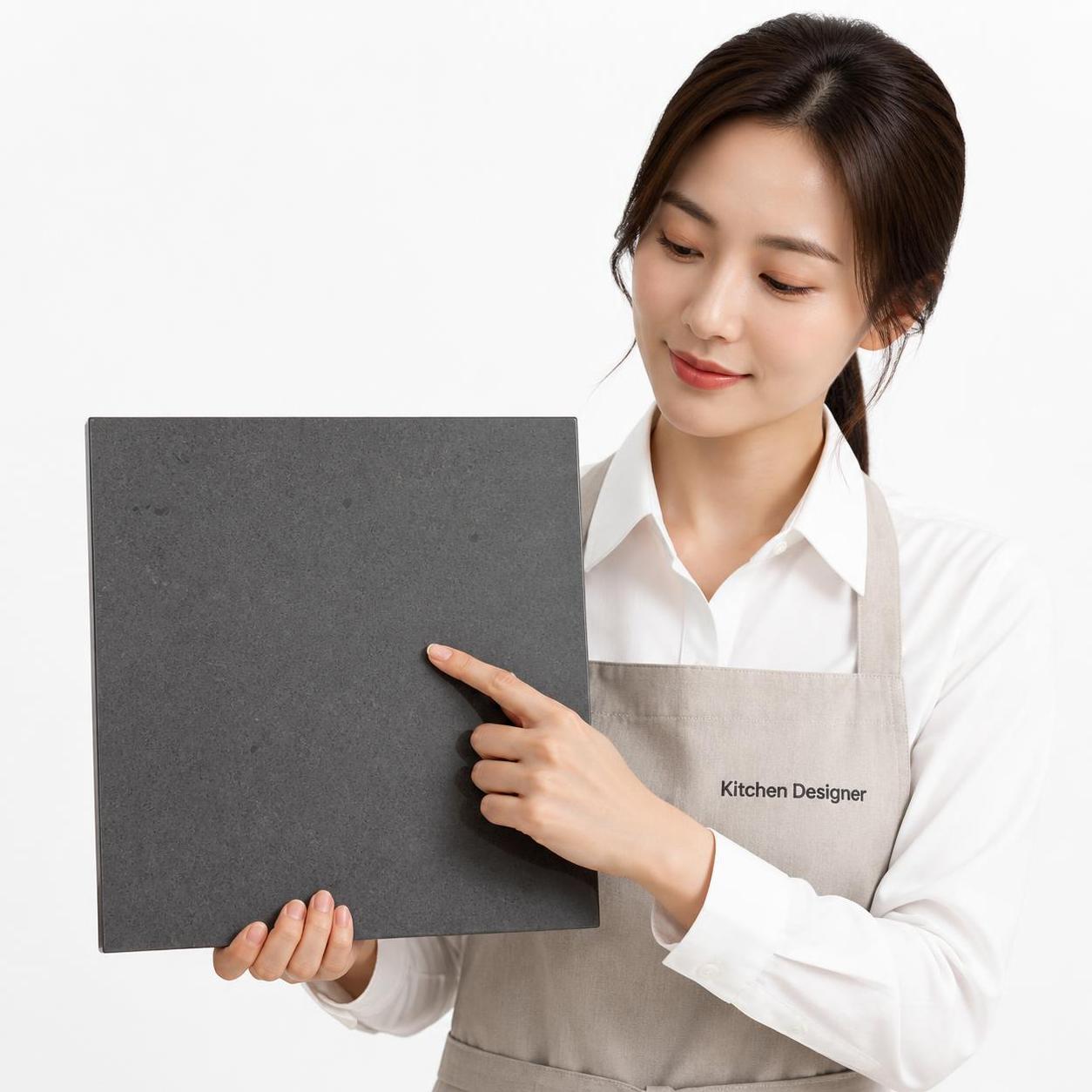
Engineered Quartz Hardness and Wear Resistance: What It Means for Your Project
In building and decorative materials, the hardness and wear resistance advantages of engineered quartz make it a preferred choice for surfaces that face daily friction, impact, and heavy use. From countertops to wall panels, engineered quartz combines lasting beauty with reliable performance, helping architects, designers, and property owners achieve both durability and modern style in demanding residential and commercial spaces.
But for most professional readers, the real question is not whether engineered quartz is “hard.” It is whether that hardness translates into lower lifecycle risk in actual projects. A residential kitchen, a retail checkout counter, a hotel vanity, and a hospital interior panel all experience wear differently. The value of engineered quartz depends on how well its surface performance aligns with those use patterns, and on whether buyers understand the limits behind the marketing claims.
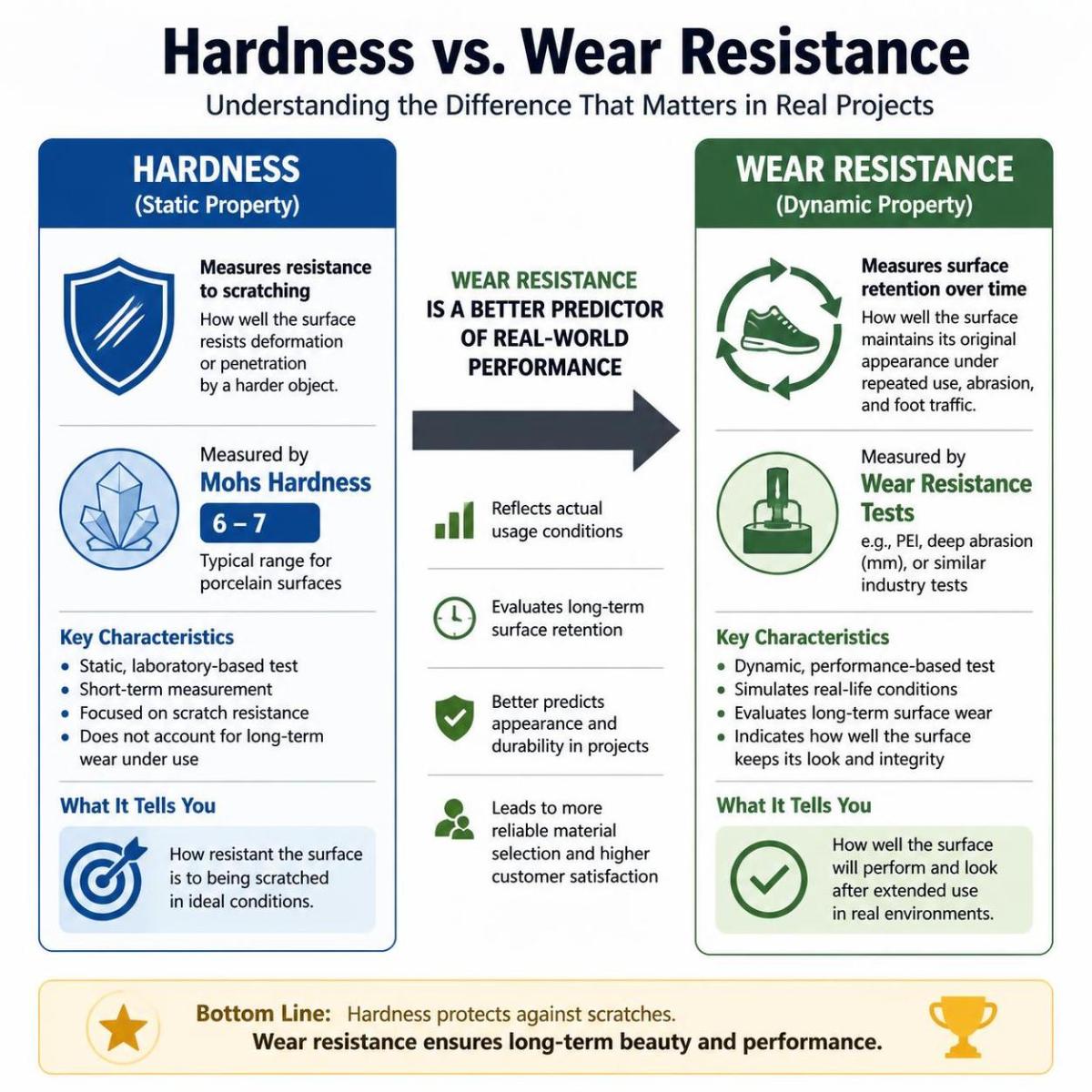
Why hardness matters in specification decisions
Hardness is often treated as a simple quality signal, but in project work it is better understood as a predictor of surface stability under repeated contact. Engineered quartz is typically made by combining natural quartz aggregates with resin and pigments, then compressing and curing the slab. Because quartz itself is a hard mineral, the resulting surface generally resists scratching and abrasion better than many common decorative materials used in horizontal applications.
That matters most where appearance retention has economic value. In a showroom, apartment development, office pantry, or foodservice support area, the question is not only whether the surface survives impact on day one. It is whether after one or three years of normal use it still looks acceptable without constant maintenance, replacement, or customer complaints. A hard, wear-resistant material helps preserve finish quality, edge definition, and overall perceived cleanliness.
For developers and contractors, this affects more than aesthetics. Premature dulling, visible scratches, and worn spots often trigger disputes around installation quality, cleaning practices, or material grade. A better wear-performing surface reduces these grey-zone arguments.
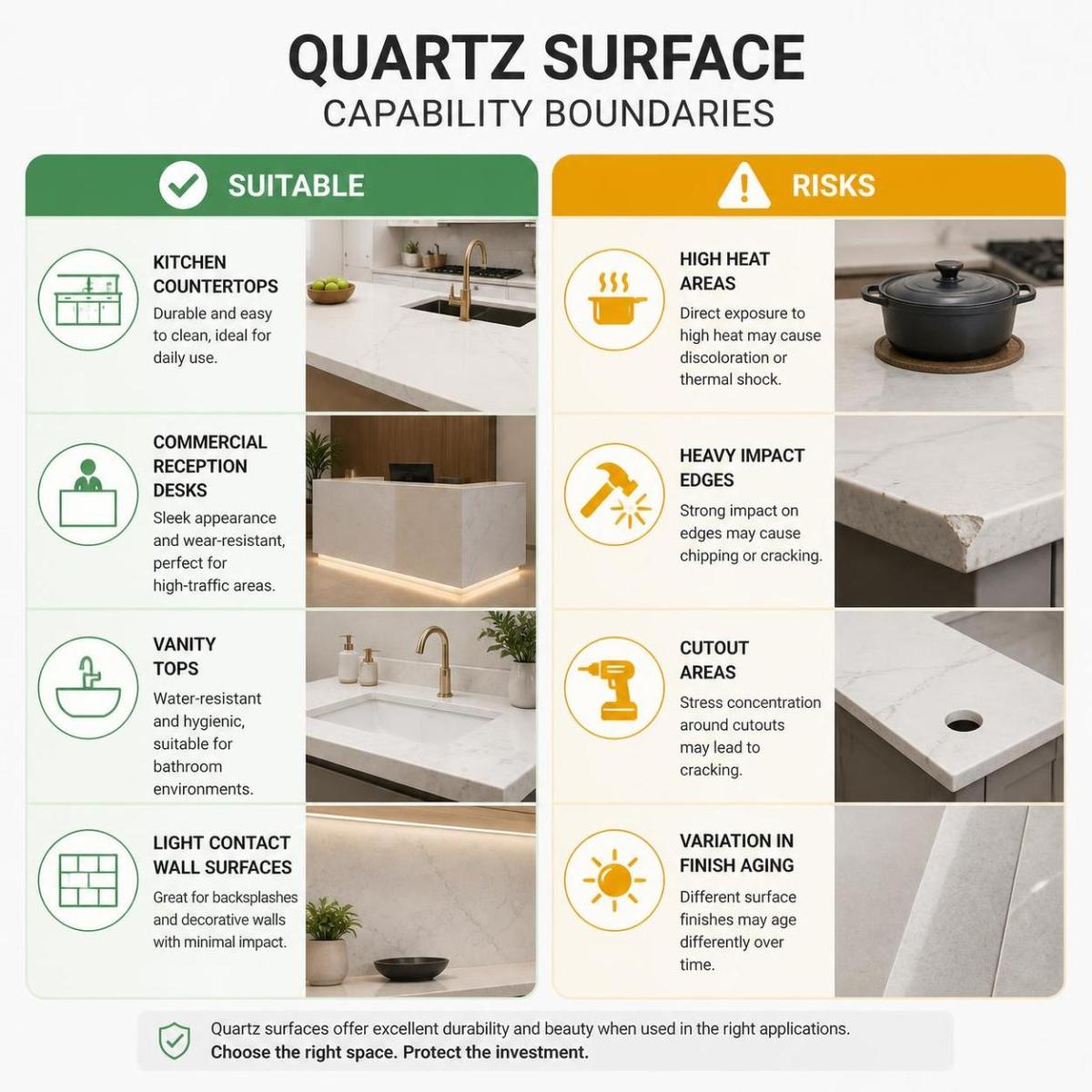
Wear resistance is more useful than hardness alone
In industry discussion, hardness and wear resistance are often mentioned together, but they are not identical. A surface can be hard yet still show performance issues if its structure, binder quality, or finishing process is weak. Wear resistance is the more practical concept because it reflects how the material behaves under repeated real-world contact: sliding objects, cleaning cycles, foot traffic in certain applications, or ongoing edge contact in service zones.
For engineered quartz, wear resistance usually shows its value in four ways:
- It helps reduce visible scratching from utensils, containers, office items, and daily handling.
- It slows the loss of gloss or texture consistency in frequently touched areas.
- It supports cleaner long-term appearance because the surface is less likely to develop micro-damage that traps dirt.
- It lowers the rate of cosmetic deterioration in high-use interior environments.
This is why engineered quartz continues to hold a strong position in countertops, vanity tops, reception surfaces, and selected wall or furniture applications. In these categories, cosmetic durability and cleaning efficiency are often just as important as structural performance.
Where the material performs best
The hardness and wear resistance advantages of engineered quartz are most meaningful in interior applications with frequent contact but controlled environmental exposure. Kitchen countertops remain the obvious example, especially in multi-family housing, mid-to-high-end residential projects, and hospitality units where the owner wants a premium look without the unpredictability of some natural stone surfaces.
Commercial interiors also benefit. Front desks, cashier counters, washroom vanities, and worktops in light-duty service areas all place steady demands on the surface. In these environments, engineered quartz offers a useful balance: more refined visual consistency than many natural stones, stronger scratch resistance than several decorative alternatives, and easier maintenance expectations for facility teams.
Vertical use can also make sense, though the decision there is often driven less by wear resistance and more by design continuity. A wall panel does not usually need the same abrasion performance as a worktop. Still, in lift lobbies, washrooms, retail feature walls, and narrow circulation zones where luggage, bags, or maintenance equipment may brush against surfaces, the extra hardness can help preserve finish quality.
Where buyers sometimes overestimate its advantages
This is where many purchasing mistakes begin. Engineered quartz is durable, but “durable” does not mean universal or damage-proof. Some common market claims flatten too many conditions into a single promise.
First, hardness does not mean immunity to impact damage. A heavy, sharp blow on an edge or cut-out area can still chip the material. This is especially relevant around sink openings, corners, unsupported spans, and fabricated joints. In project delivery, fabrication quality and installation support details are often just as important as slab performance.
Second, wear resistance does not mean all finishes behave equally. Polished, matte, and textured surfaces may age differently under the same cleaning regime. Some finishes can show residue, rubbing marks, or local dulling more visibly than others, even if the base material remains sound.
Third, the hardness advantage of engineered quartz should not be confused with heat tolerance. In many markets, the more serious operational limitation is thermal shock or high direct heat exposure, due to the resin component in the material system. That issue is separate from scratch resistance, but it affects suitability in kitchens and back-of-house areas. Buyers who focus only on hardness can miss one of the more relevant application risks.
What procurement teams should actually check
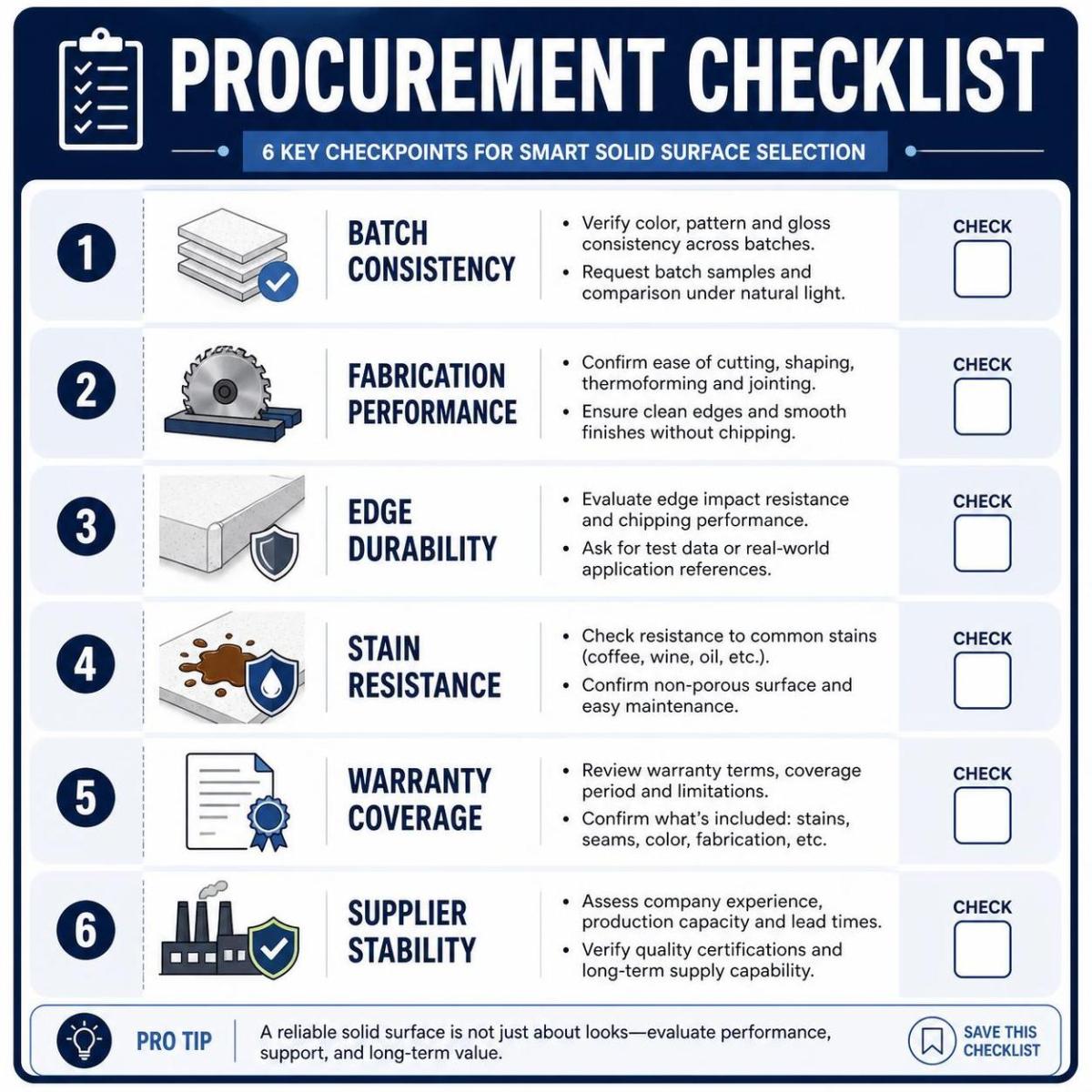
When engineered quartz is being compared across suppliers, hardness is rarely the only differentiator. Procurement teams should treat the category as a manufactured product with quality variation, not as a generic stone substitute.
The following points usually matter more than brochure language:
- Surface consistency: Check whether the slab finish is even across batches, especially in large projects requiring color continuity.
- Fabrication behavior: Ask how the slab performs during cutting, edging, and polishing, and whether the supplier has project references with similar detailing complexity.
- Thickness and reinforcement needs: Not all applications should rely on the same slab build-up or support method.
- Edge durability: Some failures start at the edge profile rather than the field of the slab.
- Stain and chemical resistance: Important in hospitality, foodservice-adjacent, healthcare, and washroom environments.
- Warranty scope: Many warranties cover manufacturing defects but not misuse, heat exposure, poor installation, or aggressive cleaning.
- Compliance and emissions: Indoor air quality claims, resin system details, and applicable product certifications should be checked case by case.
If the project is large enough, requesting physical samples is not sufficient on its own. A mock-up or trial fabrication piece is often more revealing, especially for edge finishing, joint appearance, and how the surface responds to cleaning after handling on site.
A practical comparison mindset
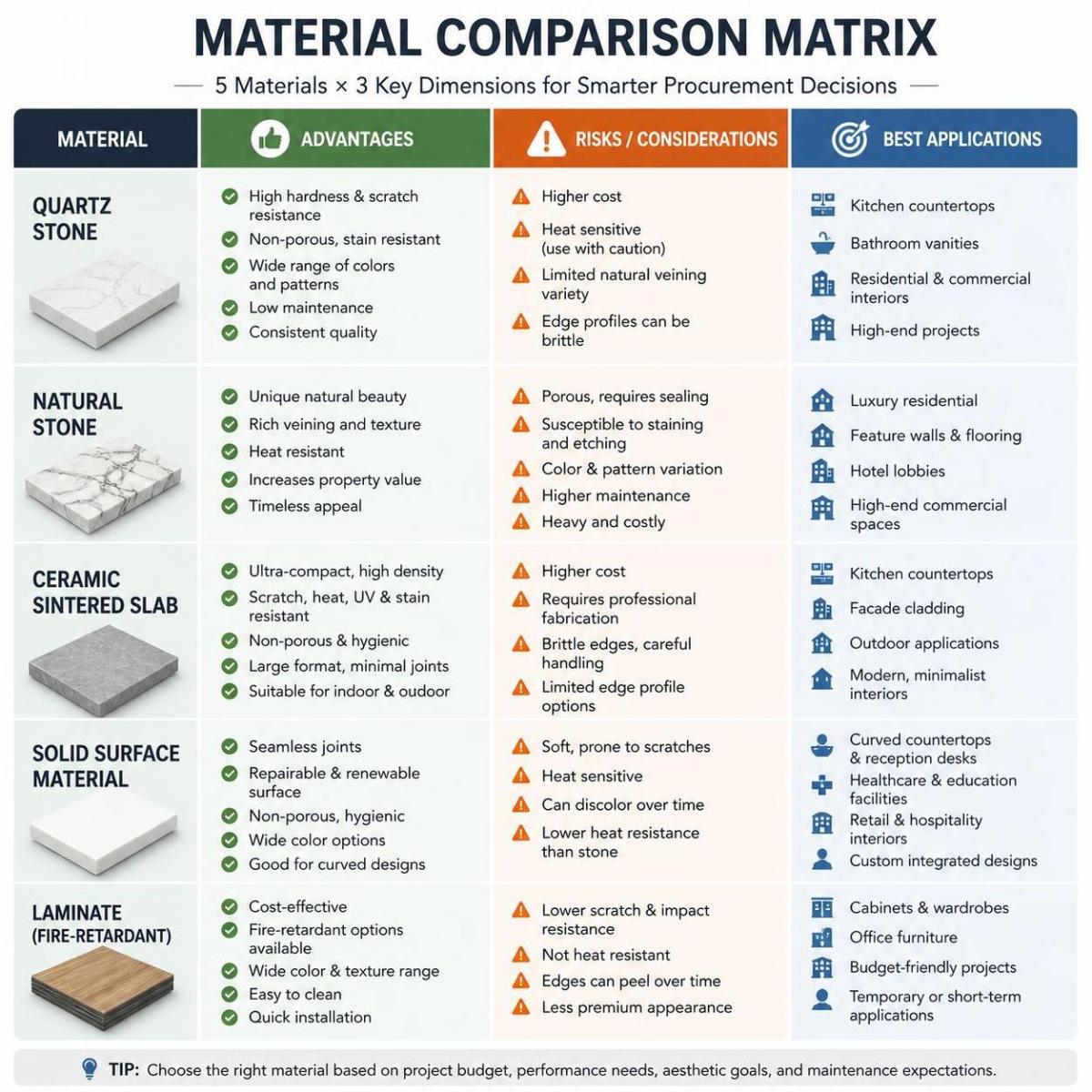
Many decision-makers compare engineered quartz with natural stone, porcelain slabs, solid surface, laminates, and sintered materials. The right comparison is not “which material is best,” but “which failure mode is most acceptable for this project.” Each material solves one problem while introducing another.
In other words, engineered quartz earns its place when the project values daily-use resilience, repeatable visual control, and manageable maintenance. It becomes less convincing when the environment includes high heat, severe impact risk, or detailing that pushes the slab beyond its comfortable fabrication limits.
The supplier side also matters more than many expect
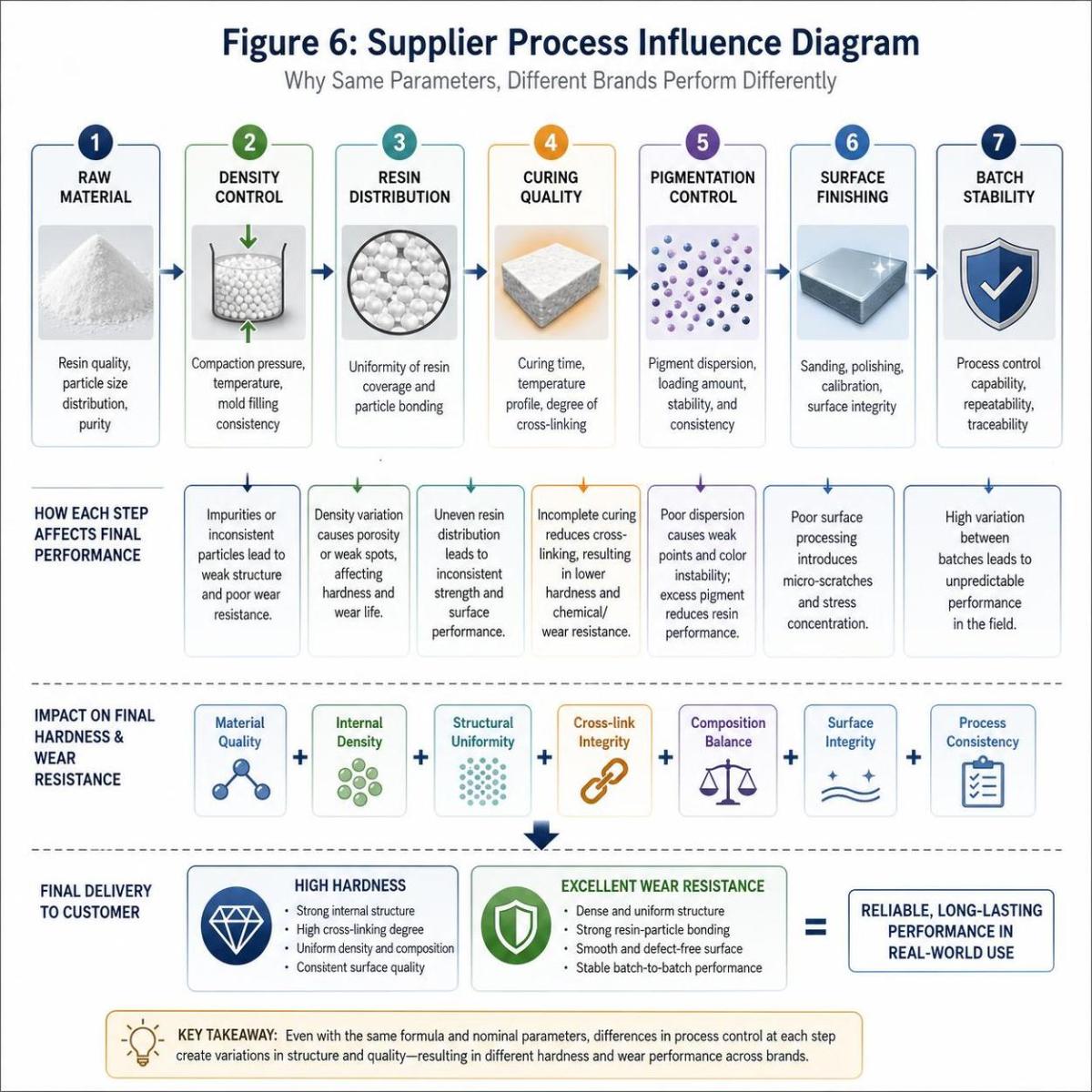
In the building materials trade, the performance of engineered quartz in the field is tied not only to composition but also to process discipline. Slab density, resin distribution, curing quality, pigmentation control, and finishing stability all influence whether the hardness and wear resistance seen in product literature are actually delivered on site.
This has a direct supply-chain implication: two products that look similar in samples may behave differently after installation. For distributors, fabricators, and project buyers, supplier evaluation should include consistency history, claim response, replacement capability, and whether the producer can maintain batch stability over the full delivery cycle.
That becomes especially important for chain retail, branded hospitality, and phased residential projects, where future matching and defect resolution have commercial consequences beyond the first shipment.
How to think about future relevance
Engineered quartz is likely to remain important because interior fit-out projects still need a surface material that balances aesthetics, repeatability, and usable durability. But the discussion is evolving. Buyers are paying more attention to fabrication safety, environmental profile, and full-system performance rather than only color and hardness claims. Depending on region, certain compliance expectations around manufacturing, dust control, workplace safety, or material disclosure may become more important over time.
That means the most competitive engineered quartz suppliers will not win only by offering harder surfaces or more patterns. They will need to show process reliability, credible technical documentation, and application guidance that reflects actual jobsite conditions.
For specifiers and procurement teams, the useful takeaway is simple: hardness and wear resistance are real advantages, but they create value only when matched to the right use case, the right detailing, and the right supplier discipline. In engineered quartz, performance is not just a material property. It is a project outcome.
For wear performance in heavy-traffic spaces, see Anti-Scratch Quartz for High-Frequency Usage Spaces, and for where this material is specified most often, see the Engineered Quartz Wall Panel and Floor Application Guide.
Related Articles
- Stain Resistance Performance of High-Grade Quartz Slabs
- Quartz vs Granite: Pros and Cons for Project Use
- Strict Quality Control System for Export Quartz Slabs
- Complete Engineered Quartz Slab Production Process
Hard, Wear-Resistant Quartz Slabs for High-Use Interiors
Our engineered quartz slabs deliver strong scratch and abrasion resistance, stable batch quality, and consistent finish across production, making them a reliable choice for busy kitchens, hospitality, retail counters, and commercial interiors. Contact us for samples, technical specs, and project pricing.
📱 WhatsApp: +86 198 6115 3736
📧 Email: raykelee@hyquartzslabfactory.com
Send Us A Message