
Quartz Table Tops: Custom Sizes, Edges and Factory-Direct Guide
Quartz Table Tops: Custom Sizes, Edges and Factory-Direct Guide
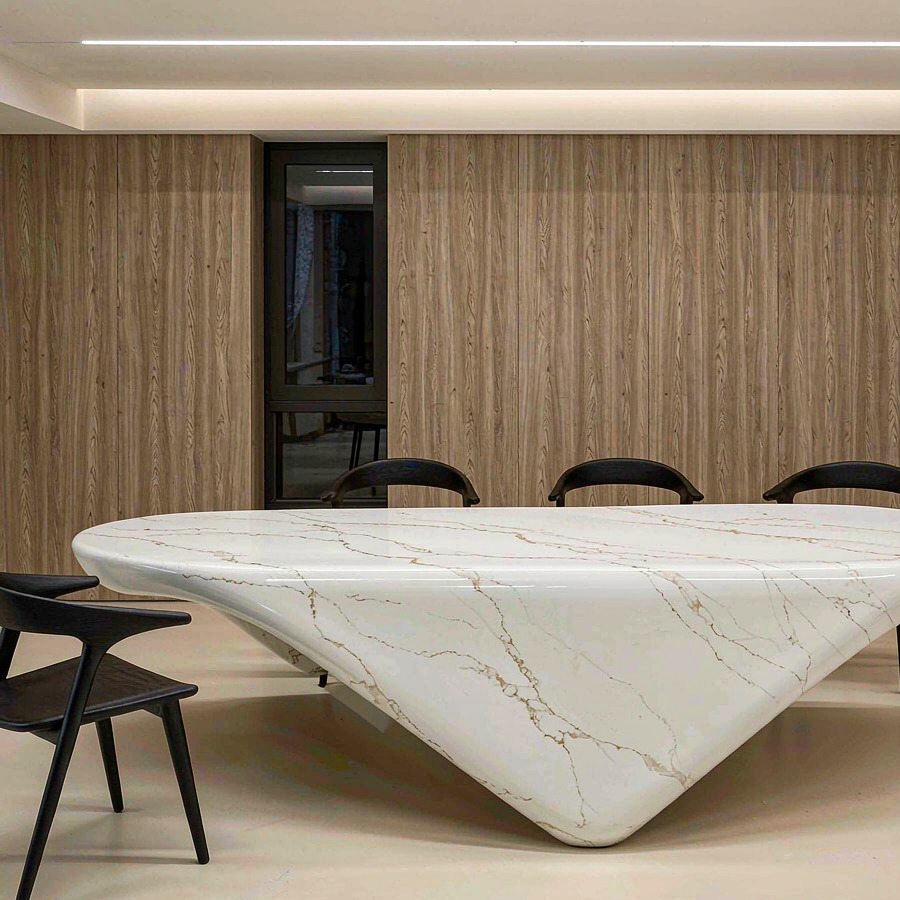
Why Quartz Table Tops Are Specified for Commercial Projects
A quartz table top is one of the most practical surfaces a buyer can specify for a restaurant, hotel, office or retail fit-out. Engineered quartz combines roughly 90 percent natural quartz aggregate with resin and pigment under high pressure, which produces a surface with the visual depth of natural stone but none of its maintenance liabilities. For a project buyer, that means a quartz table top arrives with consistent colour and vein pattern from slab to slab, resists staining from wine, coffee, oil and citrus, and does not need sealing, waxing or annual treatment the way marble and granite do.
Our factory produces engineered quartz slabs at a Mohs hardness of 6 with a water absorption rate of 0.02 percent, certified to ISO 9001, NSF and SGS standards. Those numbers matter when a table top will see hundreds of service cycles a week. In this guide we cover the sizes, thicknesses, edge profiles, colours and ordering process behind a custom quartz table top — written from the factory side, with the real specification numbers project buyers ask us for every day.
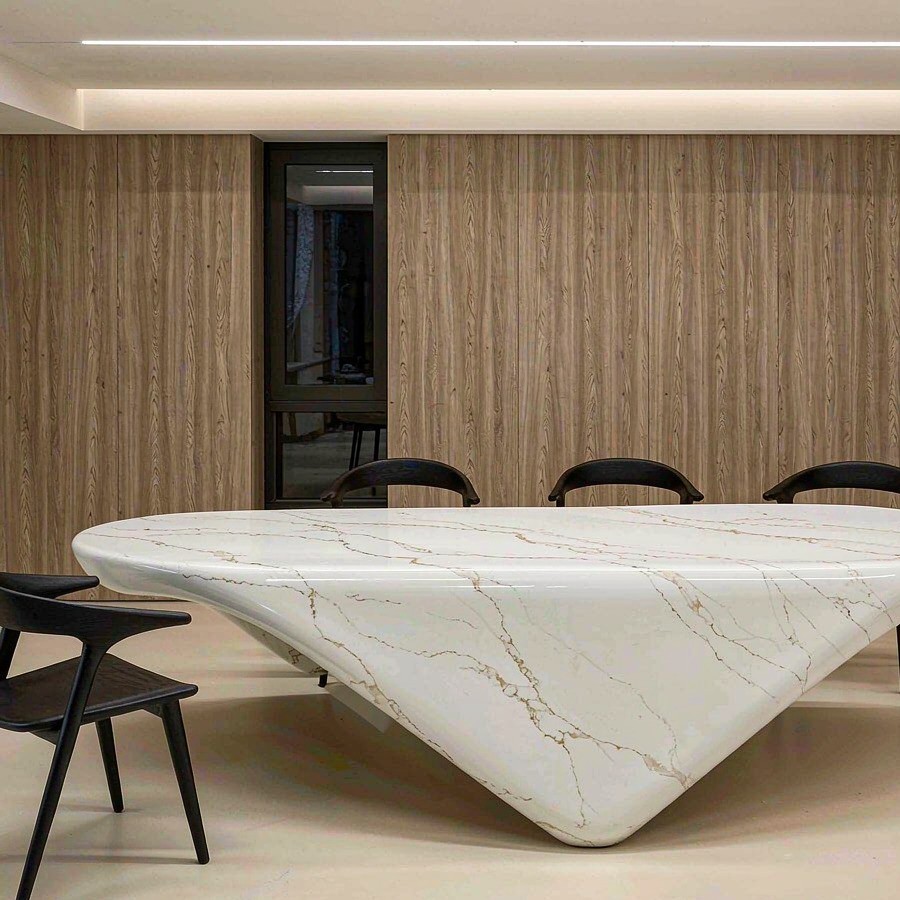
Standard and Custom Quartz Table Top Sizes
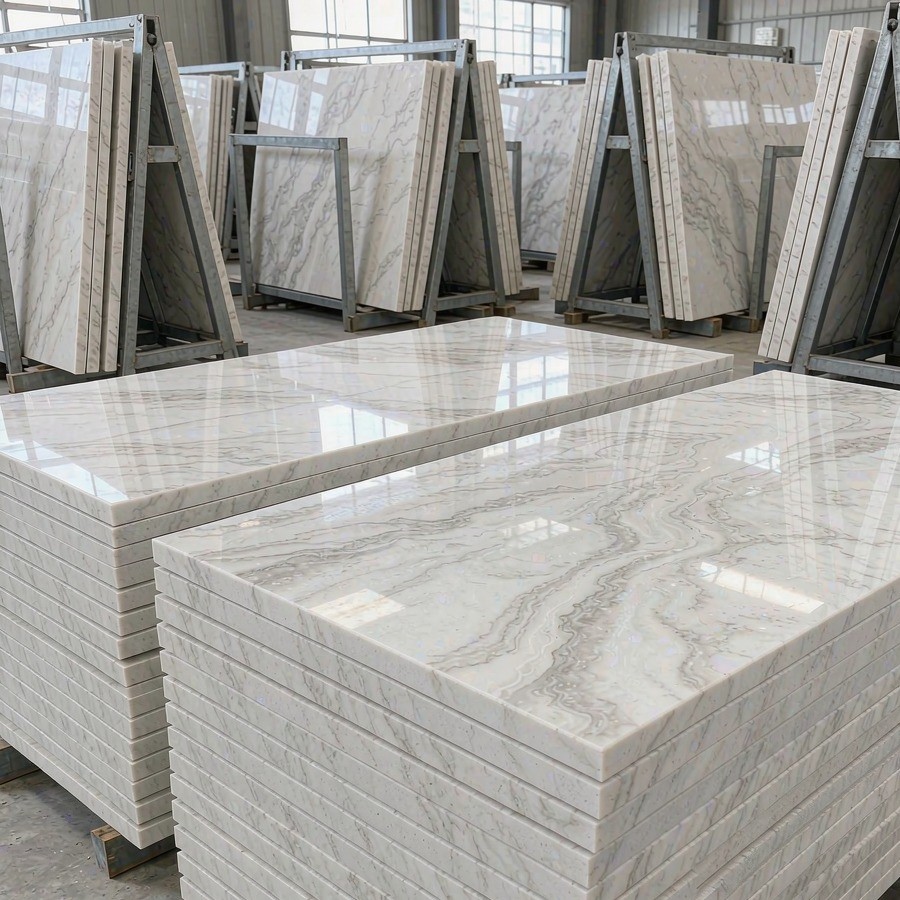
The first question every fabricator asks is what the slab allows. Our standard quartz slab is 3200 × 1800 mm, with 3200 × 1600 mm and 3200 × 750 mm also produced, plus a jumbo 1800 × 3500 mm format for large feature pieces. From those slabs, a table top can be cut to essentially any plan dimension the project calls for — cut-to-size tops are a routine request, not a special order.
For commercial dining, the common sizes are 600 × 600 mm and 700 × 700 mm for two-seaters, 800 × 800 mm and 900 × 900 mm for four-seaters, and 1200 × 750 mm or 1400 × 800 mm for communal and banquette runs. Because a single 3200 × 1800 mm slab yields multiple tops with sensible nesting, a mixed order of table sizes from one colour keeps material waste low and price per piece predictable. When a project needs a single very long top — a 3-metre boardroom table, for example — the jumbo 1800 × 3500 mm slab makes a monolithic top possible without a visible seam.
If you are converting a specification from inches, note that a 3200 × 1800 mm slab is approximately 126 × 71 inches, and 3200 × 1600 mm is roughly 126 × 63 inches. Ask us for the exact cutting diagram before you commit to a layout; we return nesting plans with every quotation so the fabricator can verify yield before the order is placed.
Thickness and Edge Profile Choices
Standard table production is 20 mm, and that is the thickness we recommend for a quartz table top in almost every application. A 20 mm top is stiff enough to span 800 to 900 mm without visible deflection under a leaning load, which keeps thin aprons and cantilevers stable. An 18 mm quartz table top is available and saves material cost on large runs, but it needs a full plywood support substrate or a steel subframe under any overhang longer than 300 mm.
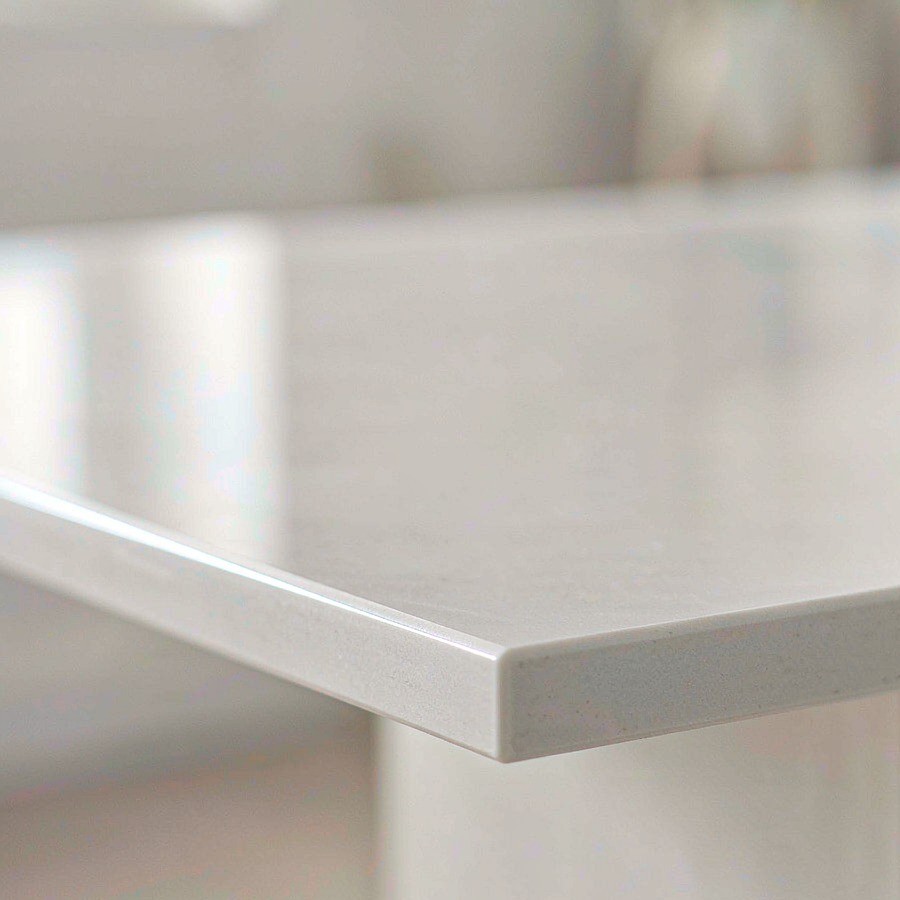
The edge profile is where a quartz table top stops looking like a cut slab and starts looking like furniture. The profiles we fabricate most often are:
- Square (eased) edge — the default for commercial dining; fast to produce, easy to repair on site, no sharp corner to chip.
- Bevel edge — a 45-degree chamfer that catches light and makes a thin top read as a deliberate design line.
- Bullnose (half-round) edge — a fully rounded profile for hospitality and family dining where hands and sleeves constantly pass the edge.
- Mitered waterfall edge — the slab continues vertically down to the floor, used for boardroom and reception statement tables.
- Profiled (ogee / ogee-to-square) edge — routed decorative profiles for premium retail and hotel applications.
Whichever profile you choose, we fabricate it in the factory before shipping, so the site team only levels and sets the top. Edge work done on site with hand tools is the single most common source of chipped corners in quartz installations — a factory-finished edge removes that risk entirely.
Colours and Patterns for Table Tops
Colour selection for a quartz table top follows different logic than countertop selection. A countertop is a background surface; a table top is the visual centre of a room, so pattern scale and contrast carry more weight. Our catalogue covers the full range buyers ask for:
- Bright white with soft grey cloud veining (Shimmering Spring Stream) — a quiet Taj Mahal-style movement that works in bright hospitality interiors.
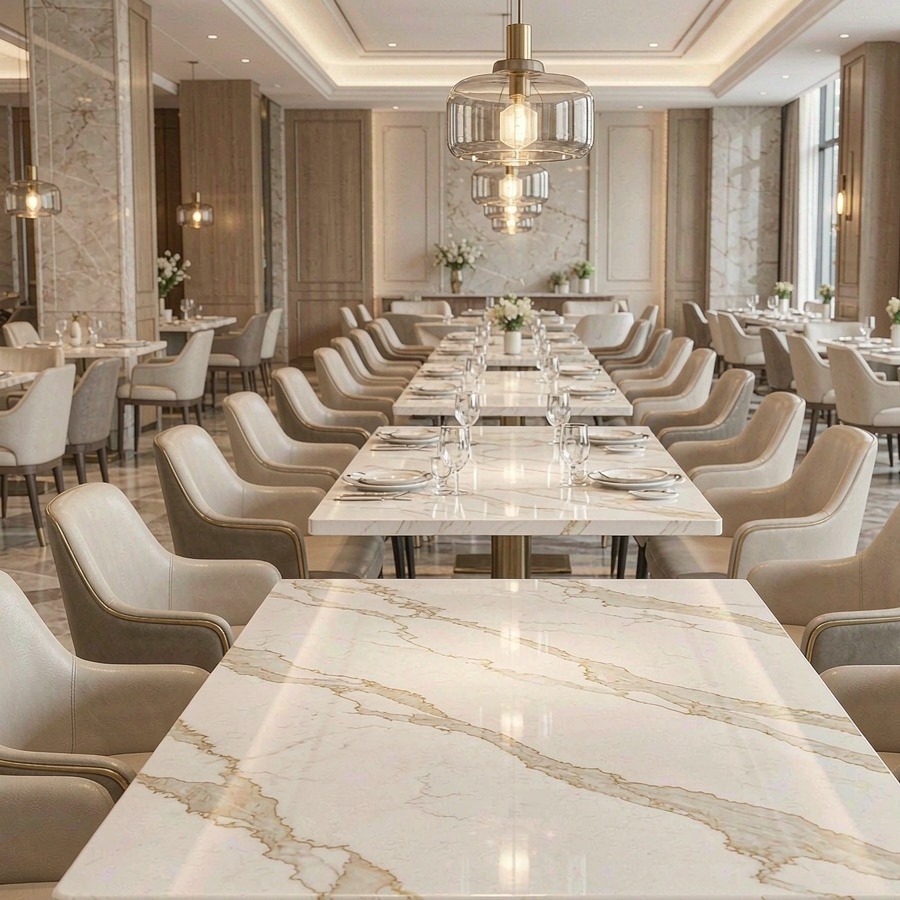
- Warm white with gold veins (Marble Golden Thread, Cloud Jade Gold Vein, Gold Vein) — the Calacatta family, the most requested look for hotel and restaurant tabletops.
- White with rose-gold grey tones (Lapis Azure Glaze) — a softer alternative when a project needs warmth without a strong gold.
- Bold black-and-white contrast (White Realm Black Mark, Ink Wave Veil) — graphic statement tops for feature dining and reception.
- Black with golden mesh veining (Obsidian Gold Mesh) — the premium dark option for bar tops and lounges.
- Grey and wood-look tones (Milky Rock Cyan Tone, Rustic Teak Rock, Spruce Whitewood) — practical choices for office and education projects.
For table tops specifically, we advise mid-scale veining over very large dramatic movement: a table is viewed from above at close range, and an oversized vein pattern can read as busy at that distance. Order 30 cm samples and view them under the actual lighting of the space before confirming the colour for a large run.
Fabrication Details: Cutouts, Overhangs and Support
The product is engineered stone, and it is fabricated with the same discipline as a countertop. The details that decide whether a project goes smoothly are agreed before cutting, not on site:
- Cutouts — undermount sink cutouts, cable pass-throughs and grommet holes are waterjet or CNC cut in the factory with a minimum 50 mm of material left between any cutout and the edge of the top.
- Corner radii — we fabricate all internal corners with a minimum 6 mm radius; square internal corners are stress risers in any stone product.
- Overhangs — unsupported overhang should stay within 300 mm for 20 mm tops; beyond that, a plywood substrate or corbel support is specified at the quotation stage.
- Substrate — for tops over 1500 mm in any direction, a plywood or MDF backing is recommended during transport and installation to control handling flex.
- Finish — polished is standard; honed and satin (textured matte) finishes are available where glare under dining lighting is a concern.
Send us the shop drawings in DXF or PDF and we will mark up any detail that risks a crack or a chipped edge before production starts. That review is free, and it is the cheapest insurance a quartz table top project can buy.
Commercial Applications: Restaurants, Hotels and Offices
The commercial case is straightforward. In a restaurant, the surface must survive hot plates, spilled wine, sanitiser and nightly cleaning; engineered quartz takes all four without sealing or refinishing. In a hotel, the same colour can be reordered two years later for an extension without a visible mismatch, because engineered quartz is produced to a controlled recipe rather than quarried by chance. In an office, a quartz surface gives a boardroom or café the weight and presence of natural stone at a predictable delivered cost.
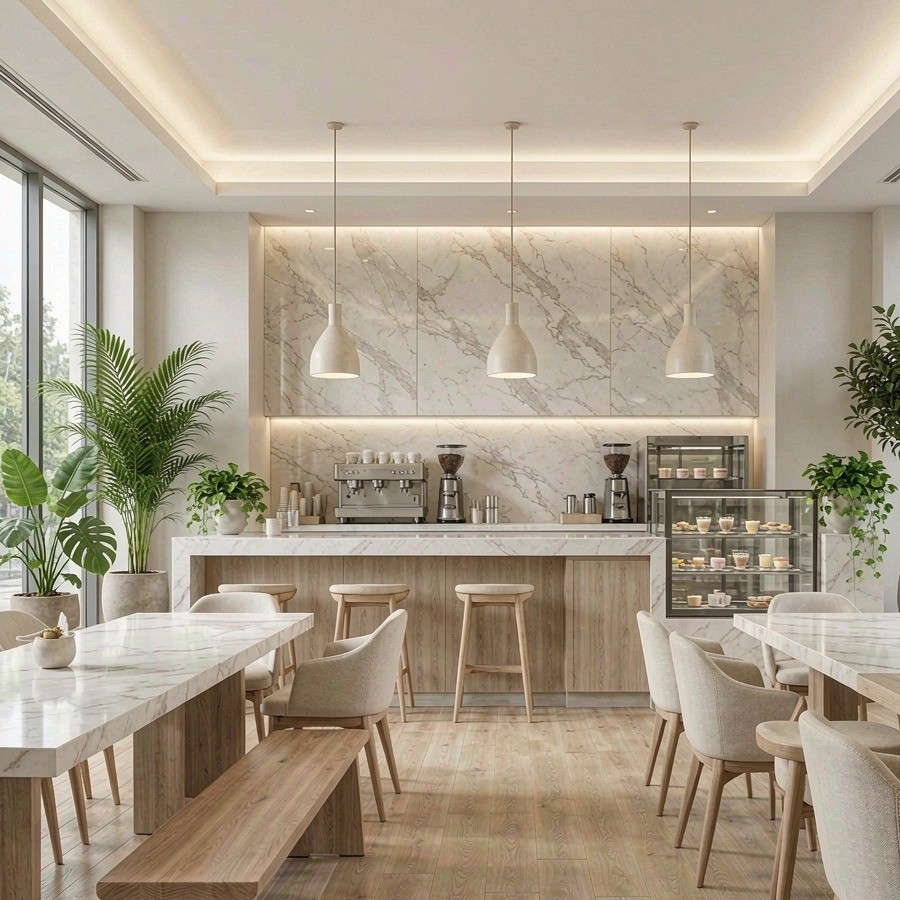
Projects we currently supply include restaurant dining tops and bar tops, hotel breakfast and banquette tables, café and QSR fit-outs, retail display tables, reception and co-working desks, and education-sector dining tables. Lead time for standard colours is 2 to 4 weeks from order confirmation, and mixed-size orders from one colour ship together in a single consignment, which keeps site logistics simple.
Care and Maintenance
The surface needs almost nothing to stay in service condition. Wipe spills with a damp cloth and a mild pH-neutral cleaner; avoid strong alkali drain cleaners and solvent-based strippers left standing on the surface, and avoid cutting directly on the polished finish (a mat is cheaper than a repair). Because the surface is non-porous, there is no sealing schedule — the same routine applies on day one and in year ten. For outdoor installations, note that prolonged UV exposure can affect resin-based products over time; ask us for the shade-stable grades if a quartz table top will live in a covered outdoor area.
How to Order Custom Quartz Table Tops from the Factory
Ordering direct from the factory removes the distributor margin and the colour surprises. The process we run with project buyers is the same every time:
- Step 1 — Specification. Send the table plan: dimensions, thickness, edge profile, colour, finish and cutout list.
- Step 2 — Samples. We dispatch 30 cm samples of the shortlisted colours so the design team can confirm under site lighting.
- Step 3 — Quotation. You receive a line-item quotation with cutting diagrams, packaging spec and lead time — normally within two working days of a confirmed specification.
- Step 4 — Production and QC. Tops are fabricated, edge-finished and inspected batch by batch; pre-shipment photos are sent for approval.
- Step 5 — Delivery. A-frame or crate packing, container or air freight to your port, with full export documentation.
We supply project buyers, importers, distributors and fabricators in more than 50 countries, and we support OEM and private-label programmes where the buyer supplies their own colour reference or brand packaging.
Frequently Asked Questions
What is the standard thickness of a quartz table top?
20 mm is the standard and the recommended thickness for commercial tabletops. An 18 mm option exists for cost-sensitive large runs, but it requires a plywood substrate or subframe for support under overhangs.
Can a quartz table top be cut to any size?
Yes. Our 3200 × 1800 mm slabs are cut to size in the factory, and the jumbo 1800 × 3500 mm format allows very long monolithic tops. Cutouts, grommets and edge profiles are all fabricated before shipping.
Is a quartz table top heat resistant?
Engineered quartz tolerates hot plates and cups well, but it is not heat-proof. Prolonged direct contact with a hot pan can mark the resin bond — always use a trivet or heat mat, the same discipline you would use with any stone surface.
How does a quartz table top compare with a natural marble table?
A quartz table top delivers the same visual veining with a non-porous, stain-resistant surface that needs no sealing. Natural marble etches on contact with acid and requires maintenance; engineered quartz is specified when the table must still look new after two years of daily service.
What is the minimum order for custom quartz table tops?
We do not impose a piece-count minimum on custom fabrication — the practical minimum is one full slab of a single colour, which typically yields a small set of tops. Mixed sizes from one colour are welcome in a single order.
Specify Your Quartz Table Tops Direct from the Factory
If your project needs custom sizes, factory-finished edges and a colour you can reorder next season, send the specification and we will return samples, a cutting diagram and a line-item quotation. Our engineering team reviews every drawing before production, so the tops that arrive on site fit the first time.
📱 WhatsApp: +86 198 6115 3736
📧 Email: raykelee@hyquartzslabfactory.com
Related Articles
Send Us A Message