
Quartz Fireplace Surround: Heat, Specs and Ordering Guide
Quartz Fireplace Surround: Heat, Specs and Ordering Guide
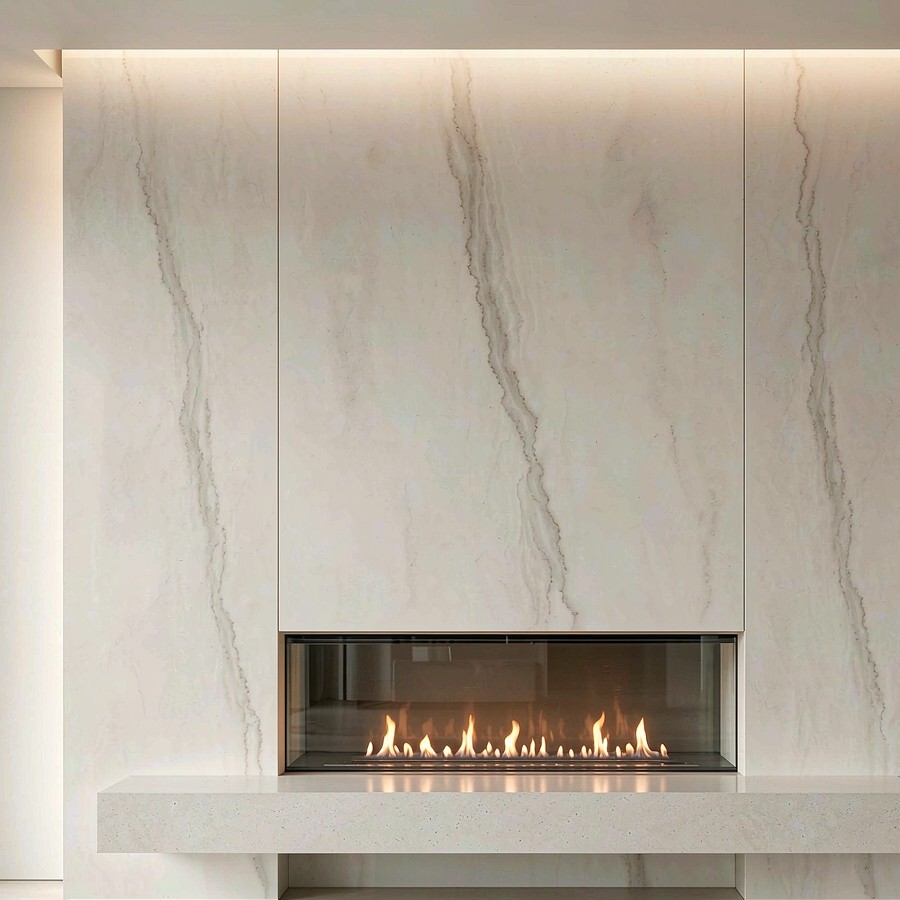
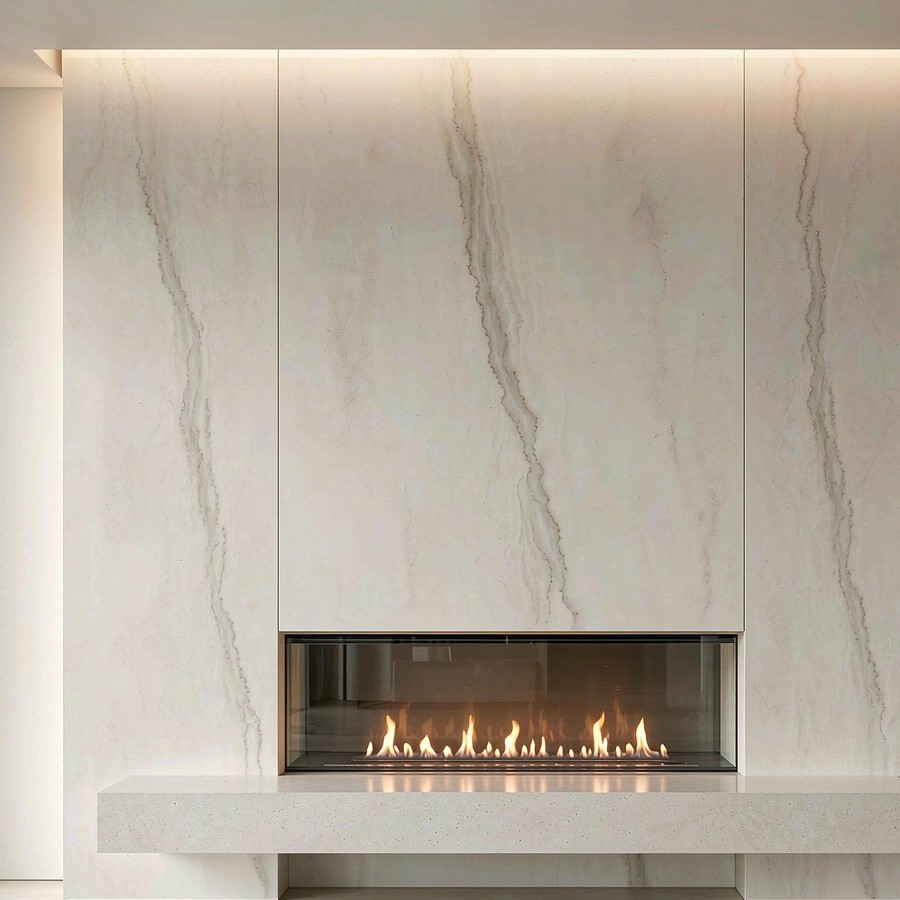
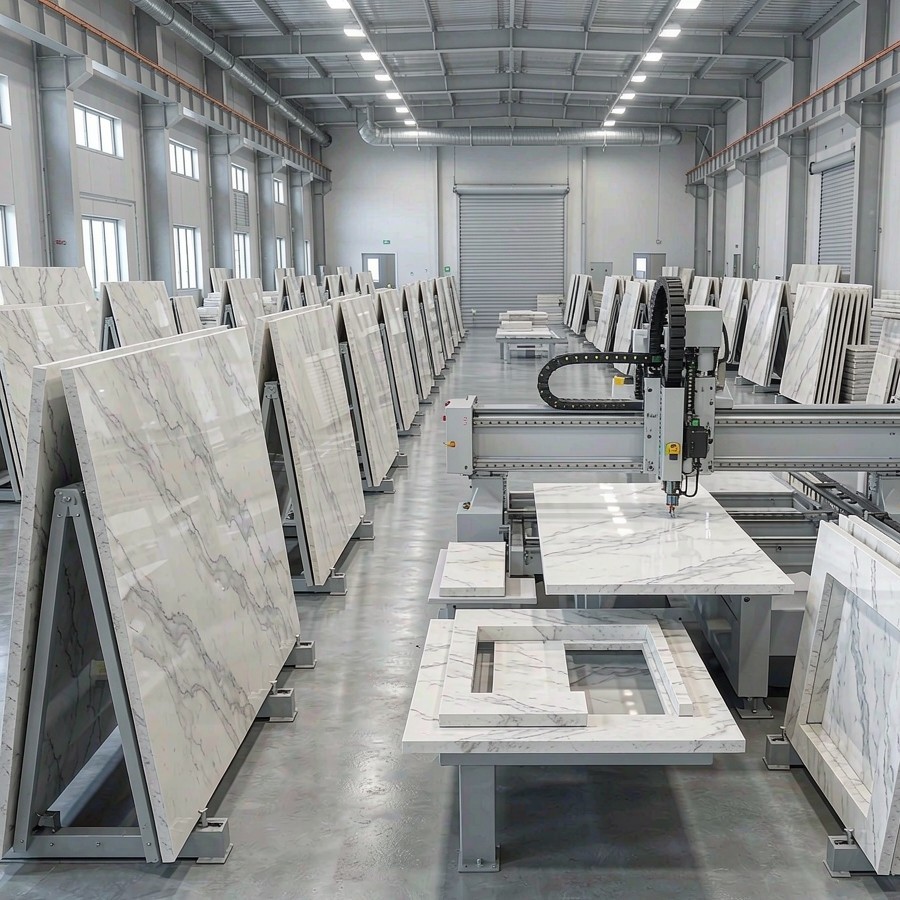
If you fabricate fireplace surrounds, or you are specifying stone for a residential or hospitality project, one question keeps coming up in enquiry emails: can a quartz fireplace surround really work around live fire? Yes — with the right slab, the right thickness and an honest conversation about heat. This guide covers what a quartz fireplace is, where the heat limits sit, what belongs on the order sheet, and how factory-direct sourcing changes lead time and price. As a quartz slab factory in Shandong, China, we produce these quartz fireplace surrounds for fabricators and project buyers every month — the guidance below comes from the production floor, not from a catalogue.
What Is a Quartz Fireplace Surround?
A quartz fireplace surround is the decorative stone cladding wrapping the firebox — the vertical face around the opening, the hearth slab in front, and often a mantel shelf above. It is cut from engineered quartz: roughly 90% natural quartz aggregate bound with resin and pigments, pressed into full-size slabs — a surface with the movement of marble but none of the etching, in a controlled colour every single batch.
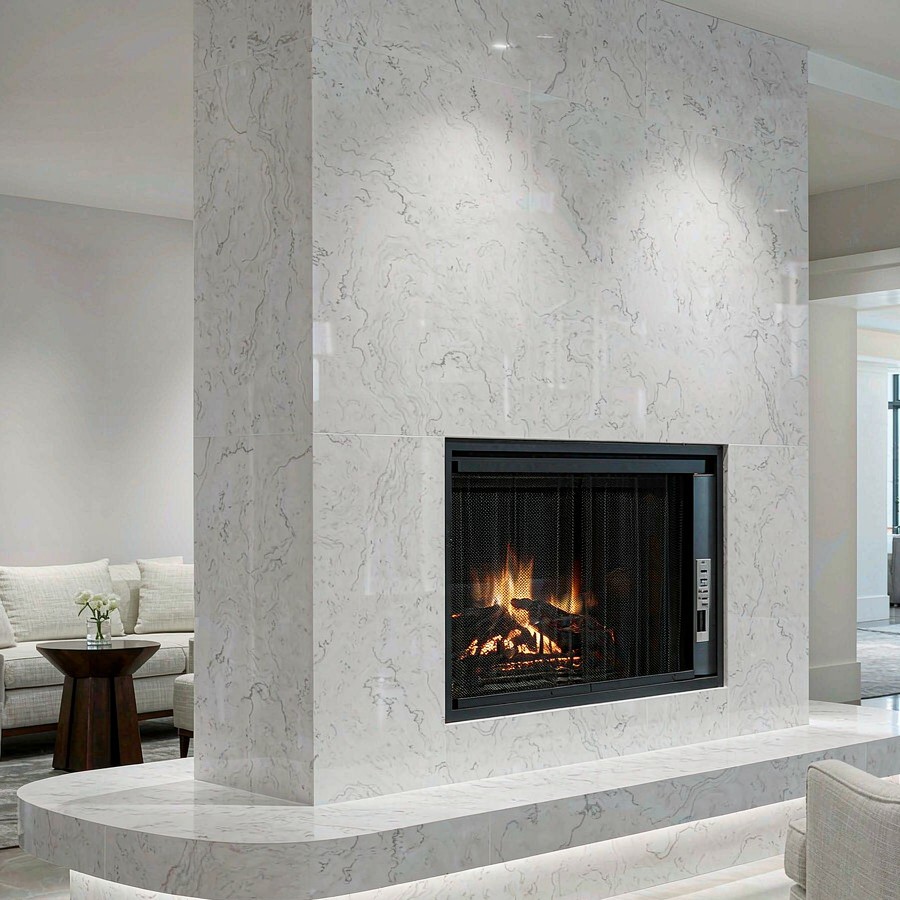
Because quartz is manufactured, a quartz fireplace can be specified in thicknesses that suit a chimney breast build-up: 18 mm for light cladding over masonry, 20 mm where a self-supporting hearth needs stiffness. Standard slabs come in 3200 × 1800 mm and 3200 × 1600 mm, with jumbo formats up to 1800 × 3500 mm — for most residential surround-and-hearth combinations, one slab covers the whole elevation, book-matched so the vein mirrors across the centre with no horizontal joint on the visible face.
Can Quartz Be Used for a Fireplace Surround?
This is the most common question we receive, and it deserves a straight answer rather than marketing copy. Engineered quartz performs well as a fireplace surround with gas fires, electric fires and closed wood-burners, installed that way in thousands of European and North American homes. What it is not is firebox lining. Quartz cladding belongs outside the fire chamber, on the decorative face, where it sees radiant warmth — not flame contact.
The reason is chemistry, and being upfront about it builds more trust than any claim of "heat-proof". The resin binder that gives quartz its low porosity (0.02% water absorption) and strength (Mohs 6) begins to soften and eventually discolour at sustained temperatures around 150–200 °C. A well-functioning fireplace keeps its decorative surround far below that. A roaring open log fire shooting flame onto the stone face, or a surround built tight around a malfunctioning flue, is a different matter.
Quartz Fireplace vs Marble, Granite and Porcelain
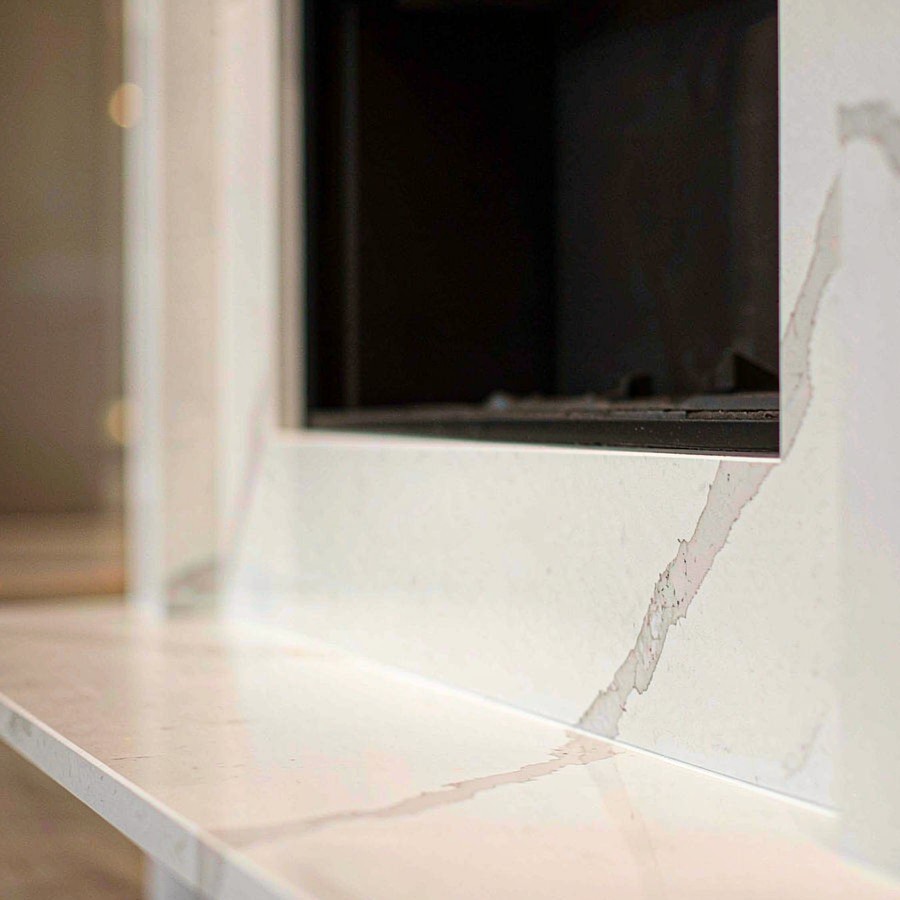
Buyers choosing quartz fireplace material usually shortlist four stones:
Marble. The classic mantel material, and it etches. Surrounds sit close to combustion by-products and cleaning agents, and marble's calcite content reacts with both — a marble hearth develops rings and dull patches within a couple of winters.
Granite. Genuinely heat-tolerant, but its colour is whatever the quarry gives you that month, and book-matching granite into a mirrored vein pattern is essentially impossible — granite veins do not run in the continuous bands a surround needs.
Porcelain / sintered stone. The strongest challenger: vitrified, UV-stable, indifferent to heat. Its weakness is pattern printed at the surface: a chipped porcelain edge reveals white body, a chipped quartz edge reveals the face colour — which matters on narrow mantel ledges.
Engineered quartz. The consistency play. Every slab from one production run carries the same base tone and vein rhythm, so a replacement slab five years later still matches. For surround-and-hearth sets where visual continuity is the design goal, quartz fireplace execution wins on repeatability.
Surround, Hearth or Mantel: Getting the Terms Right
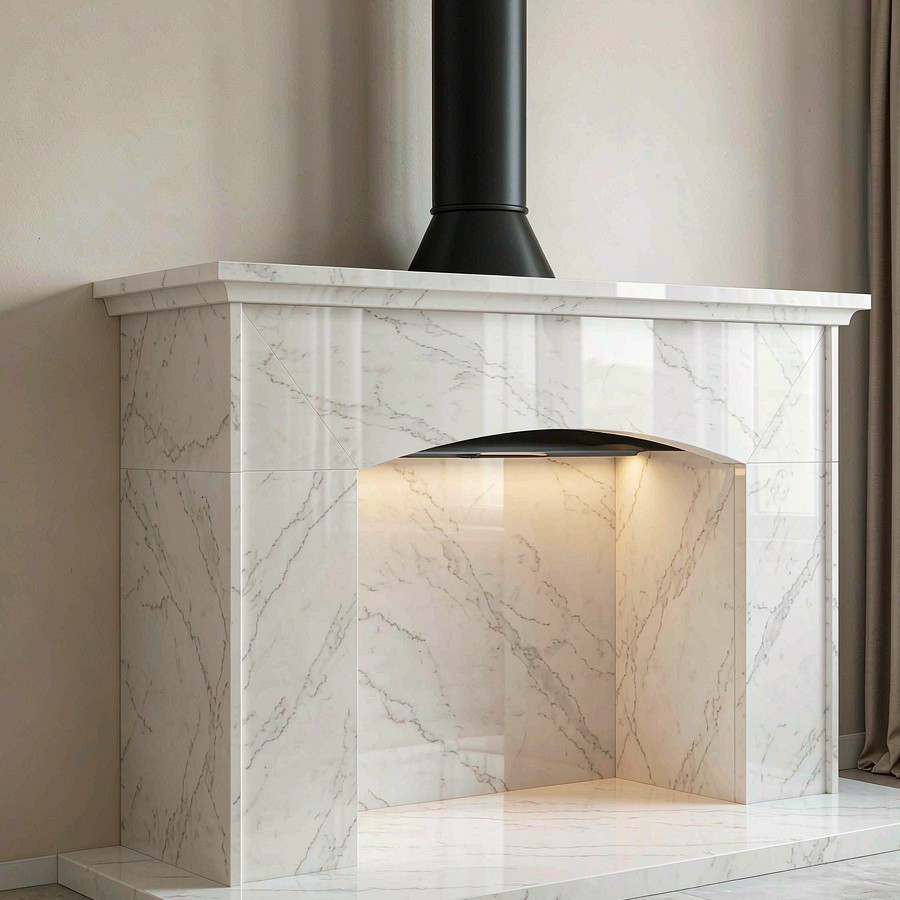
Order emails get tangled because three different parts all get called "the fireplace". Separating them speeds up every quartz fireplace quote:
Surround — the vertical cladding framing the opening, typically 100–150 mm of visible face on each side and above, usually mitred frames or full-slab panels with the firebox opening cut on site.
Hearth — the horizontal slab extending into the room. Cut from the same slab so the vein flows continuously from wall to floor — the detail that makes a quartz fireplace read as one piece of stone rather than three assembled parts.
Mantel shelf — the ledge above. In 20 mm quartz with a laminated edge build-up it spans the full width without brackets. Weight is real: a 3200 × 200 mm mantel in 20 mm runs around 36 kg, so concealed steel or timber cleats inside the chimney breast are standard practice, not an upsell.
Heat, Clearances and the Honest Limits
A quartz fireplace surround is specified around radiant warmth, and the spec sheet should say so. Three rules from our installations:
Keep flame off the face. Gas fires with a sealed glass front and electric fires are the ideal partners for quartz fireplace surrounds — surface temperatures stay low. Open log fires need a fire screen or a raised fender, and the vertical cladding should start above the point where flame can lap.
Respect the code. Clearance distances to combustible materials are set by local building regulations and the appliance manufacturer's rating sheet. The appliance rating overrides anything a stone supplier says — quote the appliance's certified clearance alongside the stone spec.
Plan the thermal joint. Stone expands a little; the steel firebox expands differently. A 3 mm silicone joint between the quartz hearth and any metal trim, plus a flexible bead behind the cladding, absorbs that movement. Rigid adhesive straight onto a hot steel box is the one detail that causes callbacks.
Where a client insists on an open wood-burner with heavy daily use, we say plainly: choose porcelain or natural granite for the fire-facing zone, and quartz on the wider elevation.
Designing with Veins: Matching Surround, Hearth and Room
The most requested look in 2026 is the quiet white-and-grey vein — a close answer to Europe's Carrara taste without its etching. Our Marble Golden Thread and Shimmering Spring Stream are the two catalogue colours fabricators reach for most on quartz fireplace work: both near-white fields with low-contrast movement, so a full surround-and-hearth execution reads calm rather than busy.
Two notes that save rework. First, decide the book-match point before the slab is sawn — the vein must arrive at the centre of the surround, not at a random height, or the mirrored pair looks off. Second, if continuous flooring runs into the hearth, quartz grain direction should follow the room's long axis; perpendicular cuts fight the eye even when the template is dimensionally perfect. For commercial lobbies we direct buyers toward warm-toned veins such as Cloud Jade Gold, which hides scuff traffic better than high-contrast white on a hotel floor.
Installation Notes That Prevent Callbacks
Quartz fireplace surrounds fail at the interface, not in the stone. Our fabricator clients and we have standardised on the following:
Substrate and fixing. Cement board or a flat masonry render — never straight onto plasterboard. Vertical panels take full-bed thin-set plus mechanical anchors at the top edge; hearth slabs bed onto a level screed, not onto the finished floor, so floor build-up cannot tilt the stone.
Seams. Where two slabs must meet on a wide elevation, set the joint over a reveal or a shadow gap rather than mid-plane on a flat face — a 1 mm seam in a flat lit wall is invisible; a 0.3 mm mismatch looks like a defect.
Finishing. Polish or honed in the fabrication shop, edges eased 1–2 mm on hearth fronts, protective film left on until the room is handed over — construction dust on a honed quartz fireplace face is ten times harder to shift than grit on a polished one.
Specifications to Put on the Order Sheet
When you request a quote for a quartz fireplace package, a complete order sheet gets you a firm price back the same day. Here is what our production team asks for:
Engineered quartz holds a 0.02% water absorption and Mohs 6 hardness, so a quartz fireplace surround cleans with a damp cloth and neutral pH cleaner — no sealing cycle. Standard production lead time is 2–4 weeks from order confirmation, and we engrave the batch number on the slab back so a reorder lands on the same tone.
What a Quartz Fireplace Costs — and What Drives It
We do not publish factory prices in articles — that is not how this trade works — but the cost structure of a quartz fireplace package is transparent, and knowing the drivers keeps your margin honest:
Slab yield. A 3200 × 1800 slab that produces one surround-and-hearth set with tiles left over for a mantel is efficient; the same elevation forced into two slabs because of a vein-match demand is roughly double material cost. Jumbo 1800 × 3500 mm exists precisely to rescue these layouts.
Colour and cutout work. Heavily veined colours cost more per slab than the white workhorses, because inspection and culling rates are higher. Every flue penetration or tight radius corner is minutes of CNC time — cheap in the quote, expensive on site as a rework.
Freight route. Slabs ship on A-frames by sea; inland rail adds days and dollars per slab. One consolidated project shipment beats five small partial containers on every metric.
How to Order a Quartz Fireplace Package Direct from the Factory
Working directly with the slab factory removes the distributor layers between the design and the stone. The sequence we run with new fabricator and project clients: send a dimensioned sketch and colour reference, receive a slab-layout proposal showing the book-match position and yield, confirm the order sheet, and take delivery of a certified consignment in 2–4 weeks. Samples of any catalogue colour ship before production, so the client signs off on the real tone, not a screen mock-up.
Multi-unit buyers — hospitality chains, developers, specialists running repeat kits — can lock one production run across the whole project so every fireplace arrives on the same colour batch. Beyond standard formats, we cut to spec: lengths up to the jumbo limit, custom edge build-ups, and colour development against a client's own reference slab for OEM programs.
FAQ
Can quartz be used for a fireplace surround? Yes — for gas fires, electric fires and closed wood-burners, quartz is a proven surround material. Keep flame off the face, follow the appliance manufacturer's certified clearances, and specify 20 mm for hearths and mantels. For open log fires with direct flame contact, porcelain or granite is the safer choice.
Will a quartz fireplace surround crack from heat? Not under normal decorative use. Engineered quartz's weakness is sustained high temperature softening the resin, not thermal shock in a correctly installed surround. The failures we see are almost always rigid bonding to a hot metal firebox without a movement joint — a build detail, not a stone defect.
Does quartz fireplace stone need sealing? No. Quartz is non-porous at 0.02% absorption — no sealing cycle, unlike natural marble or granite. A neutral-pH cleaner and a damp cloth is the whole maintenance regime.
What is the lead time for a factory-direct quartz fireplace order? Standard production is 2–4 weeks from order confirmation, plus sea freight. Samples ship ahead of production on request.
Conclusion
A quartz fireplace surround earns its place on the specification sheet for one reason: it gives a project the vein-matched continuity of natural stone with batch-to-batch consistency nature cannot promise — without the etching, sealing or colour lottery. Specify it with heat sense (20 mm hearths, movement joints, appliance-rated clearances), write the order sheet properly, and fabrication is uneventful. If you are planning a quartz fireplace project and want slab layout advice or colour samples, contact our factory team on WhatsApp at +86 198 6115 3736 or email raykelee@hyquartzslabfactory.com — we answer fabricator enquiries the same working day.
Related Articles
Quartz Slab Thickness: 18mm vs 20mm
Quartz Slab Sizes and Jumbo Formats Explained
Commercial Quartz: Specifying High-Traffic Countertops
Quartz Kitchen Backsplash: Full Guide for Buyers
Planning a quartz fireplace project? Our factory team answers fabricator and project enquiries the same working day. Reach us on WhatsApp at +86 198 6115 3736 or email raykelee@hyquartzslabfactory.com for slab layout advice, colour samples and an indicative quartz slab quotation.
Send Us A Message