
Calacatta Quartz Explained: Colors, Veins, Sizes & Buying
Calacatta Quartz Explained: Colors, Veins, Sizes & Buying
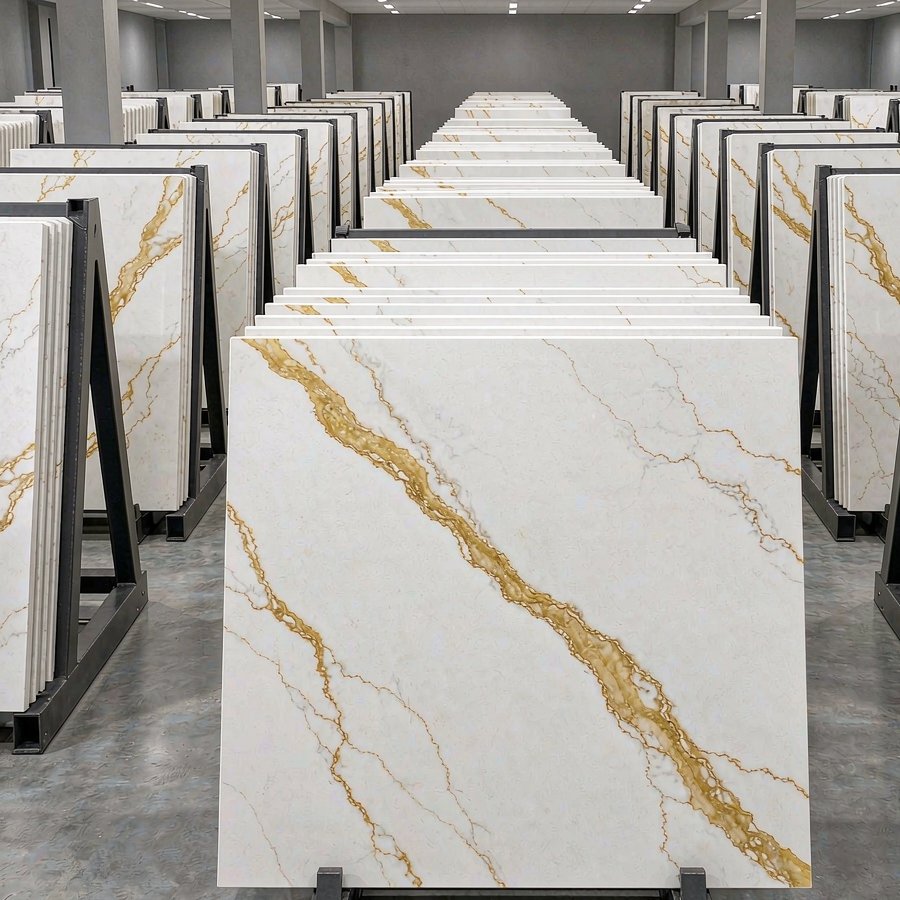
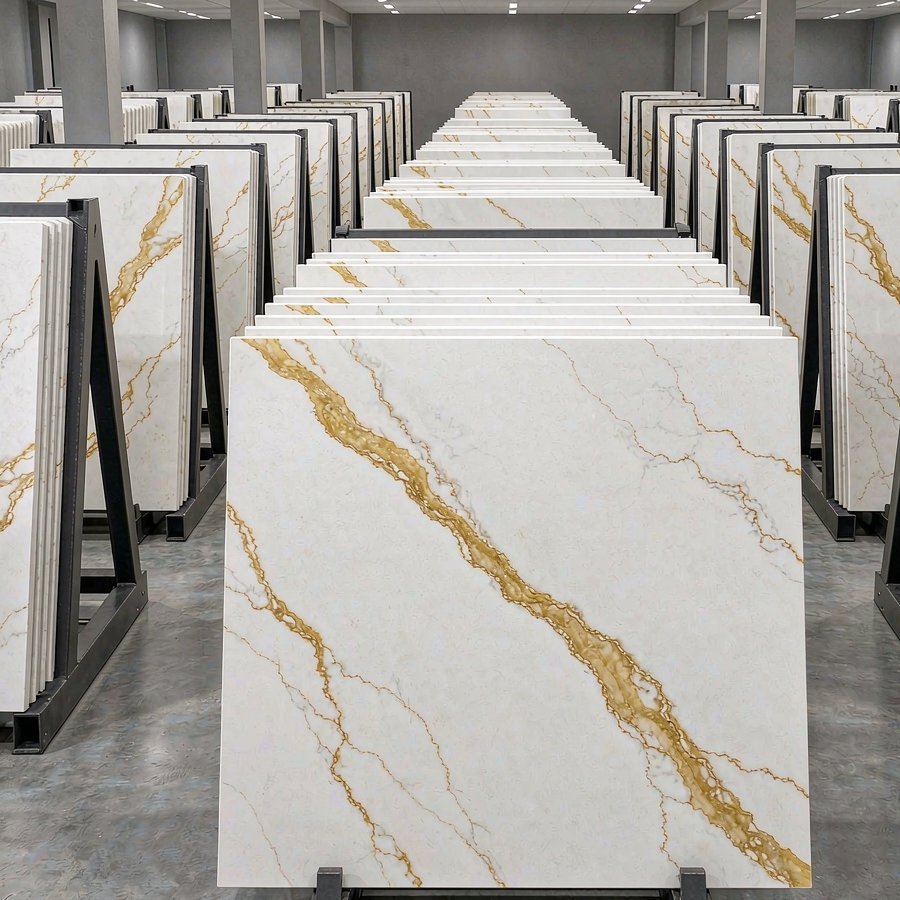
Calacatta quartz is the engineered stone industry's answer to the most famous white marble in the building trade: a bright white slab crossed by dramatic gold or grey veins, with none of the fragility that makes the original so difficult to live with. Walk into any stone showroom today and the boldest white slab on the wall is almost always a Calacatta design — and almost every importer, fabricator and project buyer has a client asking for one by name.
This guide is written from the factory floor for the people who actually buy the material: importers, distributors, fabricators and project buyers, along with the designers and homeowners who specify through them. It covers what the material actually is, how it differs from the marble it imitates, the main veining styles in production today, real slab sizes and weights, where the material earns its premium, what it should cost, and how to judge quality before an order is placed.
What Is Calacatta Quartz?
Calacatta is the name of a marble quarried in the Apuan Alps near Carrara, in Italy. True Calacatta marble has a bright white background and a small number of thick, dramatic veins in gold, grey or brown, which separates it from the busier, cloudier Carrara marble. Because the real block is rare and inconsistent, the name has become shorthand for the look: a clean white field with bold, widely spaced veins.
Calacatta quartz reproduces that look in an engineered slab. Quartz aggregates crushed to specific gradations are mixed with polymer resins and pigments, pressed into large-format slabs under vacuum and vibration, then cured and polished. The veins are not geological accidents — they are engineered into the slab, which is exactly why the look can be repeated. In a well-run production line, a Calacatta quartz design keeps the same white background and the same vein tone across every slab in a batch, which is something no marble quarry can promise.
The material underneath is what buyers already know from the rest of the engineered quartz category: Mohs hardness around 6, water absorption near 0.02 percent, a non-porous surface that needs no sealing, and certification paths such as NSF for food contact and SGS for environmental and fire performance. The Calacatta name changes the appearance; the engineering is what changes the ownership experience.
Calacatta Quartz vs Calacatta Marble: Same Look, Different Material
The comparison matters because many clients start with a photo of the real marble and a budget that does not fit it. The honest position is that the two materials share a look and differ in almost everything else that affects a project.
For a full breakdown of how engineered quartz performs against marble in kitchens specifically — etching, sealing, maintenance and long-term cost — our dedicated comparison covers quartz vs marble in detail. The short version for a Calacatta look: marble delivers an authenticity that some residential clients will still pay for, while the engineered version delivers the same visual statement with a maintenance load close to zero, which is why it dominates commercial specification.
The Main Calacatta Quartz Veining Styles
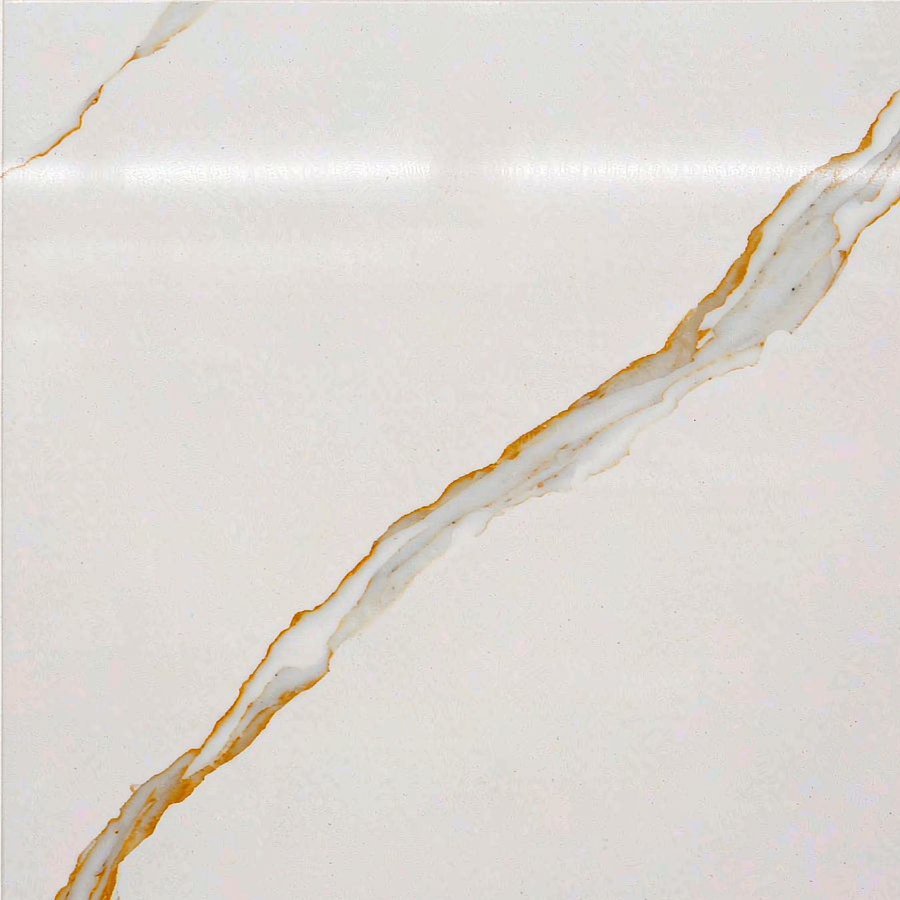
Within the Calacatta family, the trade recognises a handful of vein directions. Knowing the vocabulary makes supplier conversations faster and quotations more accurate.
Calacatta Gold. The classic: a warm white background with thick veins in honey, amber and brown-gold. This is the most searched and most specified direction, and it is also the most sensitive to execution — a well-made Calacatta gold quartz slab reads as one confident vein system, while a poor one dissolves into busy speckling. In our own range, Gold Vein carries this direction on a pure white field, and Cloud Jade Gold Vein offers the same warm vein on a slightly softer white.
Calacatta Grey and Statuario-style. The same bold vein architecture with the colour pulled back to silver and cool grey. It is the easier tone to live with, pairs with more cabinet colours, and suits projects where the countertop must coordinate with mixed interiors. Shimmering Spring Stream, with its soft grey clouding on a bright white base, sits at the quiet end of this family.
Calacatta with black veining. A high-contrast statement look — clean white crossed by deep grey to black veins, often used on island fronts and feature walls. White Realm Black Mark follows this direction in our catalogue, and for full black surfaces with gold mesh veining, Obsidian Gold Mesh is the corresponding dark design.
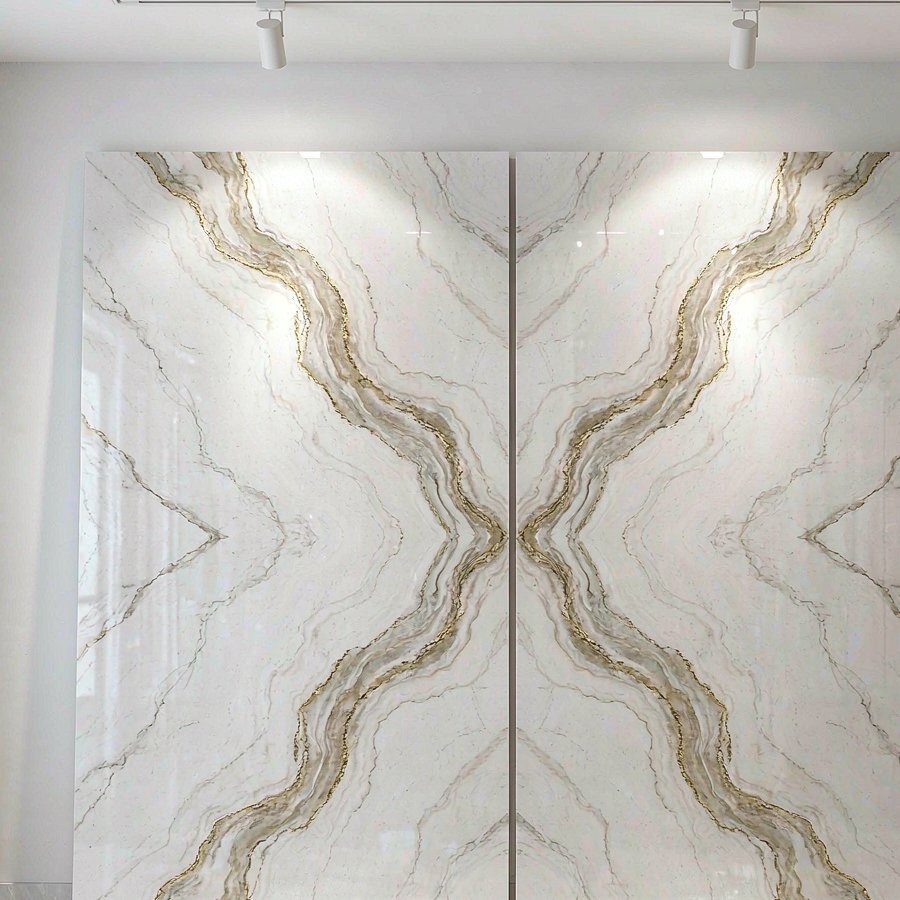
Book-match layouts. Because the veining is engineered, mirror-image pairs can be produced and matched at the joint, turning two slabs into a symmetric feature. This is a genuine advantage over marble for feature walls and island waterfall panels — the pattern is designed for the joint rather than discovered in the block. How the vein continuity is handled across seams and edges is a fabrication question, and it is worth raising before the cutting list is written, not after.
For buyers still deciding between vein tones — gold, grey or blue — our veined white quartz guide compares how each tone is produced and how it behaves against cabinetry and hardware.
Calacatta Quartz Slab Sizes, Thickness and Weight
Specification starts with the format, and format is where the engineered slab quietly outperforms the natural material: engineered slabs are produced in consistent, documented sizes, which lets a fabricator plan yield before the container ships.
Current production formats run to 3200 × 1800 mm and 3200 × 1600 mm as standard jumbo sheets, with 3200 × 750 mm serving narrow runs such as vanity tops, stair treads and counters. A 3200 × 1800 × 18 mm slab weighs 248.8 kg, and the same sheet at 20 mm weighs 276.4 kg — numbers that matter for handling, racking and installation planning. Thickness is offered at 18 mm and 20 mm. For projects that want fewer seams on long runs, an oversized 3500 × 1800 mm jumbo format extends the usable length of a single sheet.
Two practical notes follow from the veined design. First, vein continuity consumes yield: positioning the pattern across island fronts and return legs means the fabricator needs spare area, so ordering strictly to net square metres often leaves the layout short. Second, veined designs justify buying the larger format even when the cut pieces are small, because the pattern can be floated across pieces instead of restarted on each one. Our slab sizes guide works through both calculations with worked examples.
Edge planning belongs in the same conversation. A 20 mm mitred build-up gives the countertop the visual weight of a much thicker stone and lets the vein wrap the edge continuously, which suits bold designs; a simple polished 18 mm edge keeps cost down and works well on perimeter runs where the pattern is quieter. Whichever profile is chosen, the fabricator should confirm the edge treatment against the actual slab, not the sample chip, because the vein position at the edge is what makes or breaks a Calacatta-look installation.
Where Calacatta Quartz Works Best
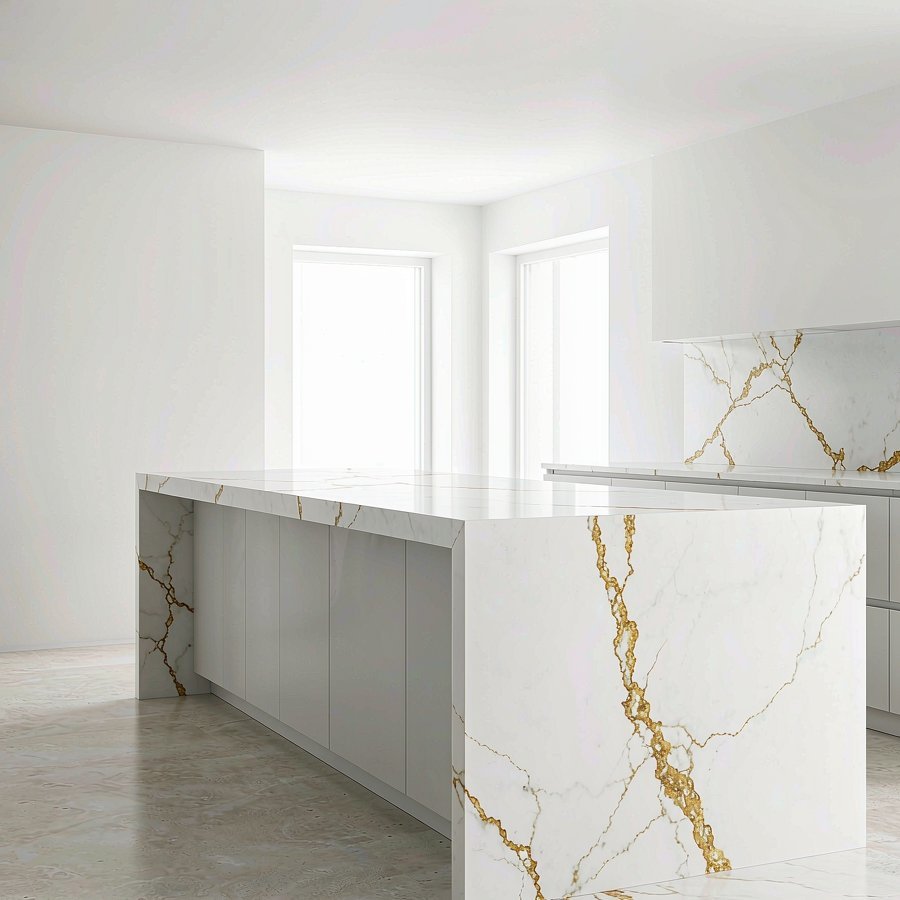
The look is bold enough to carry a room, which is why it is most often used where the surface is the feature.
Kitchen islands and waterfall panels. The single most common application. A bold vein running down the waterfall edge turns the island into the centrepiece, and the non-porous surface shrugs off the food acids that would ruin marble in the same position.
Full-height backsplashes. Running the countertop material up the wall removes the grout lines of tile and gives the veining an unbroken vertical stage. Book-matched Calacatta quartz behind a hob or a basin is one of the strongest visual moves available in engineered stone.
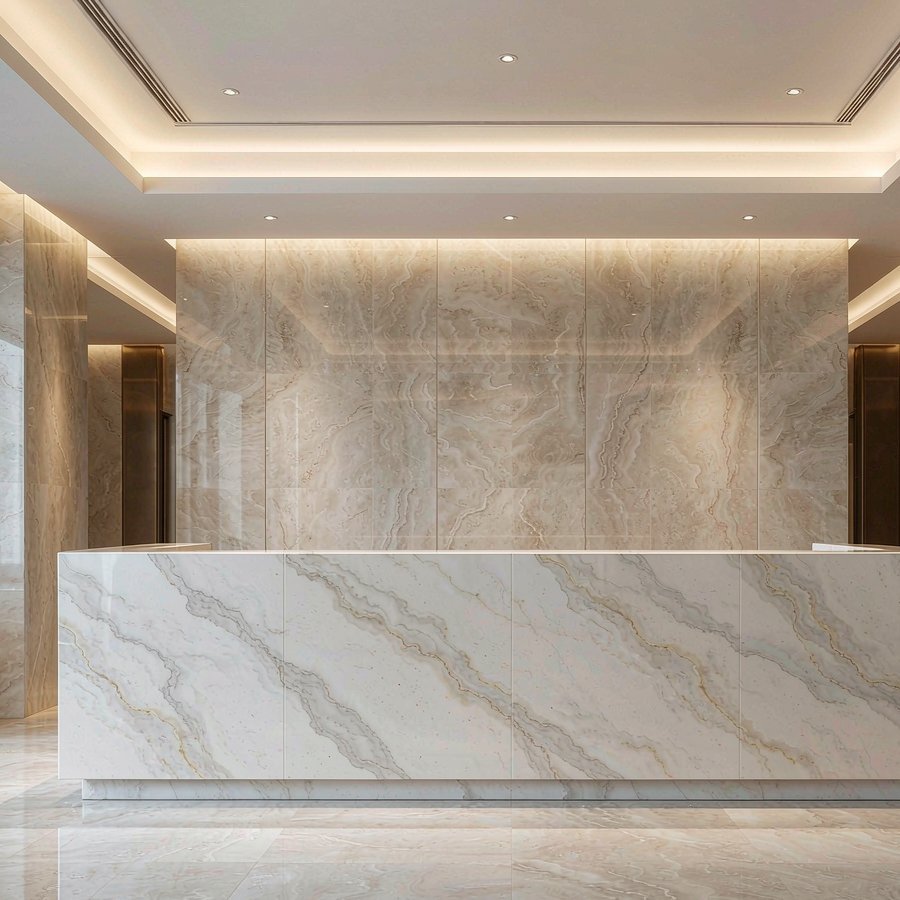
Commercial front-of-house. Hotel receptions, bar counters, mall information desks and restaurant tops all favour the look — and all of them are exactly the environments where marble's etching and sealing become maintenance contracts. This is the segment where the engineered material is not an alternative to the marble but the default choice. Our commercial quartz applications guide covers the heavier-duty specification points.
Bathroom vanities and shower walls. The white-plus-vein palette lifts smaller rooms, and the non-porous surface handles cosmetics and humidity without staining. Wall cladding in wet areas benefits from the same sealing-free property.
How Much Does Calacatta Quartz Cost?
Within the engineered quartz category, bold-veined white designs sit in the upper price band. Publicly available United States retail guides commonly place engineered quartz countertops in the region of USD 60 to 120 per square foot installed, with dramatic Calacatta-style veining at the top of that range — that is third-party retail data, not a factory quotation, and installed prices include fabrication and labour that a slab buyer does not pay at the factory gate.
What actually moves the price of a Calacatta-direction order, from the production side:
Vein complexity. Bold, multi-tone vein systems are the hardest designs to engineer and reject-rate is higher, so the slab itself costs more than a quiet grey cloud design.
Book-match requirements. Specifying matched pairs constrains how the batch can be cut and sold, which is priced either into the slabs or into the lead time.
Format. Jumbo sheets carry a premium per square metre over standard formats, and 20 mm sits above 18 mm.
Order structure. Full-container orders price very differently from mixed or LCL shipments, and factory-direct pricing excludes the distributor margin that retail slabs carry. Our quartz slab price guide breaks down the EXW, FOB, CIF and DDP layers so quotes can be compared on the same basis.
A word on the approval path, because it protects both sides of the budget. For project buyers, the efficient sequence is: confirm the design and format with the factory, approve a full-sheet image or a production sample rather than a small chip, lock the batch reference, and only then release the cutting list. Samples from a first production batch will not match a batch pressed eight months later — pigment lots drift, and pretending otherwise leads to disputes. Buying against a locked batch reference, and ordering the spare slabs for future repairs from that same batch, is the single cheapest insurance a Calacatta-style specification can buy.
How to Judge Calacatta Quartz Quality Before You Order
Because the look is engineered, quality is mostly controlled at the design and production stage — and mostly visible if you know where to look.
Vein realism. A good Calacatta-style vein has direction, depth and a natural fade at the ends; a poor one looks printed — uniform width, flat colour, repeating motifs. Ask for full-sheet photographs in daylight rather than close-up chips: the repeat, if there is one, only shows across a full slab.
Background whiteness. Compare the white across slabs from the same batch, not just against a photo. White drift between batches is the most common bulk-order complaint in veined designs, and it is controlled by pigment discipline in production. Batch-to-batch colour difference control is a legitimate question to ask any supplier — our colour difference guide explains how it is measured and held.
Surface gloss and polish. The polish must be even edge to edge; dull patches or polish lines show badly on a white reflective field. Gloss uniformity is a measured output on a controlled line, not a matter of luck.
Documentation. A serious supplier provides the technical data sheet (water absorption, hardness, flexural strength), the current certificates (ISO 9001 for the factory system, NSF for food contact, SGS for environmental and fire performance) and batch photos before shipment. For export orders, a written inspection standard with the right to third-party inspection is the norm, not a favour.
Calacatta Quartz FAQ: Six Questions Buyers Ask
1. Is Calacatta quartz more expensive than other white quartz?
Yes, typically. Bold veining is the most demanding design to engineer, with higher reject rates and more expensive pigment systems, so it prices above plain white and quiet grey designs in every serious catalogue.
2. Does Calacatta quartz stain or yellow?
The non-porous surface resists staining from coffee, wine and cosmetics without sealing. Yellowing is a resin-quality question — reputable production lines use UV-stable resins, and it is fair to ask a supplier directly which resin system the white designs use.
3. Can Calacatta quartz be used outdoors?
Generally no for outdoor kitchens: sustained UV and thermal cycling attack the resin, which can cause discolouration and warping over time. For outdoor specification, natural granite or dedicated porcelain systems are the better conversation.
4. What is the difference between Calacatta and Statuario quartz?
The names both descend from Italian marbles. In engineered form the practical difference is the vein: Calacatta designs run warmer and bolder (gold-forward), while Statuario-style designs keep the bold vein but cool it towards grey. Many factories treat them as colour families rather than distinct products.
5. Can Calacatta quartz slabs be book-matched?
Yes, and it is one of the material's genuine strengths: because the veining is engineered, mirror-image pairs can be supplied and matched at the joint for islands, feature walls and shower returns. Confirm the book-match requirement with the factory before the order, so the batch is planned for it.
6. Is Calacatta quartz heat resistant?
Heat tolerant, not heat proof. The resin component makes short contact with a hot pan risky — the surface can scorch or discolour. Trivets for cookware and barriers under heat appliances are standard advice for every engineered quartz surface, whatever the design.
Conclusion: Sourcing Calacatta Quartz Directly from the Factory
Calacatta quartz has become the default way to put the world's most famous marble look into a project without the etching, sealing and block-availability problems that come with the original. The specification questions that decide whether the installed result looks premium or printed are the ones covered above: vein realism on the full sheet, batch-to-batch whiteness, format and thickness against the cutting layout, and documentation before the container ships.
We produce Calacatta-direction designs in-house — from bold Gold Vein and Cloud Jade Gold Vein to the quieter Marble Golden Thread and the black-veined White Realm Black Mark — on jumbo formats at 18 mm and 20 mm, under ISO 9001 with NSF food-contact and SGS environmental and fire certification, shipping standard orders in two to four weeks.
If you want a cooler, more restrained member of the same white-marble family, our statuario quartz guide breaks down the vein designs and slab sizes in detail.
For softer classical veining, see how carrara quartz and arabescato quartz deliver marble looks without the maintenance.
Related Articles
- Quartz That Looks Like Taj Mahal: Quartzite Alternatives
- White Quartz Countertops: Gold, Grey or Blue Veins?
- Best Quartz Colours for Modern Kitchen Projects
- Quartz Slab Price Per Square Foot: What Actually Drives It
Specifying Calacatta Quartz for a Project?
Send us the vein direction you are working towards — bold gold, quiet grey or black-on-white — together with the format, thickness and approximate quantity. We will match it against the current designs, share full-sheet images rather than chips, provide the technical data sheet and certificates, and confirm lead time for your schedule. Trade and project buyers are welcome to ask for an indicative calacatta quartz quotation, priced per sheet at a stated format and thickness so the number can be compared like for like.
📱 WhatsApp: +86 198 6115 3736
📧 Email: raykelee@hyquartzslabfactory.com
Send Us A Message