
Quartz Slab MOQ: Minimum Order Quantities Explained
Quartz Slab MOQ: Minimum Order Quantities Explained
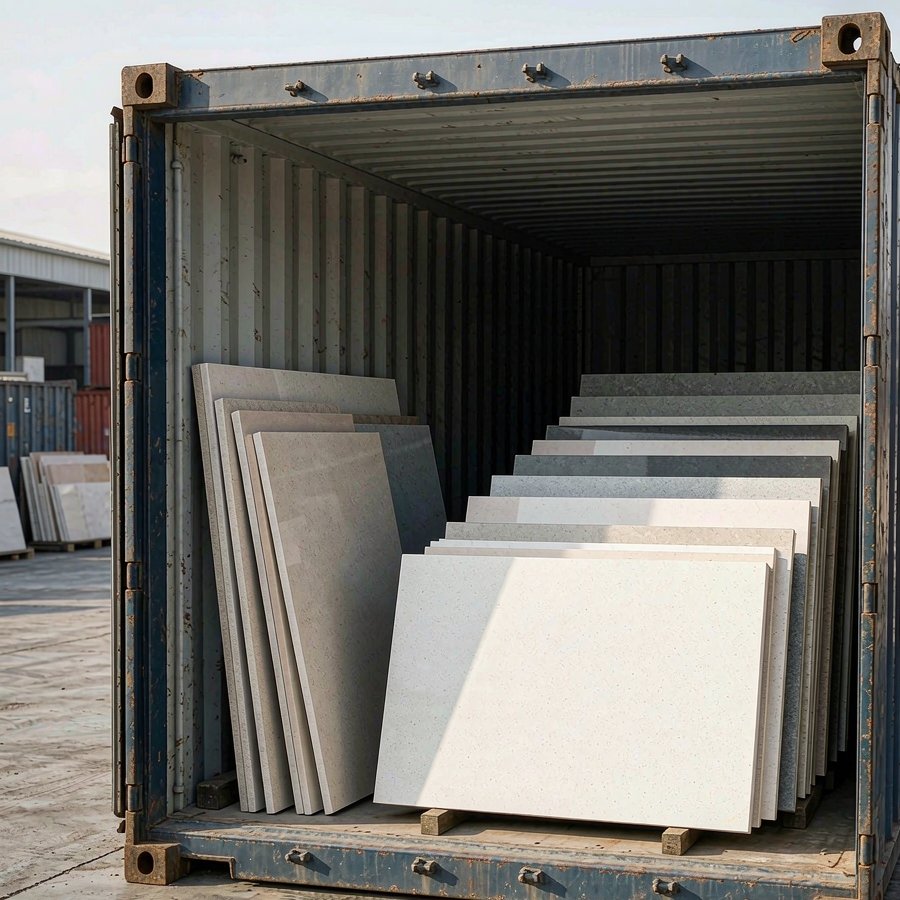
Quartz slab MOQ is one of the first questions importers, fabricators and distributors ask when they contact a manufacturer. The answer is rarely a single number — it depends on whether you are ordering a standard colour, a custom design, a full container or a small project lot. In this guide we explain how quartz slab MOQ is structured, what a typical minimum order looks like, how colours can be mixed, and how to negotiate terms as a new buyer.
What Is Quartz Slab MOQ?
MOQ stands for Minimum Order Quantity. In the quartz slab business, the MOQ is usually expressed as a minimum volume — either a number of slabs or a full container — rather than a single slab. The reason is economic: setting up a production run, curing slabs, packing them on A-frames and shipping them by sea only makes sense when the order is large enough to cover labour, material and logistics costs.
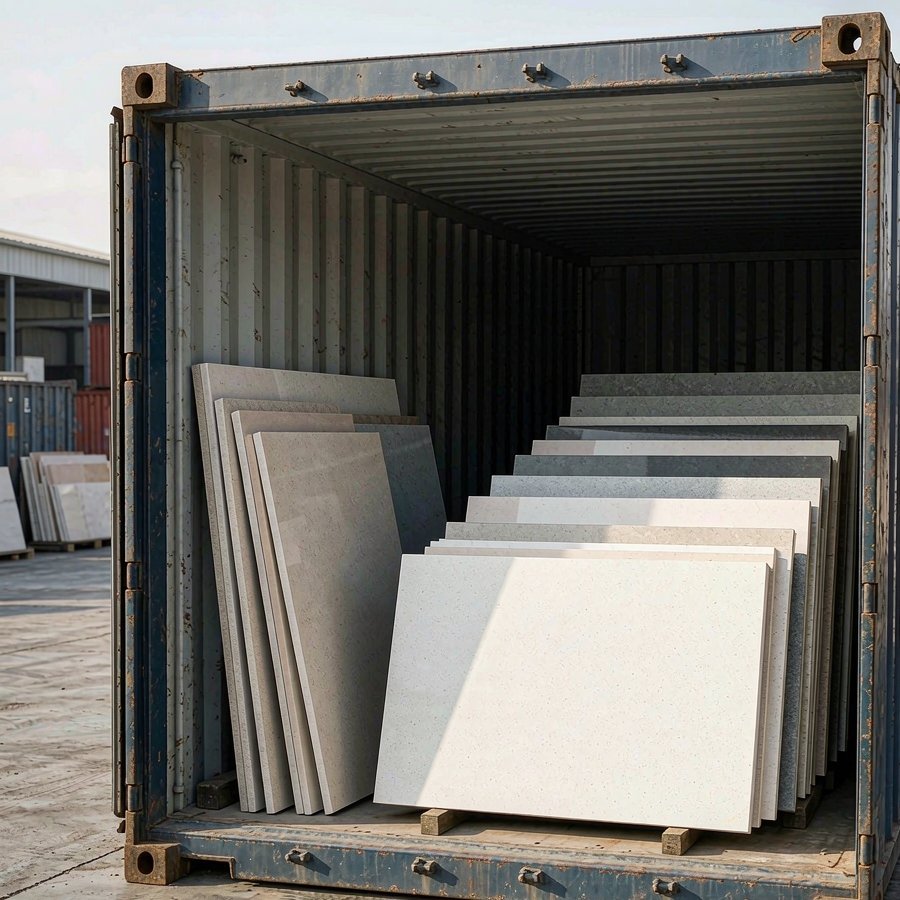
For most direct manufacturers, a full container is the practical quartz slab MOQ. A 20-foot container holds roughly 140–160 standard 3200 × 1800 mm slabs, depending on thickness and packing. Some factories accept half-container or project-sized orders, but the per-slab price rises because the fixed shipping cost is spread over fewer slabs. For first-time buyers, a full container is usually the sweet spot between price and commitment.
Standard Colours vs Custom Colours
The quartz slab MOQ changes dramatically depending on whether the colour is already in the manufacturer's standard range or needs to be developed from scratch. Standard colours — plain whites, greys and popular marble looks — can usually be added to a production schedule with a low minimum because the factory already has the pigment recipe and the slabs are produced in rotation.
Custom colours, on the other hand, require a dedicated production run. The factory must develop or match the pigment mix, run test boards, and adjust the recipe before full production begins. That setup cost means the quartz slab MOQ for a custom colour is usually much higher — often one or more full containers of the same colour. Some factories also charge a non-refundable development fee for colour matching.
How Colour Mixing Works Within One Order
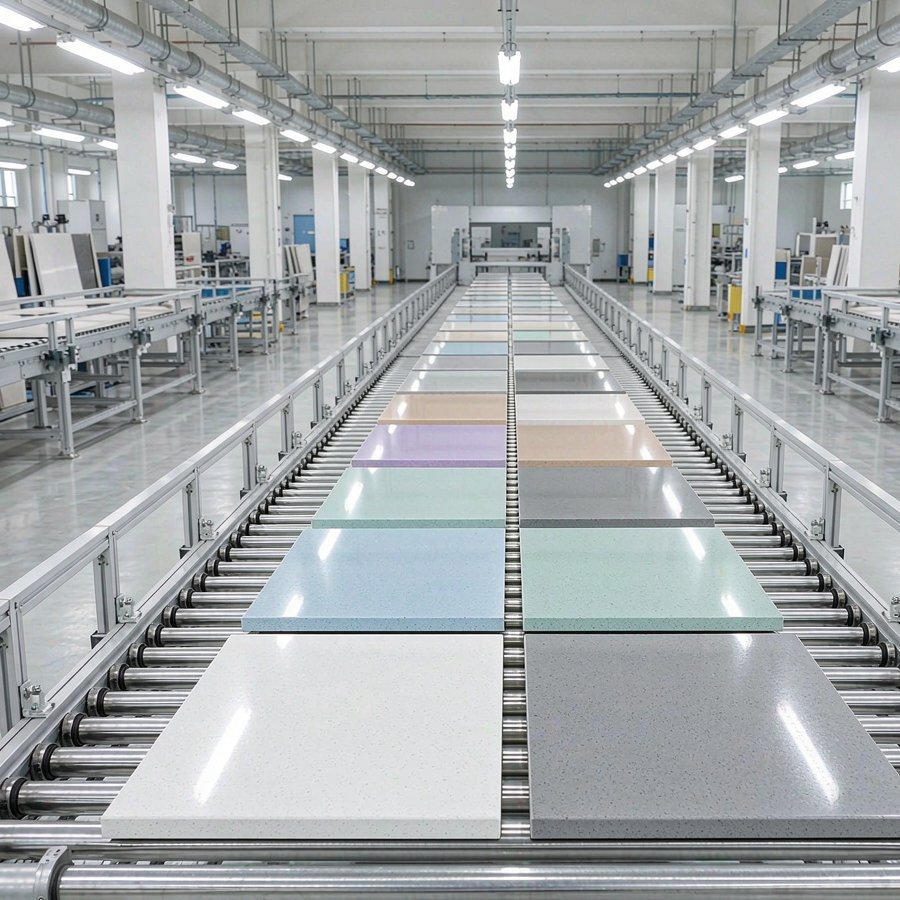
One of the most important things to understand about quartz slab MOQ is that it usually applies to the total order, not to each individual colour. A buyer can mix several standard colours in one container as long as the total container minimum is met. For example, you could split a 20-foot container across four colours — 40 slabs of white, 30 slabs of grey, 40 slabs of Calacatta-look and 30 slabs of black — as long as the factory has a reasonable minimum per colour, often 20–30 slabs.
This flexibility is what makes quartz slab MOQ manageable for distributors. You do not need to commit to ten containers of one colour; you can build a starter inventory with the best-selling colours in your market. Always confirm the per-colour minimum in writing, because it varies between factories and between standard and custom colours.
Sample Orders and Trial Quantities
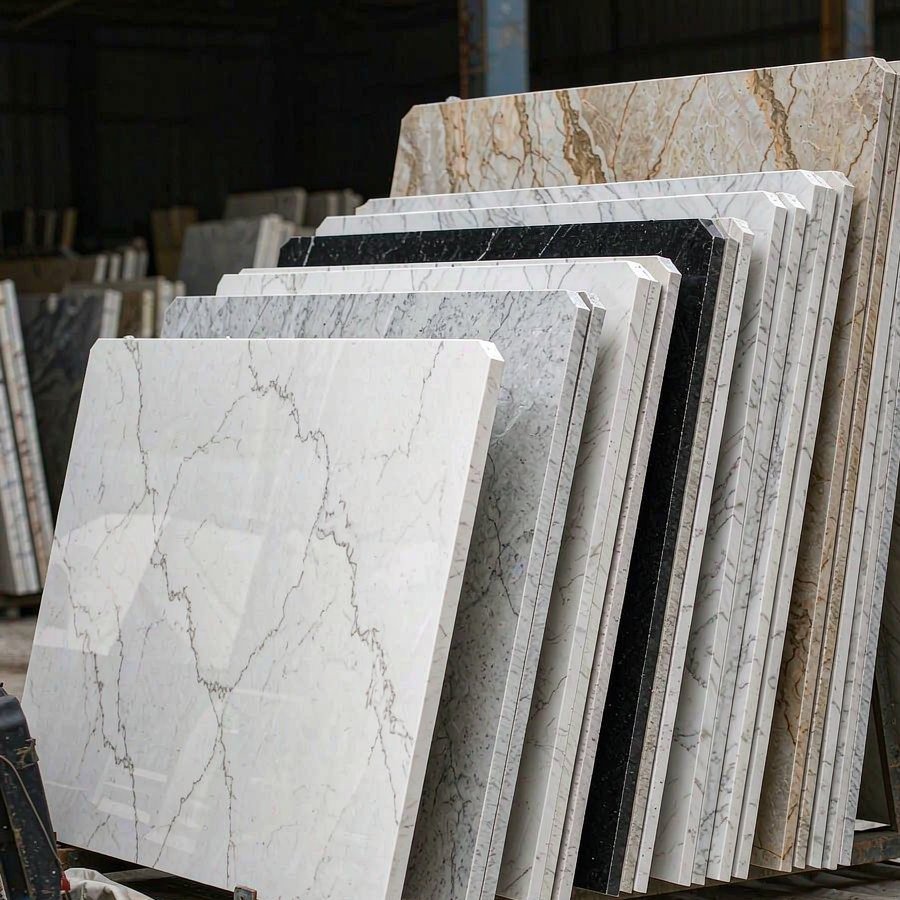
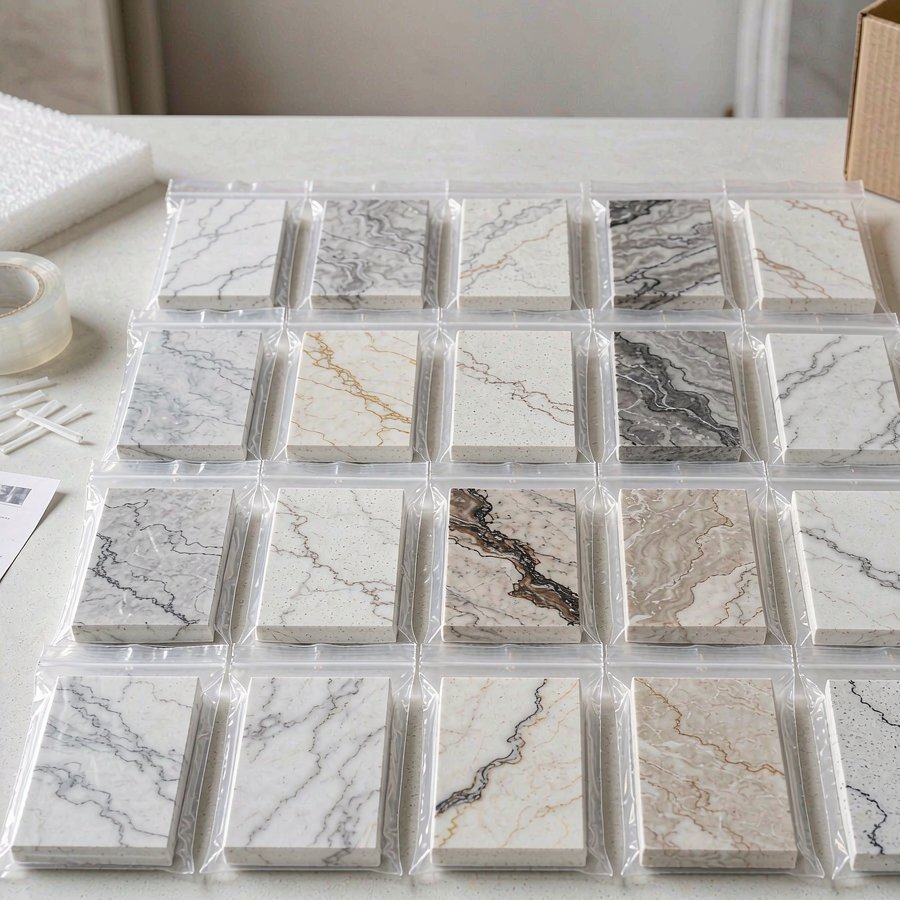
Before committing to a full container, most buyers want samples. A sample order is not the same as the quartz slab MOQ — it is a separate, small-quantity transaction. Samples are usually supplied as 10 × 10 cm chips, 30 × 30 cm tiles or half-size slabs, depending on the factory and the shipping cost. They let you check colour, finish, edge quality and hardness before placing a larger order.
Some buyers also place a "trial order" of 20–50 slabs before committing to a container. This is more expensive per slab than a container order, but it reduces risk. Factories may accept trial orders for standard colours but usually not for custom colours, because custom production only becomes economical at higher volumes.
Payment Terms and the MOQ Relationship
Payment terms are often linked to quartz slab MOQ. For a standard container order, the common structure is 30% deposit before production and 70% balance against copy of bill of lading. New buyers may be asked for a higher deposit, or even full payment in advance, until a trading history is established. Larger or repeat orders can sometimes negotiate better terms.
Buyers sometimes try to lower the quartz slab MOQ by offering full payment upfront. This can work for standard colours because the factory has lower risk, but it rarely applies to custom colours. Custom production still needs enough volume to justify the line setup, regardless of payment timing.
Container MOQ and Shipping Costs
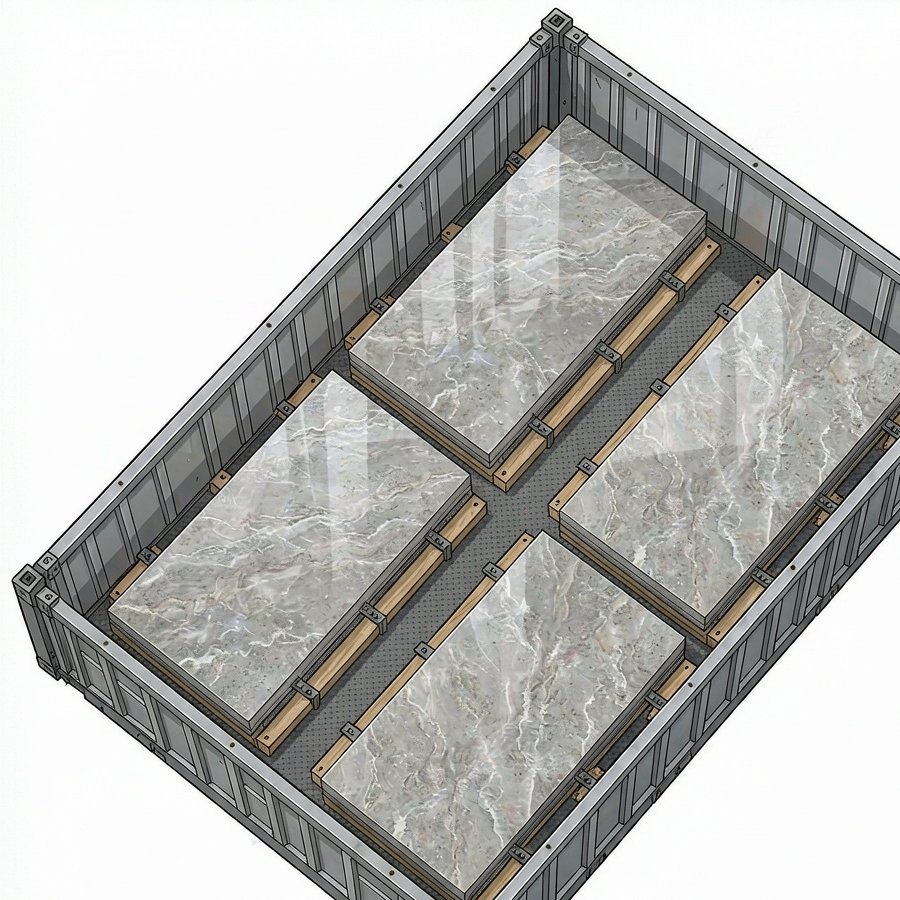
Sea freight is the reason the quartz slab MOQ tends to start at a container. A 20-foot container costs almost the same to ship whether it carries 50 slabs or 150 slabs, because the main cost is the space and handling, not the weight. Once the container is booked, every empty slot raises the per-slab cost. That is why manufacturers encourage full-container loads and why partial containers carry a premium.
A standard 3200 × 1800 × 18 mm slab weighs 248.8 kg, while a 20 mm slab weighs 276.4 kg. Container weight limits are usually the binding constraint, not volume. A 20-foot container can carry about 28 tonnes of cargo, which limits the slab count even when there is physical space left. For more on container planning and slab weights, read our quartz slab sizes guide.
How to Lower Your Effective MOQ
If a full container is too much for your first order, there are three ways to reduce the effective quartz slab MOQ. First, join a consolidated shipment with other buyers heading to the same port. Second, focus on standard colours that the factory can slot into existing production. Third, order during a period when the factory is already running your target colour for other customers, because the setup cost is already covered.
Be cautious of factories that advertise a very low MOQ but quote a high price. A legitimate factory has real production costs and will price low-volume orders accordingly. If a price looks too good to be true for a small quantity, the seller may be a trading company marking up seconds or using inconsistent sub-contractors.
Frequently Asked Questions
What is the typical MOQ for quartz slabs? Most direct manufacturers treat a full 20-foot container — roughly 140–160 standard slabs — as the standard MOQ.
Can I mix colours to reach the MOQ? Yes, for standard colours. A container can usually be split across several colours as long as the total volume is met and the per-colour minimum is reasonable.
What is the MOQ for custom colours? Custom colours usually require a full container or more of the same colour because of setup and pigment-matching costs.
Do samples count toward the MOQ? No. Samples are a separate, small transaction and do not reduce the minimum for a production order.
How can new buyers reduce risk? Start with samples, then a small trial order of standard colours, before committing to a full container.
Conclusion
Quartz slab MOQ is not a single fixed number — it is a structure based on container economics, colour type and production setup. A full container is the standard threshold for wholesale pricing, but standard colours can usually be mixed within that container. Custom colours require more volume and often a separate development process. For importers and distributors, the best strategy is to start with samples, confirm per-colour minimums in writing, and build a relationship before negotiating custom terms. For more on wholesale buying, read our quartz slabs wholesale guide and manufacturers buying guide.
Grade language belongs in the same document as your MOQ terms — our explainer on quartz slab grades: full bundle vs selected bundle shows how to write it into the order.
Related Articles
- Quartz Slab Manufacturers in China: Buying Guide
- Quartz Slabs Wholesale: How to Buy Direct from a Manufacturer
- Quartz Slab Sizes and Jumbo Formats Explained
- Large Batch Quartz Slabs Ready for Shipment
Quartz Slab Supplier with Flexible MOQ
Shandong Hongyue Quartz Stone Co., Ltd. supplies quartz slabs worldwide with container-based MOQ, standard-colour mixing and custom-colour development for larger programmes. Request samples, a trial order or a full-container quote — we provide ISO 9001, NSF and SGS-certified slabs with 2–4 week lead times.
📱 WhatsApp: +86 198 6115 3736
📧 Email: raykelee@hyquartzslabfactory.com
Send Us A Message